Restored in Christ: managing the scope and funding of the Diocese’s largest restoration project
Laura Keener
Editor
Covington’s Cathedral Basilica of the Assumption has long been one of the Diocese of Covington’s greatest treasures. But after more than 100 years of wind, rain, freezing and thawing, parts of the stone and terra cotta exterior needed serious repair. Through the Restored in Christ project, the diocese has completed a large restoration meant to keep visitors safe and preserve the beloved landmark for future generations.
Don Knochelmann, diocesan director of Buildings and Properties who helped oversee the work, said the problems began to stand out around 2019 and early 2020.
“We really started to see more pieces of stone fall off,” Mr. Knochelmann said. “We’d find pieces on the ground, or things would have to be strapped together.” That led to a close study of the building. SHP Architects used a 3D scan of the cathedral, then inspected the exterior up close from a crane basket over several days.
What they found showed the project would be much larger than first expected. Mr. Knochelmann said the team found “severe cracks in the gargoyles and chimera,” along with “spalled stone, cracked stone pieces of the terracotta capitals,” and limestone that was “falling apart due to the freeze and thaw conditions in this part of the country.” He said he did not know of any exterior restoration this extensive in the cathedral’s history.
The work was wide in scope. All 26 chimera and all 32 gargoyles were replaced with exact replicas. The old pieces were scanned and sent to Boston Valley Terra Cotta in New York so new hollow terra cotta pieces could be made with vents and weep holes for drainage. Dozens of limestone columns were replaced, along with colonnade pieces, copper flashing and much of the tracery.
Mr. Knochelmann said the team first thought about 10 percent of the tracery would need replacement, but once workers got started, they found rusted steel pins and deeper damage. “Once we started cutting into it, we had to replace more and more,” he said.
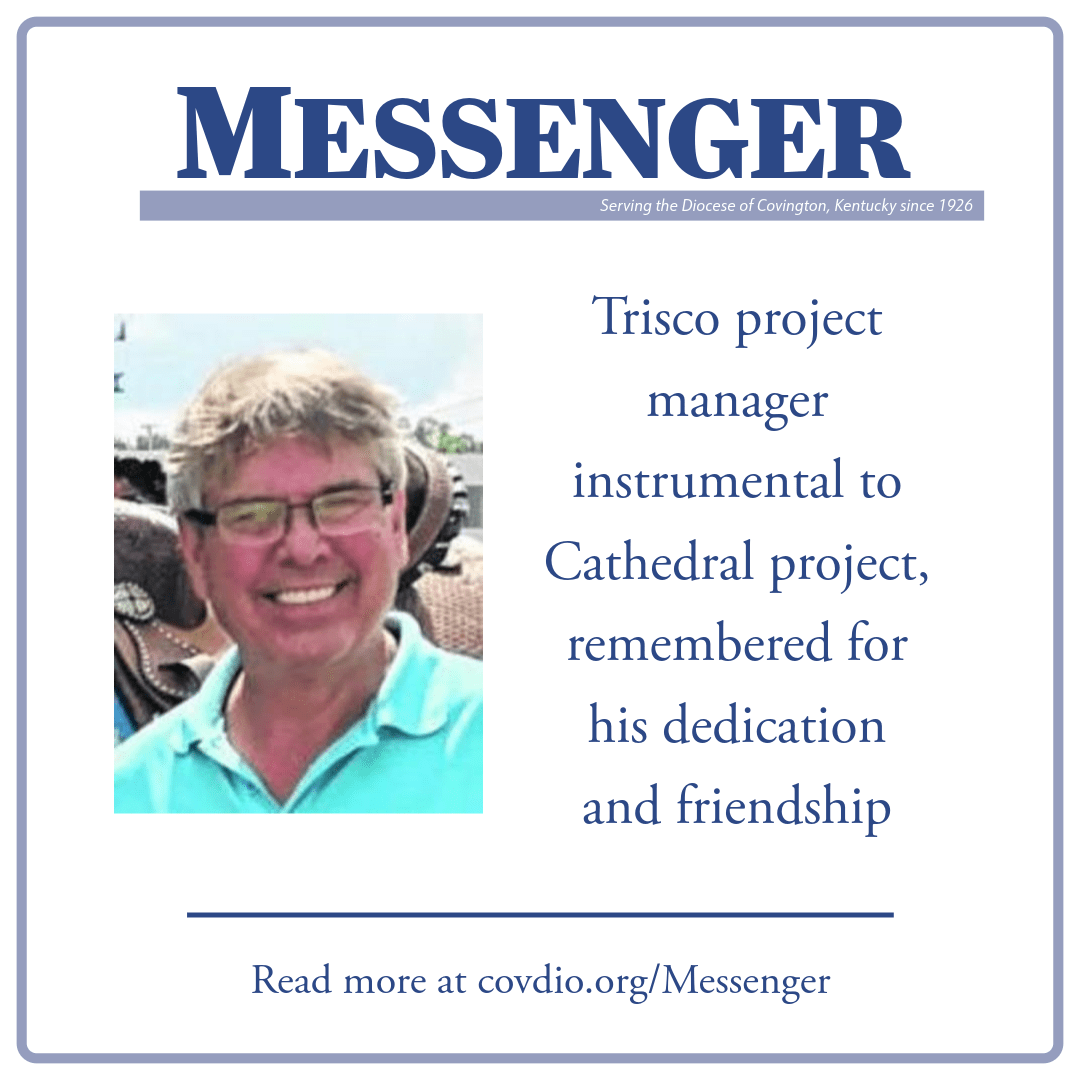
Trisco Systems performed the masonry restoration, while Imbus Roofing handled copper work, flashing and detailed copper repairs. Mr. Knochelmann praised Trisco’s field and office teams, saying they were “extraordinarily helpful” as unexpected problems appeared. “They were really part of the team,” he said. “They wanted to be here. They wanted to have their name on such a highly visible, just a very well-known building.”
The project also grew in cost. Jim Hess, director of Stewardship and Mission for the Diocese of Covington, said the restoration began as a $6 million project and ended up around $8 million.
“Anybody who owns an old building knows once you begin work and you start taking out bricks or you start taking down tiles, inevitably there’s more damage than you initially thought,” Mr. Hess said.
He said the original plan included about a half million dollars for expected overages, but “the true overage far exceeded that” by about $2 million.
Mr. Hess said some stones that were first marked for repair had to be replaced by the time workers reached them. And once a stone marked for replacement was removed, it was discovered that adjacent stones would also need replacing.
“Sometimes you thought you were replacing one stone, and you’re actually repairing or replacing three,” he said. The same was true for some of the terra cotta figures. “Some of the chimera initially, we thought we could repair,” Mr. Hess said. “But it became evident that we had to replace all of them.”
Funding came from three main sources. Mr. Hess said those were “a diocesan-wide public campaign,” “the Cathedral Parish’s parish campaign,” and tax credits through the Kentucky Heritage Council. Because the cathedral is a national historic landmark, the diocese could apply for historic tax credits and then sell them to a local bank. Mr. Hess said that resulted in “a little over a million dollars for the campaign.”
The Cathedral Parish campaign raised about $1.3 million, according to Mr. Hess, who said the parish effort was “very successful.” A planning committee recruited volunteers who met with donors and asked them to consider gifts. “The cathedral parish itself did all it could as a cathedral parish to contribute to this campaign,” Mr. Hess said.
The rest came from the wider public campaign, including generous gifts from nearly 2,000 donors. Mr. Hess said important grants also came from the St. Elizabeth Foundation, the R.C. Durr Foundation and the Butler Foundation. Their support, along with gifts from people across the diocese and beyond, helped make the project possible.
Bishop John Iffert also played an important role by supporting the team as the scope grew. Mr. Knochelmann said, “Bishop was awesome throughout this entire project.” When the team showed new damage and explained the need for added work, Mr. Knochelmann said the bishop’s response was clear: “We need to find a way to do it.” That cooperation helped the project move forward, even as costs rose.
For Mr. Hess, the campaign renewed interest in the cathedral, not just historically but also theologically. He said it gave Bishop Iffert and the priests of the diocese an opportunity to explain that the cathedral is not just one parish, but “the Mother Church of the diocese.” He added, “We’re all parishioners of the cathedral.”
For Mr. Knochelmann, the finished work is a gift to the future.
“The end result is a building that should give us another 100 plus years,” he said. He also called the cathedral “by far the most beautiful cathedral I’ve been to.” Being part of the team, he said, is something he will “look back on fondly.”
As work on the Restored in Christ restoration project ends, there is still time to financially contribute to the project. According to Mr. Hess donations are needed to close a $300k funding gap. Make a donation and add your name to the already nearly 2,000 donors at covdio.org/give and click on “Make a Gift” to Restored in Christ.