Fraternal correction
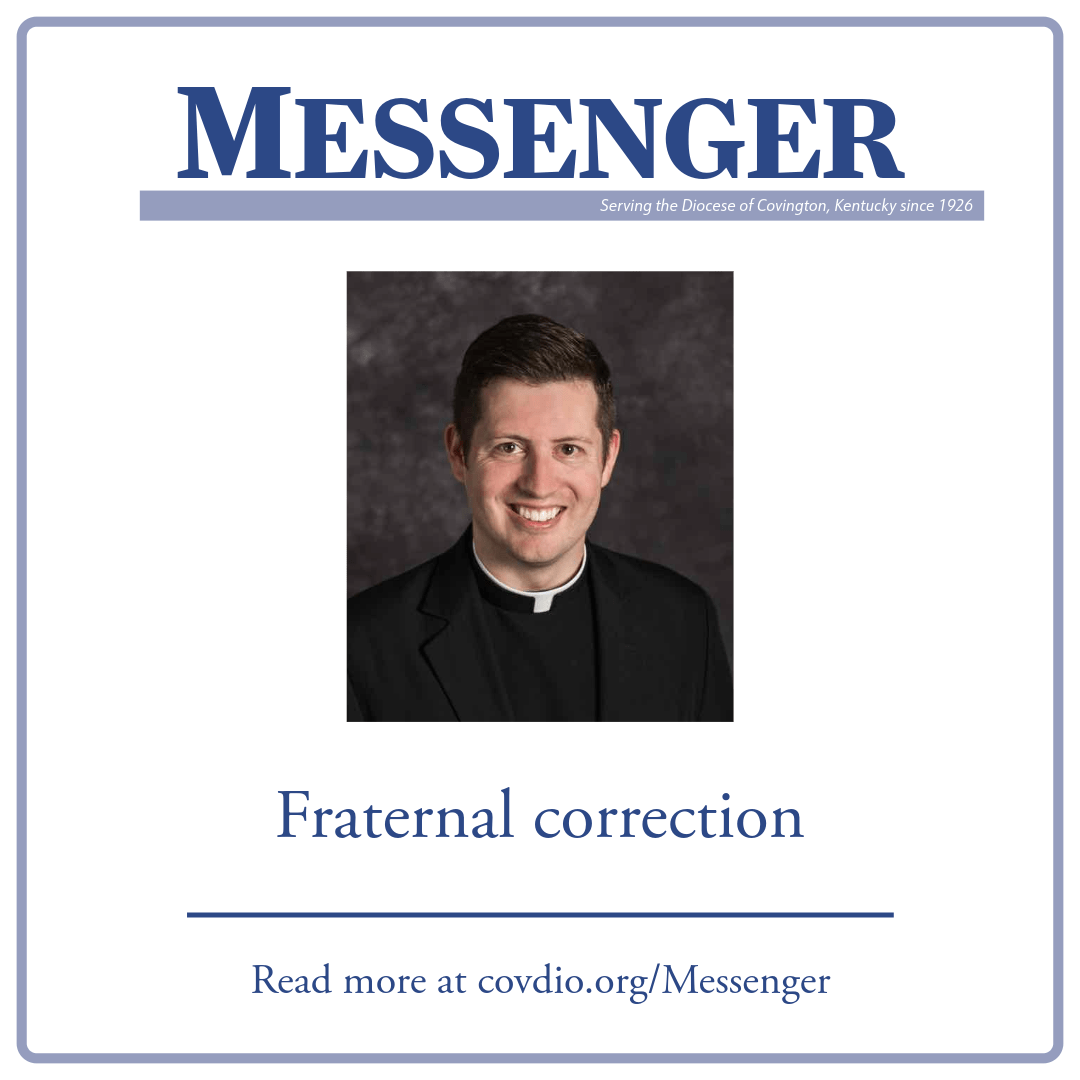
Father Daniel Schomaker
Guest
On this 23rd Sunday in Ordinary Time the Church calls us to reflect on “fraternal correction.” We need a little context to understand Jesus’ teaching. Immediately preceding the passage for Holy Mass this weekend, is the story of the lost sheep — where only one of a hundred is lost. And Jesus tells his disciples (us): “It is not the will of your heavenly Father that one of these little ones be lost.” (Mt. 18: 14b)
Being lost in the spiritual life is multifaceted. Sometimes, it means abandoning the Way that leads to Heaven. Or, being deceived into thinking you are on the right path though you aren’t. We might find ourselves searching but end up wandering around aimlessly instead. And sometimes we can be on the right path, we just get turned around and are facing the wrong way, or we have stumbled and fallen on our face!
All of this “lostness” is the consequence of sin. Living contrary to our nature — which is willing the good of the other — and instead giving into the ego and living for the self. The Lord Jesus, does not accept us being lost, and comes seeking us out.
Too often in our society we forget that our selfish actions, our sins, have an effect not just on ourselves, but on the community of believers — the Church. And so, Jesus teaches us how to correct the bad behavior of a disciple and heal the hurt caused to the Church.
It starts privately! Not on social media as is so often the case today! As Jesus’ disciples, we are not called to shame or humiliate each other, but to love. Remember what we learn in the Scriptures: the love the disciples had for one another lead to the “adding of those who were being saved.” (Acts 2:47b) Shaming a brother or sister in Christ can be a detriment to the apostolic mission.
If the correction isn’t accepted, then Jesus calls us to take one or two others with us to give witness to the facts of the bad behavior. This is in keeping with the Law found in the Book of Deuteronomy. It is still quiet, private.
Only when there is obstinance in the one who is sinning is it brought to the authority of the Church — those who have the power to bind and to loose. And then if there is not conversion and reconciliation does Jesus command that they be cut off from communion. It is from Jesus that we get the practice of excommunication.
This sounds extremely harsh on the part of Jesus, but all sin is a barrier to communion. But there is in fact a positive side to this being “cut off” from the Church. The sinner is returned to the state of one who is in need of evangelization. They then get to hear the Gospel proclaimed again. And hopefully more clearly so that they can be returned to the communion of disciples and reintegrated into the Church. Remember, sometimes the healing process can be difficult, and the medicine doesn’t always taste good.
There is nothing that cannot be healed and forgiven. “Forgive us our trespasses, as we forgive those who trespass against us.”
Father Daniel Schomaker is pastor, Blessed Sacrament Parish, Ft. Mitchell and director, Office of Worship and Liturgy for the Diocese of Covington, Ky.