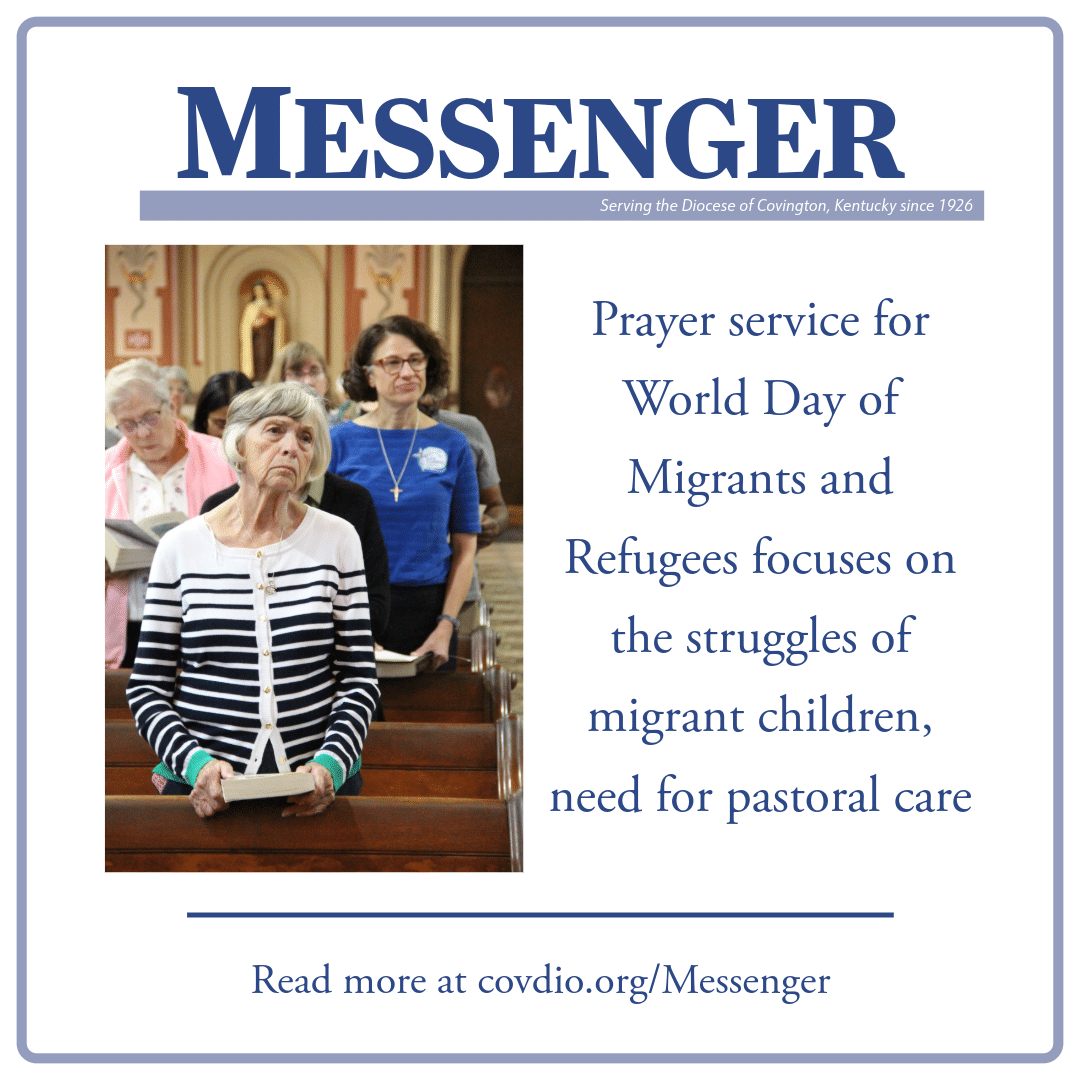
Prayer service for World Day of Migrants and Refugees focuses on the struggles of migrant children, need for pastoral care
Maura Baker
Staff Writer
On World Day of Migrants and Refugees, Sept. 27, people of the diocese gathered at Mother of God Church, Covington, for a prayer service alongside many women religious of the Diocese of Covington, including members of the Intercommunity Sisters Peace and Justice Committee, who organized the service in collaboration with parishioners of Mother of God Parish.
The theme for this year’s World Day of Migrants and Refugees, as suggested by Pope Leo XIV, is “Even Just One of These Children” — emphasizing the struggles and needs of vulnerable migrant and refugee children.
Reflections for the afternoon were provided by Father Michael Comer, pastor of Mother of God, with guest speaker Mini Masih, volunteer coordinator and outreach program support for Kentucky Refugee Ministry — who immigrated herself to the United States 17 years ago.
Cindy Hassan, a lector and parishioner of Mother of God, welcomed those gathered by tying the day of prayer with the United States’ 250th anniversary.
“We join in this national observance with gratitude and hope,” Mrs. Hassan said, “honoring the many immigrant communities whose faith, labor, cultures and sacrifices have helped to shape this nation into what it is today.”
In his reflection following the readings, Father Comer remarked on his arrival to the parish nine years ago, drawn to Mother of God for its “history of social justice.” He drew attention to the statement published by Pope Leo XIV in advance of the observance, encouraging those gathered to read.
“He talks about migrants and refugees, focusing specifically on children,” Father Comer said, “the ones who suffer the most.” He said, in all tragedy in the world, it is “children who pay the price” — encouraging reflection on the struggles children endure when faced with displacement due to war, poverty and other strife.
Calling back to the service’s Gospel reading, Father Comer quoted Matthew 25. “Jesus says, ‘whatsoever you did for the least of my disciples, you did for me.’ What you’re doing socially is worship,” Father Comer said. “… Jesus has taught us that doing for the least of our brothers and sisters — that’s worshiping. That’s the way we show Jesus our love for him.”
Speaker Mini Masih spoke on her work with Kentucky Refugee Ministry (KRH), saying that it is “about helping people feel that they are not alone as they begin again, and that is especially important when we talk about children.”
Many refugee children arrive in the United States with gaps in their education, and many have had little to no formal schooling, according to Ms. Masih.
“They are suddenly expected to learn in a new language, understand a new culture and adjust to a completely different school environment,” she said, resulting in children feeling isolated as they try to make friends in a new community. Struggles with experiences surrounding war, violence, loss, displacement and separation can further exacerbate these issues — which Ms. Masih says is the “reason” pastoral care is so important.
“Children need more than academic support,” said Ms. Masih. “They need adults who listen to them, encourage them, help them feel safe and remind them that they belong. They need people who will walk alongside them as they grow and heal.”