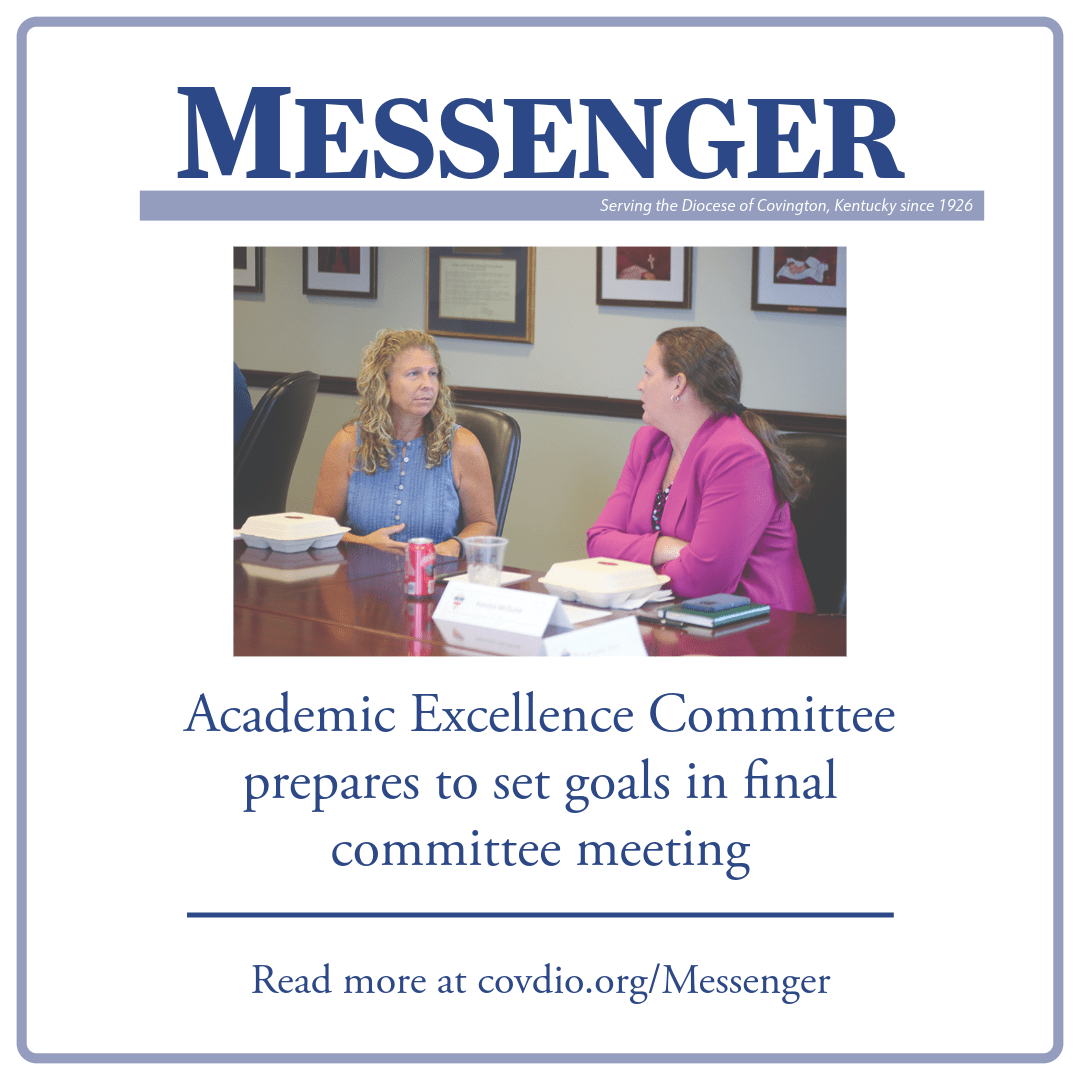
Academic Excellence Committee prepares to set goals in final committee meeting
Bella Bailey
Multimedia Correspondent
As the spring portion of the Diocese of Covington’s strategic planning process draws to a close, each commission and their respective committees will meet once more to draft their goals for the future. Since May, each commission has been involved in a deep process of education and discernment with members of the Diocesan community who have volunteered their time and effort as members of commission committees.
Over the course of three months, each committee has met to learn, grow and develop specific interest areas of the Diocese of Covington’s strategic plan. Together, they worked toward a common goal of improving the lives of all those who live and worship in the Diocese of Covington. For some commissions it was planned giving, for others it was ministry work, for the Schools Commission their goal was simple: promoting student success.
Chair of the Academic Excellence Committee and Chair of the School of Education for Thomas More University, Crestview Hills, Christy Petroze, said “my thought is always ‘how does this impact my students,’ and if it doesn’t really impact my students then I’d rather be doing something else.”
The Schools Commission consists of four committees: mission and Catholic identity, academic excellence, governance and leadership and operational vitality. “Those have to exist to support our work,” said Dr. Petroze, “but I would imagine at the heart of it is about student success in our Catholic Schools, to promote the Catholic faith in education.”
Dr. Petroze outlined that the Academic Excellence Committee has identified two primary areas focus areas of standardizing curriculum and increasing inclusive education. In August of 2025, the Diocese of Covington hired Emily Urlage, director of curriculum and instruction for the Diocese of Covington’s school office. Since being hired, Mrs. Urlage has worked to create a standardized curriculum for Diocesan schools.
Once completed, these new curricula will serve as “guidelines,” said Dr. Petroze, “they are not telling teachers how or what to teach.” But rather, the curriculum will continue to move Diocesan schools into a “more rigorous academic setting … that’s the expectation across the Diocese,” said Dr. Petroze.
In addition to standardized curricula, the committee is also focused on inclusive education, citing the support of the Fire Foundation of Northern Kentucky. Dr. Petroze explained that the question is “how can our Catholic schools be more inclusive to students with special needs?”
As the committee continued to meet throughout the summer months, members comprising of parents, grandparents, teachers and alumni have all come away with a deeper understanding “of the structure of the schools and the expectations of teachers, parents and students,” said Dr. Petroze. “It has been a nice community space to have these open conversations and people are just feeling free to ask the questions.”
As the committee meetings come to an end, Dr. Petroze reflected on the opportunity to meet and discern with members of the community who are spiritually invested in the state of Catholic education in the Diocese of Covington.
“It has been a really wonderful experience to see all of those community stakeholders who really do want to see Catholic education continue. They all have a stake in it, they want to see it grow and they are committed in positive ways to listening and solving … it’s been awesome to have that many people in the room who care about Catholic education,” she said.