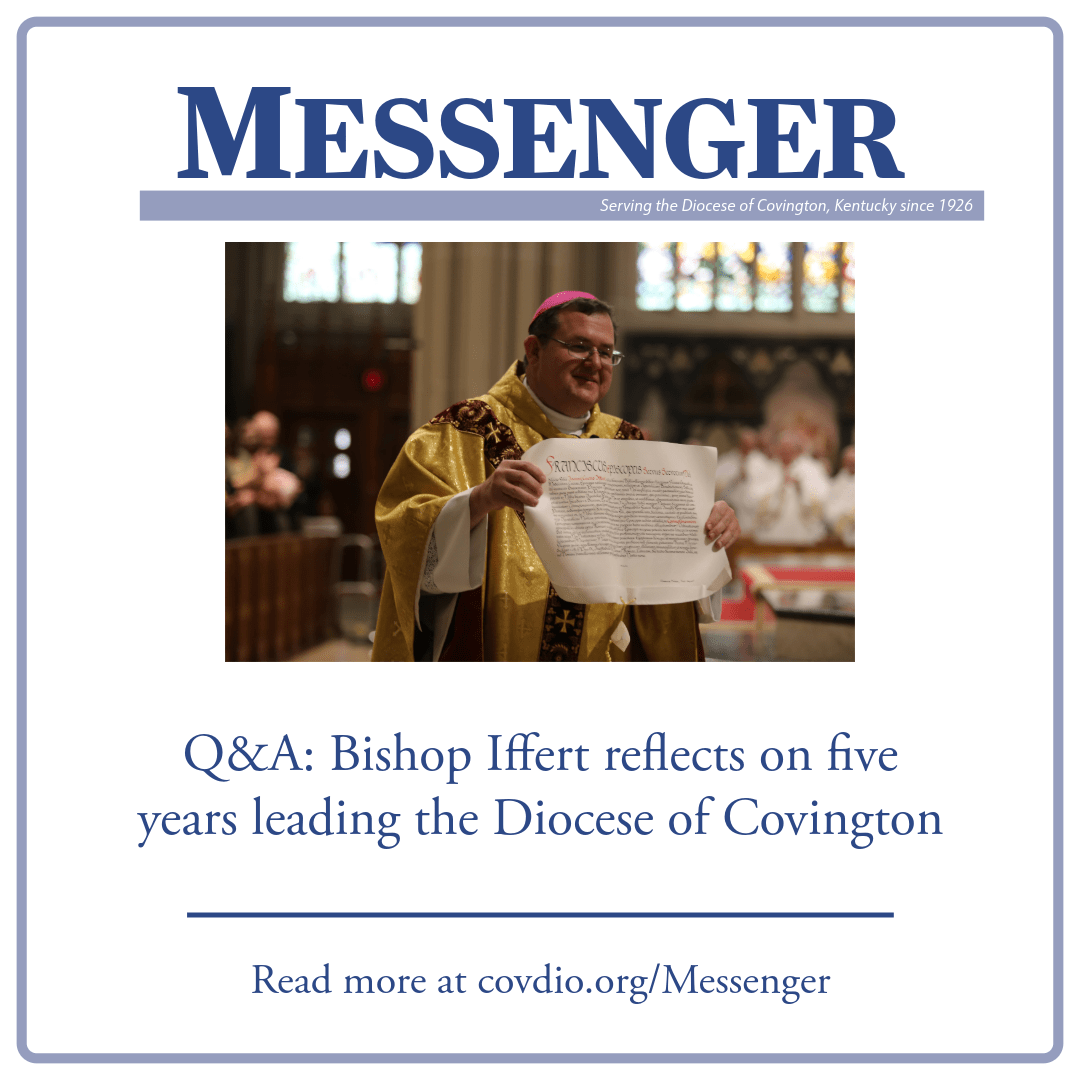
Q&A: Bishop Iffert reflects on five years leading the Diocese of Covington
Laura Keener
Editor
Question: Looking back on your first five years as bishop, what has surprised you most about the role and about the community you serve?
Bishop Iffert: One of the most surprising things is just how warmly I have been welcomed by people. The welcome here has been very warm, and I continue to be surprised by how eager people are to have me engaged in their activities. The office of bishop somehow makes the whole Church present, and it communicates that what a person is engaged in is meaningful for the life of the Church. I was familiar with that as a pastor, because the pastor does the same thing in a parish, but as a bishop it is magnified. I am amazed at what ordination and consecration as a bishop can do, and how the bishop can embody the Church and Christ in people’s lives.
Question: What about the Diocese of Covington itself? Was there anything that surprised you?
Bishop Iffert: One surprise is how much it feels like home. I come from the very southern part of Illinois, where Midwestern and Southern culture mix, and I feel the same thing here in Covington. It is also the same Catholic German settler culture, with similar settlement patterns. The other surprise is the strength of the Church here. We have a very strong and dynamic Church in Covington, especially the strength of the school system. To have the number of students we do, and such a strong school system, has been amazing.
Question: Has the office of bishop itself been fundamentally different than what you thought it would be?
Bishop Iffert: Not really. I had always worked closely with bishops, so I had seen what bishops do. The one thing that has surprised me is how much there is to contribute beyond the diocese — to the life of the Church in the region, the national Church and even the universal Church. I am engaged with a couple of committees for the conference, and there is also the work of maintaining fraternity among the bishops in the province and region. I have been a little surprised by how often that takes me outside the diocese, but it is good. Every bishop has a responsibility not only to his diocese, but to the larger Church as well.
Question: You mentioned before how well the bishops respect and work together. Has that been refreshing?
Bishop Iffert: Yes, refreshing. Sometimes if you read media, even Catholic media, you get the idea that bishops are at one another’s throats, or that clergy are marked by careerism. I have never found that to be true. Five years in, the fraternity among the bishops is overwhelming. Even bishops who disagree, maybe even publicly, can still be very supportive of one another. There are bishops who would do things differently than I would do them, or decide things differently than I would decide them, but I have always felt supported by my brother bishops, I’ve never seen a lack of caring. Terms like liberal and conservative get thrown around, but there is a fraternity among the bishops that bridges all of that.
Question: In your first five years, you have seen quite a bit of change — the death of two popes, the election of the first American pope and the Synod on Synodality. What are your thoughts on that change?
Bishop Iffert: Synodality, this is a movement, a characterization of the Church that I welcome. I think it has been present from the beginning in the life of the Church. At the Council of Jerusalem, Peter led not by domineering, but by inviting people into discussion, giving his witness and letting people respond. I understand synodality not as putting everything up for a vote or simply airing opinions, but as valuing and listening to one another, then turning together to the Holy Spirit to discern the path forward. I think it is one of the essential qualities of the Church. I see Pope Francis, and now Pope Leo, reminding us of that and helping us recover it. It has always been a natural part of the way leadership looks in the Church, so, I embrace that.
Question: You have encouraged councils, deaneries and parish councils to adopt that kind of approach. What do you call it?
Bishop Iffert: Spiritual conversation — conversations in the Spirit. Councils sometimes need business meetings and agendas, but that should never be the main work of councils. We need to recover time spent in prayer together, holding one another in prayer, and a conversational approach attentive to the movement of the Spirit. I think we’ve forgotten that the reason we call it a “council” is that those people who serve are “counselors,” who are intended to give pastors the benefit of their wisdom. When we state an opinion or put an idea on the table, we give up ownership of it. Then we work together to discern which ideas seem to have the life of the Holy Spirit within them and what God’s will is in that moment … It’s reminding us that we, the Church, we are a living organism. We are the body of Christ, and we are the temple of the Holy Spirit. And it’s reminding us to take seriously the vocation of being attentive to the way the Holy Spirit moves in the whole temple, in the whole body.
Question: Pope Francis called you to the episcopacy. What did his death mean to you, and what are your thoughts on Pope Leo?
Bishop Iffert: There will always be a special place in my heart where I mourn Pope Francis. Every bishop has a special relationship with the pope who calls him to the episcopacy, it’s more than a brotherly connection, almost like a grandfatherly connection and my time with him was short. On pilgrimage to Rome last year, I was able to visit Francis’ tomb at St. Mary Major and pray for him there. That was very meaningful to me. At the same time, the election of Pope Leo is exciting — an Illinoisan, a man born in the United States and a citizen of the world who knows the American context well. I think he has proven adept at advancing much of the agenda Pope Francis brought to us, perhaps even more effectively than Francis himself. I could not be more thrilled with the spiritual richness of the Petrine ministry right now.
Question: You like to travel, and since arriving here you have been on pilgrimages, a mission trip, a pastoral visit to Africa and a trip representing the USCCB. How do those travels inspire you?
Bishop Iffert: Encountering the Church is what it is. My first trip to Africa was a kind of pilgrimage. I went to the Archdiocese of Kumasi to thank the archbishop and the families of the men who serve here in our diocese, and to understand the local Church that has been sending priests to us. It is a very different experience of Church — incredibly young. I learned the median age in many of these societies is as low as 17. The median age in Kentucky is 39.7. So, the Church is so much younger, even though the Church there is ancient, going back to the apostles. To witness that Church, to pray with that Church, to dance with that Church in a way that would make our little German hearts just stunned, in a way that for them is absolutely normal, all of that, gives you a broader experience of what the Church is and who Christ is in the midst of that living body. In Madagascar, I visited a parish community that began with one priest and about 40 lay people serving people living on polluted dumps. Now they feed 12,000 people a day and educate about 8,000 young people. To pray with thousands of extraordinarily poor and very young people is like being formed again. Travel is an exercise in formation and education for me; it’s like a catechism. Pilgrimage travel also gives me the chance to know people from our diocese and share moments that can be life changing.
Question: You have led the diocese through one major planning process, With One Heart, and are in the middle of another, the Commissions. How are these planning processes informing your episcopacy?
Bishop Iffert: I am grateful to see fruit coming from that work. So, we did the DMI survey as we began that process and we did it again after three years. We saw movement across the diocese on many indicators, and parishes that actively worked their pastoral plans saw even stronger growth in some areas. It reinforces for me that we cannot just keep the lights on. We have to set goals and work to achieve them. That’s just my experience of our human nature. What separates the With One Heart process from what we’re doing now with the Commissions is the leadership development piece and that has been crucial. Many priests have completed Good Leaders, Good Shepherds and have integrated those skills into their life as a priest, especially around team formation. Then we had 70 or more lay people formed as Missionary Disciples who meet regularly now. They are now sharing that formation with others across the diocese. Planning brings intentionality. It strengthens my conviction that the Holy Spirit is calling us to be Church outside the walls and outside Sunday morning — to let liturgy form us into active agents of compassion and mercy. Planning helps us clarify how we move toward mission.
Question: What would you say about the strategic planning process happening now, especially around the Curia, resources, schools and structures?
Bishop Iffert: I often compare the Church to a Jell-O mold; the Church is very sensitive. You touch a Jello-O mold, and it quivers. It’s the same way with the Church. Right now, my hands are on a lot of the life of the Church, so there is a lot of quivering, and it will take time. With the Foundation work, we are asking how we can promote a gracious response to God’s goodness and move from a mindset of scarcity toward one that takes God’s abundance into account.
In our Schools, Catholic Charities and Diocesan structures, we are asking how we can receive what we have been given and move forward in a way that builds on it. Our schools have been and can continue to be tremendous tools for evangelization. We have inherited a beautifully developed Catholic school system, but our Catholic school system is struggling with enrollment, where enrollment has seen decreases over last two decades. We have the crisis of how we replace the free labor of the religious who built these institutions. We’re saying, okay, we have to now provide for these institutions in a different way. How do we do that? How do we do that while maintaining the strength and health of our parishes, so that the parishes can be active agents of Christ’s love in the world. I know there has been fear that this is a Trojan horse to close parishes or schools, but there is no intention of that. We are hearing recommendations, inviting people to help shape goals into plans, and bringing a realism test to what we can accomplish. I am very hopeful good can come from this time of consideration.
Question: The Catholic Church is navigating declining Mass attendance, fewer priests and changing attitudes toward religion. How do you see the diocese responding over the next five years?
Bishop Iffert: First, there are good signs that some of those things are changing. Over the last two years, Sunday Mass attendance across the diocese has increased by about 1,300 to 1,500 people. Lay movements and prayer groups are taking hold in people’s lives in a way that I think is incredible. You know, I went for lunch the other day at PeeWee’s for the first time. People kept coming to me and saying what a very Catholic place it is, that on Saturday morning there’s 70 men in the back, they call it a chapel, here in this restaurant bar. When Jesus says, “Be the leaven in society,” Pee-wee is being the leaven and God bless him for it. So, yes, we’ve seen a lot of regression over the last couple of decades, but let’s not get so stuck in that past data that we don’t see the signs of hopefulness and change that lie ahead of us.
I see young people who are on fire for their faith, and Christian initiation numbers have increased in recent years. I went to the SEEK conference with just 1000s of college students gathered there in Columbus, Ohio — young people who want to live for their faith. The first thing I would say is, yes, we’ve had a couple of difficult decades. Our culture has changed tremendously under our feet, but I think there’s good reason to think that people are beginning to realize some of the poverty in that, you know, and so I’m very hopeful about the future.
I think we remain hopeful, that we commit to the mission and to start thinking of ourselves as constantly being in formation, constantly seeking greater conversion, constantly seeking to be greater, more effective disciples of Jesus, and turn ourselves towards the needs of others. If you’re tempted to seek sink into despair, find someone who needs you and respond to their need, and it will save you from despair. Christ will save you from despair through that action.
Question: If you could speak to the person you were on the day you became bishop five years ago, what would you tell him now?
Bishop Iffert: I would say, enjoy the ride and work hard. I have shared the advice I got from a freshman football coach: head up, feet moving. That has been valuable advice. But I do not know if I would lecture the me from five years ago. I came into this role with eyes open. If anything, I would say, stay closer to Christ. Remember to gaze on the Cross. Remember the Jesus prayer: — “Lord Jesus Christ, Son of God, have mercy on me, a sinner” — and use it all the time. When I stay focused on Christ and his Spirit, everything is protected. When I fail to do that, I may assert myself more than I want to.
Question: What has been the most difficult challenge you have faced, and what have you learned about dealing with challenges?
Bishop Iffert: There are always going to be challenges. When I am at my best, I keep faith in Christ, listen to others and take a stance of humility. Ordination does not mean I always possess the right answer. When I enter into deliberation both with my coworkers in the vineyard, and accept the guidance that comes in prayer, that’s when I’m at my best. The challenge comes when I let myself get in the way, invest in my own pride or take misunderstanding personally. That is a spiritual journey on my end. Being consultative does not mean ceding decision making to others. Decision making is something we do together; decision taking is something a pastor or bishop must do. At some point, I have to take the risk and responsibility for a decision. The hardest thing about being a bishop is having that responsibility and not always being free, or able, to explain myself in a way others can understand.
Question: Is there anything else you want to say as you celebrate your fifth anniversary as bishop?
Bishop Iffert: Thank you for five beautiful years. I love this Church, I love the people of this Church, and I am very grateful for the way I have been received.