
The Processional Cross: a catechism of sacrifice and revelation

Sir Stephen Enzweiler

Cathedral Historian

It has been a part of the Cathedral Basilica’s pontifical liturgies for decades. It is a golden, bejeweled work of sacred art carried by gloved crucifers in high ceremony and with great solemnity leading the entrance processions of each Pontifical Mass. It is a striking object, made of fine hammered gold and gold filigree, enameled inlays, and ensconced with precious and semi-precious stones.

It is the Episcopal Processional Cross of the Bishop of Covington. Also known as a “processional crucifix,” the cross is larger and heavier than most and dates back more than 70 years to 1953 and the episcopacy of Bishop William T. Mulloy. It was in that year that St. Mary’s Cathedral was elevated to the rank of Minor Basilica by Pope Pius XII. Bishop Mulloy, who was known for his predilection for highly decorative sacred art, commissioned the cross for the occasion.

It is said to have been made for him at the Benedictine Abbey of Maria-Laach in Germany. The cross is elaborately decorated on both sides. The front, or crucifix side, depicts the sacrificial themes of the Old and New Testaments, while the reverse, the Marian side, depicts symbols of Mary and themes related to Revelation and her Assumption and Coronation.

The crucifix side is dominated by the central figure of Jesus Christ in his sacrifice on the cross. Beneath his feet we see the serpent crushed in defeat by the victory of the cross. On either side of Christ’s head are depicted the sun and the moon, titles the Church has given to Jesus and Mary. The sun is the source of light, and Jesus is “the light of the world,” while Mary, like the moon, can only reflect the light of her son. Standing beneath the dying Jesus are the weeping figures of his mother and St. John the Evangelist.

At the ends of the cross are four enameled medallions illustrating sacrificial themes found throughout the Bible. At the top, Moses stands with the bronze serpent mounted on a pole, a reference to Numbers 21:9. Here Yaweh relents and heals the sin of his people, so that anyone bitten by a snake who gazes upon the bronze serpent would live. The passage also prefigures Jesus’ own crucifixion and promise of salvation: “And I, when I am lifted up from the earth, will draw all people to myself” (Jn 12:32).

On the right is depicted the sacrifice of bread and wine offered by Melchizedek, the “priest of God Most High” (Gen 14:18). A messianic Psalm written by King David a thousand years later would compare the coming Messiah with Melchizedek: “You are a priest forever after the order of Melchizedek” (Ps 110:4). To the left, another medallion depicts Aaron holding a lamb in offering to God, reflecting the passage in Exodus 12 that describes the sacrifice during the Passover ritual. This ritual is repeated in the New Testament, where Jesus fulfills his role not only as high priest but as the Lamb of God who sacrifices himself for his people. A fourth medallion on the bottom speaks to us of the story of Abraham’s sacrifice of Isaac. We see God’s hand reach out to stop him, pleased with Abraham’s unwavering faith.

Six kinds of precious and semi-precious stones ensconce the cruciform front. These include Chrysolite (a type of yellow quartz), Topazos, Calcedony, Beryl, Amethyst, and Chryoprase. Each stone was selected because each decorated the breastplate of the high priest Aaron in the Old Testament; they were also chosen because they are listed in Revelation as among the foundation stones in the New Jerusalem (Ex 28:15-30 & Rev 21:20). Encircling the figure of Jesus are twelve individual stones made of Beryl and Calcedony, a reference to the 12 stones of Aaron’s breastplate, the 12 tribes of Israel, 12 Apostles, and the 12 foundation stones in the New Jerusalem.

Inscribed on the round stem node beneath the cross is the promise of Christ himself: “I am the way, the truth, and the Life.”

The reverse side of the processional cross is devoted to Marian imagery and evokes her as the Mary of the Book of Revelation. In the center, surrounded by gold filigree and 12 semi-precious stones, she ascends in the glory of her Assumption and Coronation as the woman clothed with the sun, the sun and moon beneath her feet (Rev 12:1). Above her, two angels with the Holy Spirit gently place the crown of glory upon her head. Four gold medallions surround the scene with images of her royal titles: the New Ark of the Covenant, the Tower of David, Mystical Rose, and Gate of Heaven.

Together, both sides of the processional cross speak to Revelation history, the prophecy and prefigurement of the Old Testament revealed in the new sacrifice made in Christ and brought about through Mary, the premiere member of the Church whose Fiat brought about Emmanuel, God with us.
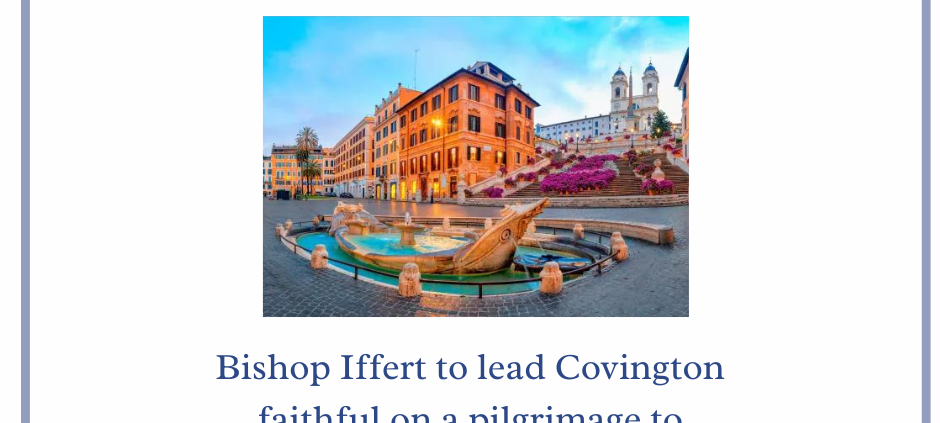
Bishop Iffert to lead Covington faithful on a pilgrimage to Rome during the jubilee year

Bella Young

Multimedia Correspondent

“You shall treat this fiftieth year as sacred. You shall proclaim liberty in the land for all its inhabitants. It shall be a jubilee for you, when each of you shall return to your own property, each of you to your own family.” (Leviticus 25:10)

The first mention of jubilee in the Bible is found in Leviticus — one of the five Books of Moses. Pope Boniface VII proclaimed the Church’s first ordinary Jubilee in 1300, with the intention for a Jubilee year to be celebrated every 100 years. Responding to requests to celebrate a Jubilee earlier, the second Jubilee was held 50 years later. The years between jubilees fluctuated until 1470 when Pope Paul II issued a Papal Bull fixing the Jubilee for every 25 years. The year 2025 will be the 28th jubilee year the Church has celebrated.

‘The practice of the jubilee year was originally meant as a time of “forgiveness and restoration of freedom from servitude and debt.” Bishop Iffert explained that though this was the original intention of the jubilee year there is not such a need for the everyday person to forgive someone of servitude or debt. The general spirit of forgiveness, however, remains true to this day.

“It is a time for mercy, a time of repentance, a time for being set free, a time for letting go of grudges … a time for deepening faith, seeking freedom, a time for letting God free us from grudges that we hold against one another,” said Bishop Iffert.

This theme of forgiveness and restoration is common throughout past jubilees as it is the biblically prescribed meaning of jubilee, but each jubilee has a special focus in addition to forgiveness. For the Great Jubilee of the year 2000, the theme focused on the anniversary of Jesus’ death; the theme for the extraordinary jubilee year of 2015 was mercy, and the theme for the 2025 jubilee year, as announced by Pope Francis, is Pilgrims of Hope.

“The focus by choosing that theme,” Bishop Iffert said, “the Pope has brought that tradition of pilgrimage together with the tradition of the jubilee year.”

It is the spirit of being pilgrims that the Diocese of Covington will be hosting a pilgrimage to Rome during the jubilee year. From October 22–30, Bishop Iffert will be leading a group of faithful from the diocese to Rome, living out the theme of jubilee year, Pilgrims of Hope.

During the pilgrimage, stops will include major historical sites such as the Holy Stairs, the tomb of St. Paul the Apostle, the catacombs underneath the church of St. Sebastian and the Sistine Chapel.

“There is something about an experience like that,” Bishop Iffert said, “where you come to incorporate that into your being — not just in an intellectual way, but in a bodily way … you stand in that space and that experience of that moment becomes part of your body. You can remember the smell of the air in that place, you can remember what it was like to be with others in that place and that is part of what fuels our hope.”

For those unable to spare nine days away from everyday life for a pilgrimage to Rome, the diocese is organizing several local pilgrimages, giving everyone the opportunity to be pilgrims of hope.

Visiting these historical sites reaffirms the message of hope says Bishop Iffert. “Hope is a kind of certainty, a kind of way of knowing. To be on a pilgrimage that way means we are going to rehearse living these nine days of our lives that way and allowing our confidence in our hope to be strengthened by remembering the places, letting those places help us to remember what God has done for us through people like St. Paul. It will allow us to have that sense of trust and belief.”

To learn more about the Jubilee year and the 2025 pilgrimage to Rome go to covdio.org/jubilee.

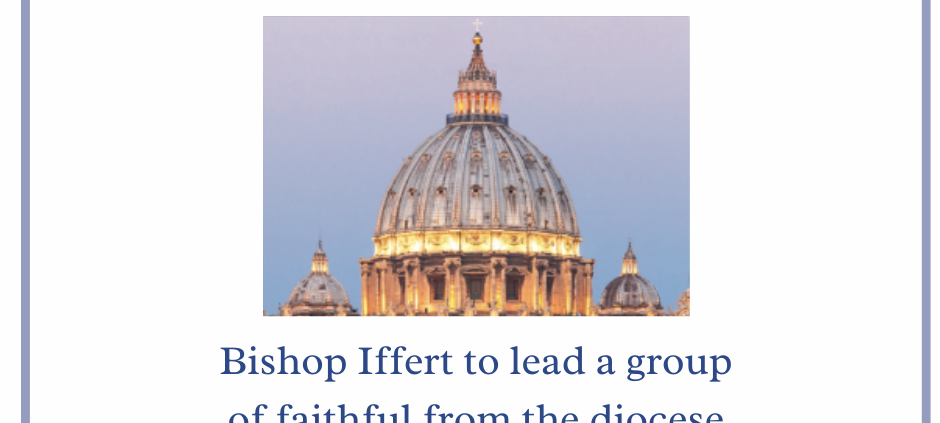
Bishop Iffert to lead a group of faithful from the diocese on a pilgrimage to Rome

Bella Young

Multimedia Correspondent

A group of faithful from across the diocese will have the opportunity to join Bishop Iffert for a pilgrimage to Rome for the Jubilee 2025. For nine days, Oct. 22-30, in 2025 Bishop Iffert will be leading a pilgrimage to Rome, fulfilling the theme of the jubilee year — Pilgrims of Hope. Jim Hess, director of the office of Stewardship and Mission Services, says that the jubilee year is one of the primary reasons for this pilgrimage.

“The whole premise of this trip, the whole reason we’re doing this trip, is because of the Holy Year, to go to Rome together as a diocese,” said Mr. Hess.

For those able to attend, the nine-day itinerary is packed with visits to some of the Church’s oldest historical sites and the most iconic destinations in Rome. Pay your respects to St. Paul the Apostle at his resting place, venture beneath St. Sebastian Outside the Walls to the catacombs where you will be able to visit the tombs of early Christians, martyrs and saints. Attend a papal audience where you will be able to pray with Pope Francis, then explore the Sistine Chapel and St. Peter’s Basilica. While the majority of the pilgrimage will spent inside Rome, there is one day dedicated to visiting Assisi. There you will be able to see where St. Francis of Assisi spent most of his life.

Mr. Hess, when speaking about the itinerary said, “When we’re there we’ll be able to say the Angelus with Pope Francis at St. Peter Square which will be incredible. We’re essentially spending a vast majority of the time, like seven days, in Rome. We will get to see a lot of the beauty of the Catholic Church, of the early Church, and celebrate a jubilee year in Rome. We will take a day to visit Assisi so people can learn more about St. Francis, where he prayed and spent most of his time in ministry.”

While the attractions and experience of Rome are what make the nine-day pilgrimage exciting, the opportunity for a plenary indulgence is one that is “certainly going to be a part of our pilgrimage,” said Mr. Hess.

A plenary indulgence, as Mr. Hess explained, “removes the temporal punishment of sin as if you’re being baptized, it is a total cleansing of the person, a total forgiving of sin and its effects. It is only offered in special times and special situations and there are certain things you have to do and a certain disposition you have to have.”

One of the longest standing ways to obtain a plenary indulgence involves walking through designated Holy Doors which are only made available during jubilee years. Of these doors are the doors to St. Peter’s Basilica, St. John Lateran, St. Mary Major, and St. Paul Outside the Walls. All four of these basilicas will be visited throughout the pilgrimage, giving each pilgrim ample opportunity to take part in a tradition that has taken place since the 1400s.

For those that are unable to attend Rome and walk through the Holy Doors, there are ways to receive plenary indulgences from home. These include fasting, volunteering in your community, supporting religious or social works, offering support to migrants, the elderly, the poor, young people in difficulty and abandoned children. One of the best ways to receive a plenary indulgence is to perform a work of mercy, tying into Bishop Iffert’s Campaign of Mercy that launched this year on Corpus Christi Sunday.

For more information on the Holy Year pilgrimage to Rome, refer to the brochure that has been inserted or contact jhess@covdio.org. If you are interested in reserving your spot reach out to Mr. Hess or call Collette at (800)-581- 8942 Booking #1227991. Or visit the Diocese of Covington website, www.covdio.org.