Amid the winds of Providence
Stephen Enzweiler
Cathedral Historian
This is the third in a four-part series celebrating the Quasquicentennial (125th) anniversary of the Dedication of St. Mary’s Cathedral (Cathedral Basilica of the Assumption) on January 27, 1901.
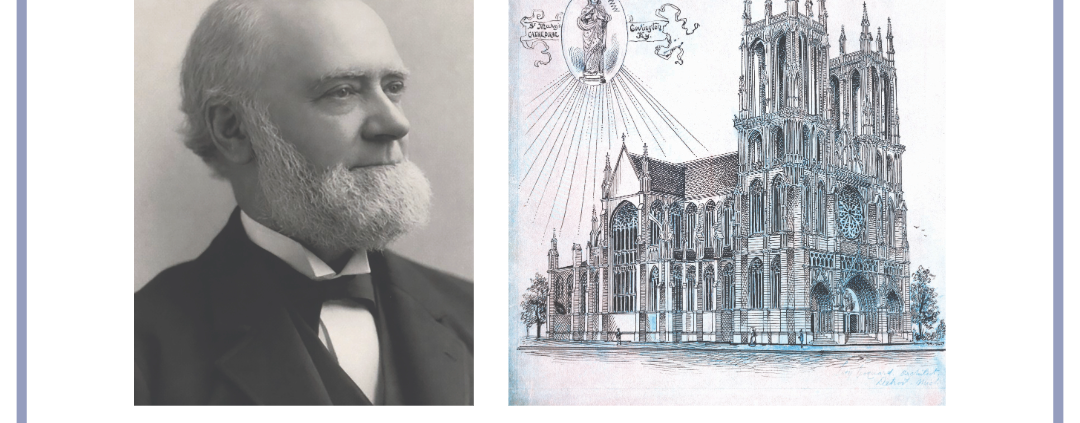
On April 8, 1890, a man named James Walsh, Sr. (1818-1890), former resident of Covington, retired owner of James Walsh & Company, distiller of whiskey, wealthy citizen and philanthropist, supporter of Catholic charities and institutions across Northern Kentucky, and lifelong parishioner of St. Mary’s Cathedral, died suddenly from a fatal stroke at his residence in Washington, D.C. An emigrant from Ireland, Walsh had lived in Covington and Newport since 1848, entering the employ of a distillery business and rising to become a partner in 1867. At the time of his death, he was one of the wealthiest men in America and head of the largest producer of whiskey, with a massive distillery headquartered on the Ohio River at Covington and with a second distillery at Lawrenceburg. In his Last Will and Testament, he left bequests in large amounts to 10 Catholic beneficiaries, including “the sum of twenty-five thousand dollars” to the Rt. Rev. Camillus Paul Maes, “for use and benefit of a new St. Mary’s Cathedral at Covington.”
The $25,000 for the new cathedral was the largest of Walsh’s bequests, and within days all the newspapers across the region carried the many details of his generosity. His example occasioned others to make their own bequests to the new cathedral fund. Throughout that year, money steadily came in. According to The Catholic Telegraph, “the total of the bequests by November of that year amounted to $90,000.” With the cathedral parish itself having already agreed to pay $75,000 of the cost from their own pockets, it brought the total available means for construction to $165,000, which was more than the roughly $150,000 the bishop calculated it might cost.
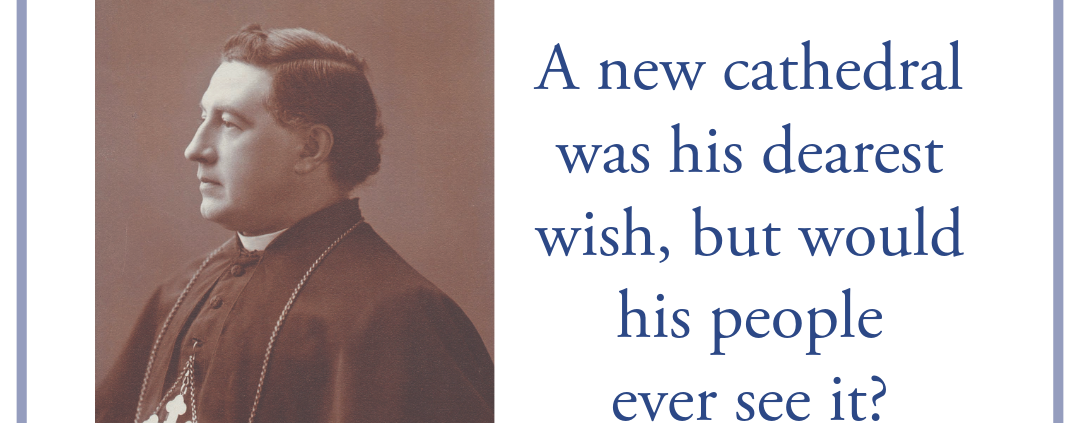
Since his arrival in Covington in 1885, Bishop Maes had been working and praying hard for a solution to his new cathedral problem. There had been many dark times when he turned out the light at the end of a day feeling that he would never be able to build the kind of cathedral his people should have or one that was worthy enough to be a House of God. With each passing year he watched as the cost of building materials and labor increased and the cost of erecting it became greater and more unaffordable. Sometimes it seemed to him a new cathedral would never be built at all.
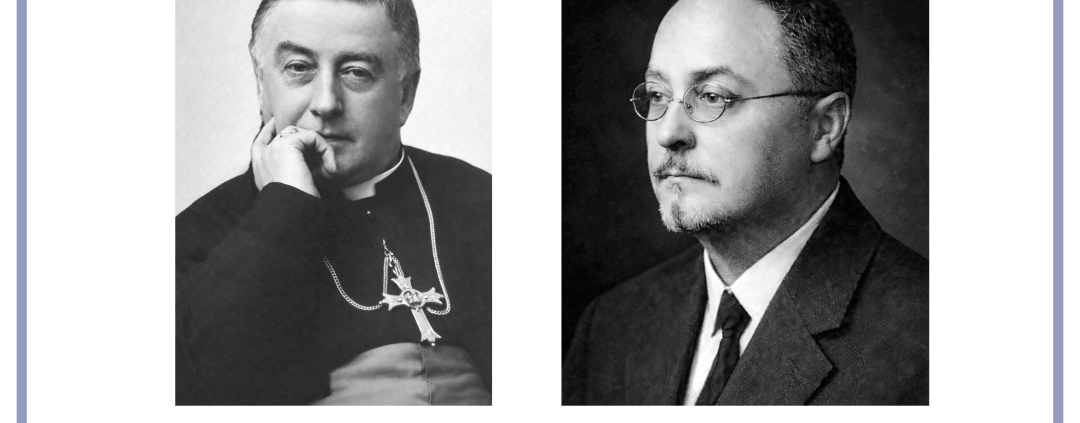
Yet, despite his frustrations, he knew by faith and with confidence that if God wanted a new cathedral, he would provide the means for it. Over time, Maes came to recognize that Providence had been at work all along. He mused over the reasons why Pope Leo XIII chose him, “a poor and useless servant in the vineyard of the Lord.” He knew of many other qualified candidates, and to his friends he repeatedly denied his own merits, writing, “I am fully conscious of my own unworthiness.” Yet, Camillus Paul Maes was also a man of duty and ironclad conviction, infused with a seemingly limitless energy, a boundless determination, a business savviness, creative talents and deep spiritual qualities, the kind of attributes that make apostles. Detroit’s Bishop Caspar Borgess certainly recognized this rare combination when he submitted his name to the Holy Father for the episcopacy.
Then there was the unknown little girl who visited him in 1886 with an unusual message. Described years later in a Kentucky Post interview, Bishop Maes told how she visited him one day at his office and placed into his hand a shiny, new silver dollar, telling him to “take it and build a new cathedral in Covington.” On the surface, it was the impossible request of a child; but Maes saw it differently and came to recognize it as a sign of Providence.
The bishop, like most clergymen of his day, understood that God sometimes spoke to man through the innocence of children, just as he had through the Marian apparitions of in his own day. There was the 1842 apparition at Celles in his native Belgium, in France at La Salette (1846), Lourdes (1858), Pontmain (1871), and in Germany at Marpingen (1876). According to the Post story, he took the little girl’s gesture as the sign that God wanted him to build the new St. Mary’s Cathedral. “From that hour,” the Post reported, “Bishop Maes determined to act upon the suggestion of the child, and from that day he has labored without rest to accomplish the task the child had given him to do.”
In 1890, with funds pledged and feeling the winds of Providence filling his sails at last, Bishop Maes found himself with two very large questions before him: where to locate the new cathedral, and what kind of cathedral it should be. To the first question, he chose its location at what was then considered the center of the city – the corner of Twelfth Street and Madison Avenue. Two properties were situated there — the residences of Dr. John Delaney and the McVeigh family. And when the opportunity presented itself, he purchased both, giving him a large footprint on which to build.
Back in Detroit, Leon Coquard had become an architect in his own right after leaving the employ of Albert E. French in 1887. His reputation must have been secured, because the newspapers reported he was rarely without work. Up to this point, he had been designing commercial buildings, schools and residential homes, such as the posh and spacious neo-Gothic homes of Detroit’s famed Indian Village and the sprawling Saint Peter and Paul Academy in Midtown. But it didn’t satisfy him as greatly as did his work on St. Ann’s, and he longed for a great commission to design something that would make him an architect of consequence.
Maes didn’t yet know what kind of cathedral he wanted to build, but his thoughts kept drifting back to his 1888 visit to St. Ann’s Church and the deep impressions it left on him. As a result, he had long ago settled on Leon Coquard as his architect of choice.
In June 1891, Maes finally penned a letter to Coquard asking for his terms of contract. “The fact that I select you without competitive plans is because I am pleased with your art and work,” he wrote. “I consider that your terms … for preliminary sketches, definite drawings, working plans, specifications and details, are very low. Hence, I accept your terms; and foreseeing that you will give me the best work you are capable of, I feel that I am your debtor.”
It would be another year before the two men began a serious collaboration on the plans. In a June 10, 1892, letter, Bishop Maes laid out his basic preferences for what he would like to see. His lingering worries over “burdening the people with further debt” prompted him to first suggest constructing “a lofty basement church to be used for the next two or three years or longer.” He eventually saw the folly in it and yielded to Coquard’s insistence on a full-scale Gothic cathedral. The bishop replied with simple demands: that the new Cathedral should be cruciform in its floorplan, with the apse facing east and the front “facing Madison Avenue, with a stone front, the balance of the building, Gothic style.” The details he left up to Coquard.
Within weeks, the architect sent him a detailed pen and ink rendering of the structure he proposed. It was an ambitious concept, incorporating the bishop’s earlier requests, but also presenting Coquard’s own creative vision for what he liked to call “the pure French style of Gothic Architecture.”
The main body of the church was in High Gothic style, with flying buttresses wrapping around both sides and large rose windows in the transepts to give one the impression of Notre Dame in Paris. The façade was more complex — a blending of mixed Rayonnant and Flamboyant Gothic styles, crowned by two tall, open bay bell towers liberally ensconced with pinnacles, crockets and finials.
It was beautiful, but it frightened the frugal Maes. “The trouble is,” he lamented to Coquard, “that those who appreciate true art are often the very ones who are too poor to pay for it; and I am sorry to say that this is my case and is the reason I reluctantly underwent the mortification of asking for lowest terms.”
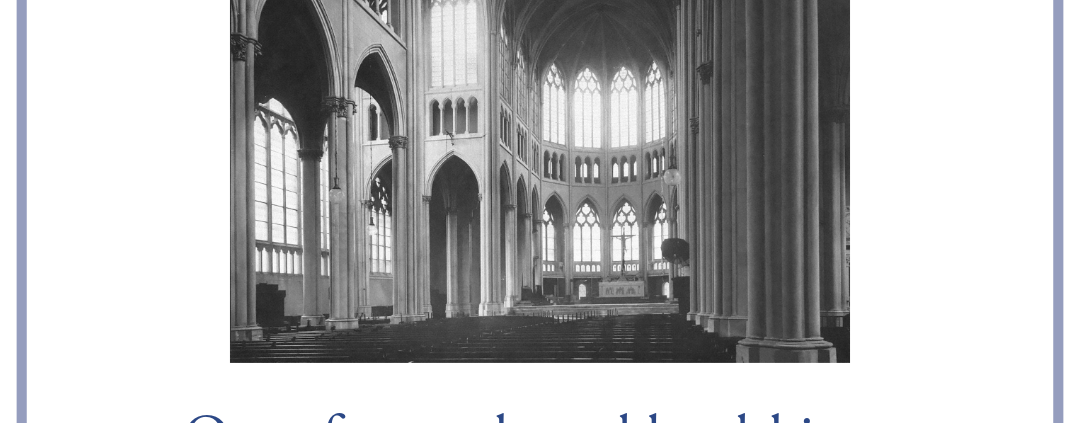
The two men spent the rest of 1892 and much of the following year in back-and-forth discussions. They compromised on details, adding new features and removing others, refining and distilling it all down until both men were comfortable with the result. With Maes’ approval, Coquard chose the interior design after St. Denis Cathedral in Paris, its apse inspired by the apse of the Cathedral of Notre Dame d’Évreux in Normandy. The triforium was designed after the triforium of Chartres Cathedral. The façade was edited down to a modest adaptation of Notre Dame’s façade topped by the same open bay bell towers from Coquard’s original sketch.
By March 1894, with plans in hand, permits obtained, contractors hired, and construction schedule established, Bishop Maes was ready to officially break ground. Though he still felt the preliminary costs were steep, he knew these could be negotiated as work progressed. But his overriding justification for building such a costly House of Worship was expressed in an article he wrote later that year for the American Ecclesiastical Review.
“Our zeal in building churches must be a starting point toward a reviving love for Jesus Christ whose Tabernacle is erected therein,” he wrote. “Lack of traditions will make it somewhat more difficult to arouse the enthusiasm of the faithful, but the personal sacrifices which they have made to build the temple can be successfully used as a lever and as an interested incentive to make them adore and love with more exterior, and especially with more convinced interior devotion, the Divine Treasure enshrined therein.”
When Bishop Maes sank the blade of his shovel into the earth to break ground in April 1894, he had high hopes that construction would commence quickly and proceed without incident. In the weeks that followed, engineers and workmen descended on the site and began surveying and excavating the ground according to the architect’s plans. Heavy equipment moved in and steam shovels hissed and scooped, transforming the site into a beehive of activity.
Coquard’s plans called for them to dig down 25 feet along the foundation perimeters, where piers could be sunk that would support the massive weight of the cathedral super structure. But as deeper and deeper buckets of earth were scooped out, supervising civil engineer Willis Kennedy noticed a big problem. While hoping to find a stable ground for construction, he found instead only a wet, marshy soil with layers and layers of sand and clay. It didn’t look good. He knew immediately it was the type of soil upon which no cathedral could be built.
Kennedy broke the news to a stunned Bishop Maes as best he could. The bishop was devastated. The ground was what engineers called a “compressible” soil, one that was not uniform throughout and could never support the weight of a massive building weighing hundreds of tons. Kennedy tried to reassure the bishop. There were a few things he could still try in hope of saving the situation. Yet, not even the city engineer could guarantee that any of it would work.
For the first time since becoming Bishop of Covington, Camillus Paul Maes found himself with the wind completely out of his sails.