Hands that touched the Cathedral — Trisco craftsmen reflect on restoring the Cathedral Basilica of the Assumption for another century
Laura Keener and Maura Baker
Editor and Staff Writer
High above the streets of Covington, in the hidden upper spaces of the Cathedral Basilica of the Assumption, the building keeps a quiet record of the people who built it. Brian Walter has seen it there: initials and dates carved or written by workers who climbed into the attic-like spaces generations ago, men whose names are otherwise lost but whose hands helped shape the cathedral.
“What’s interesting up in the top, up in the attic space, way up in the top, is you see a lot of initials and dates of guys that have been there, either worked on it or were there for some reason,” Mr. Walter said. “You see like, you know, JLV were his initials, and then the date. That guy was up there almost 100 years ago. He’s been dead for years and years and years. Nobody knows who that guy was or anything, but his fingers touched that building and did something there.”
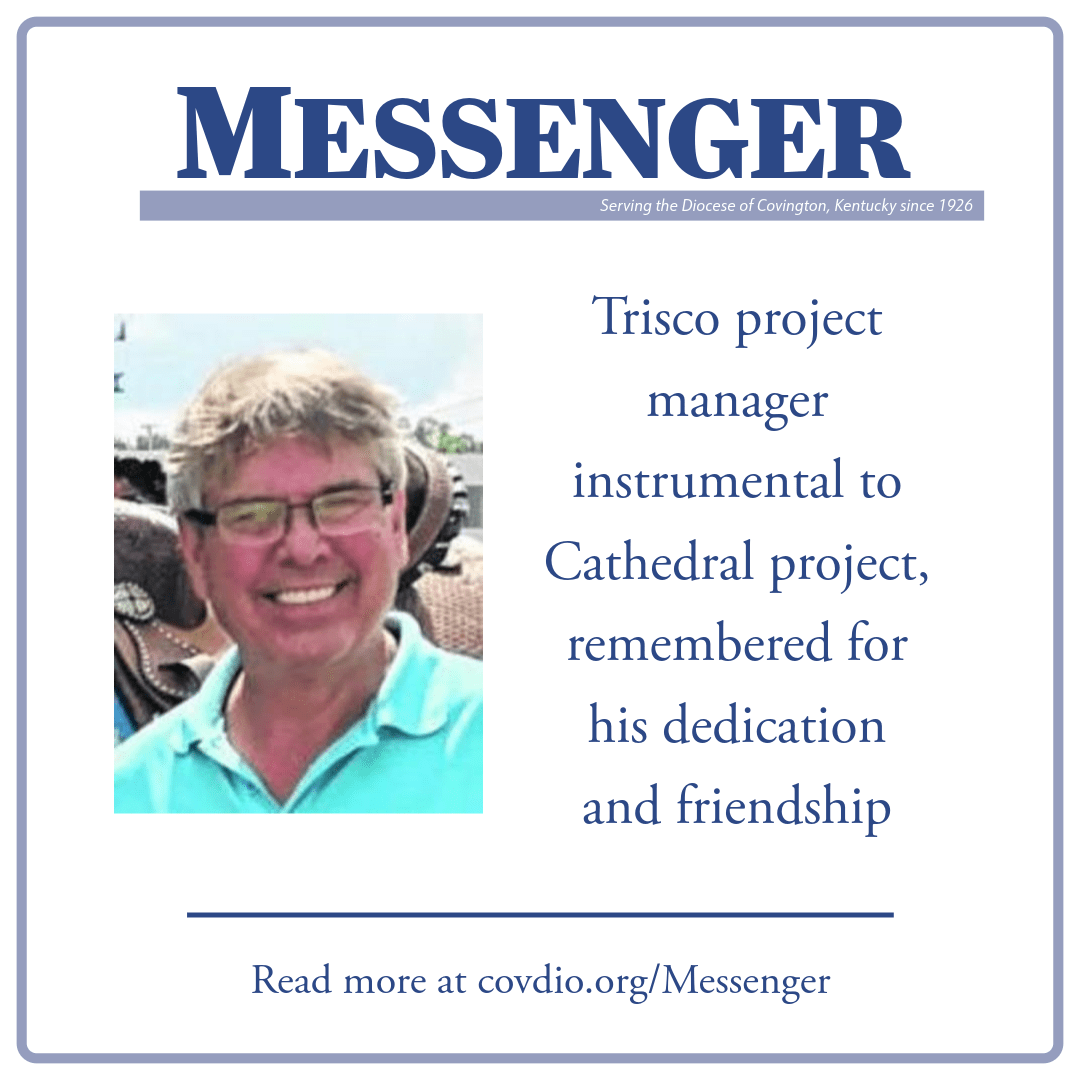
That thought stayed with Mr. Walter as Trisco Systems worked through the most recent restoration of the cathedral. For Mr. Walter, Trisco’s owner, and Rob Davis, one of the company’s veteran craftsmen, the project was never simply a construction job. It was a continuation of a century-old chain of labor, skill and responsibility. The original builders left behind a sacred landmark. The Trisco team’s task was to make sure it could stand for another century.
“Just like we’re going to be faceless, nameless people someday, too, that touched that building as well,” Mr. Walter said. “But the building will still stand long after us. And I guess it’s our duty to pay respect to those guys that built that building and that have worked on that building, that we do our best so it’s here 100 years from now.”
Trisco had history with the cathedral before this restoration began. Mr. Walter served as project manager on an earlier phase in 2001, when exterior work accompanied a larger interior renovation. At that time, he said, Trisco cleaned the building, performed tuckpointing, addressed window caulking and focused on urgent exterior problems, including chimeras that had been damaged, deteriorated or even knocked loose.
“The focus was keeping the water out, life safety issues,” Mr. Walter said of the earlier work. “We didn’t want stones falling on the street, falling on the sidewalks or over the public areas. We were just trying to buy you some more time before a bigger project could be done.”
The 2001 work did buy time. The chimeras were patched with terracotta materials, pinned, epoxied, glazed and returned to their places. But Mr. Walter knew even then that some elements eventually would need full replacement. “We got a few more years out of them. And now this project here turned into replacement of all of the chimeras, and that was very, very necessary,” he said.
When the more recent project began, Mr. Walter was not managing its day-to-day work. Todd Zapp, Trisco’s original project manager for the restoration, led that effort with Mr. Davis and Tim Purdy. Mr. Walter had shared what he remembered from the earlier phase, but Mr. Zapp, Mr. Davis and Mr. Purdy carried the new scope from the beginning.
From the ground, Mr. Davis’ first reaction was awe. “When I first pulled up on the job site, first thing I could say is, wow, what a beautiful building,” he said. “First time I’d ever seen it. It became a very interesting project. We knew our regular scope of work, which was a big job, but it wasn’t as big as it ended up being.”
That changed once the team began inspecting the cathedral up close. “Once Todd and I got up there and started inspecting things, we realized that things were in worse shape than what they originally thought,” Mr. Davis said. “At that point, obviously the job grew. And the things that we had to do was a little more involved than we anticipated. So that’s why it took the time and obviously the money.”
Mr. Walter said that kind of discovery is common in restoration work. Drawings, estimates and scopes of work can only reveal so much. “A lot of those things you can’t really blame anybody for,” he said. “It’s what you find when you actually get your nose up on the work.”
Much of the public attention centered on the cathedral’s chimeras and gargoyles, the dramatic figures that can be seen from below. Those were important, but Mr. Walter and Mr. Davis emphasized that some of the most complex and significant work involved the stone tracery: the columns and arching stonework around the upper portions of the building.
“All those arch stones that come together and land on top of the columns, those are the tracery. We replaced all of those stones, all of those columns,” said Mr. Walter. “That’s the really severe deterioration that we noticed when we first started the project. Everybody sees the chimeras and the gargoyles and is happy with those, but everything in between all that got replaced as well.”
For Mr. Davis, the tracery was both the most difficult and most critical part of the project. “That was like putting the puzzle back together,” he said. “When you took that apart, you had to put it back. It had to be precise. A quarter inch off when you first start, you could be an inch off when you’re on the right side when you’re done. So, it had to be exact.”
The work demanded planning long before stones were moved. Mr. Davis recalled “a lot of nights of Todd Zapp and I on the phone, sleepless nights, wondering how we’re going to do this and the best way we could do this and the safest way to do it.”
Some of the deterioration came from the very materials that originally held the cathedral together. Mr. Walter explained that buildings of the cathedral’s era commonly relied on carbon steel pins, fasteners and structural elements. Over time, that steel rusts. As it corrodes, it expands, placing pressure on the surrounding limestone until the stone cracks or breaks.
“Most all of the problems with the stone deterioration were caused by the carbon steel fasteners, hidden fasteners, pins and those types of things that are holding things up,” Mr. Walter said. “They were rusting and corroding and no longer able to do their job. So, when we put new stone in, we put new stainless-steel pins, stainless steel fasteners, stainless steel structural elements that will last indefinitely.”
Mr. Davis said many people asked what was causing the stone to fail. “The old pins that they used, like Brian was saying, when they rust, they swell,” he said. “At that point, your limestone is your weakest point, and that’s why it’s going to bust. And that’s what caused that. And there was a lot of it.”
Mr. Walter summed up the approach this way: “We put it back not the way it was, but better than the way it was.”
The restoration also highlighted how much construction technology has changed since the cathedral was first built. Historic photographs show horses, wagons, ropes and wooden derricks used to lift stone into place. Mr. Davis joked he was glad the modern crew did not have to rely on horse and buggy. “I felt like I was the horse sometimes,” he said.
Mr. Walter describes the contrast plainly. “If you see those old photographs, that’s how they got the stone up there,” he said. “They had these derricks made out of wood with pulleys on the top and used ropes to pull the stone up. And the horses were pulling on the ropes to pull the stone up to the top. And the way we do it now is we call the crane guy. In 10 minutes, he lifts those heavy stones right to the top.”
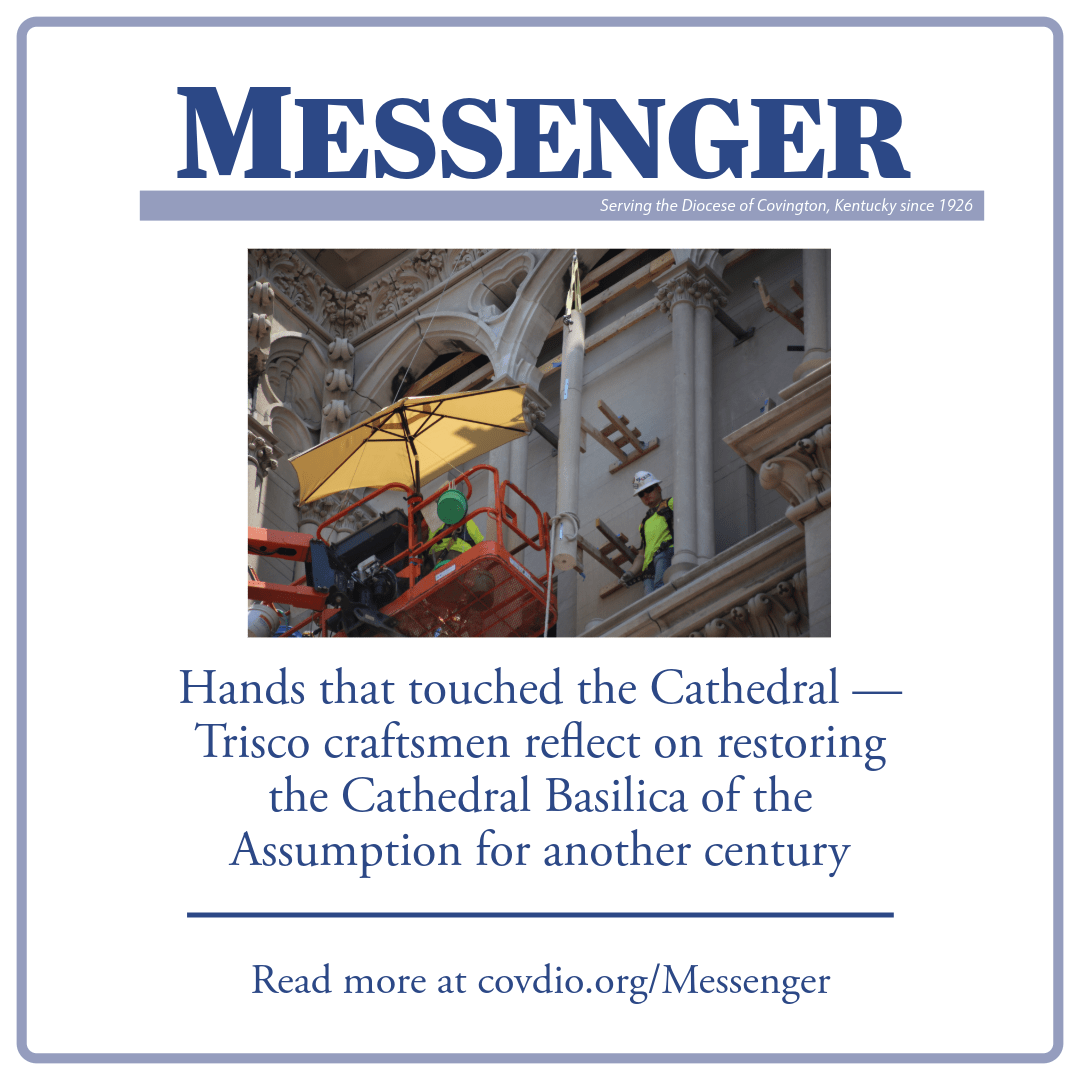
The team relied on cranes, boom lifts, scaffolding and a monorail system that helped raise and position stones around the building. Mr. Davis describes the monorail as “an electric motor with a cable that you hook the stone to, to take them out and put them back in.” Mr. Walter said it was essentially an I-beam system running horizontally near the top of the building, assembled and moved by the scaffolding contractor as work progressed.
Even with modern equipment, the work could be tense. Mr. Davis often worked from the ground manning a rope tied to heavy stone being lifted, keeping it away from the building so it would not scuff the masonry as it rose. Asked if he wore two hard hats for that work, he answered, “Probably should have, but I didn’t.”
Still, the heart of the work remained the human eye and hand. “That’s where you rely on Rob and his guys,” Mr. Walter said. “They are master craftsmen. You can say all you want, you can show him a drawing, but it takes the guy and his eye to get it on the wall.”
For Mr. Davis, successful restoration is measured partly by whether anyone can tell where the new work begins.
“Once we left there, the best way to say it is, you can’t tell we’ve even been there,” he said. “That’s key to me, that none of our work stood out. You want everything to look like you haven’t been there. And that’s even the new stone, everything blended in as well with washing everything down. So nothing really stood out. And that’s the key to restoration, making everything look like you haven’t been there, make the whole building look beautiful again.”
Mr. Walter said some of the finest work on the project is nearly invisible to most visitors. On the roof are inner areas and courtyards few people will ever see. There, hidden from the street, are more traceries, stone columns sitting on the roof and copper flashing and caps worked carefully into place.
“You’ll never, nobody will ever see that stuff,” Mr. Walter said. “And it’s the most beautiful work. It should be on the front down low so people can see it, but nobody will. And what you get with us and what you get with master craftsmen like Rob and his guys is you get perfection 150 feet in the air, the same perfection as you get 10 feet in the air. I’m really proud of that. I’m really proud of the work we did.”
Both Mr. Walter and Mr. Davis said the cathedral project felt different because it was deeply collaborative. Mr. Walter said some projects are driven by architects or engineers who tell contractors what to do without drawing on their experience. This restoration, he said, was not like that. It was a team effort among the architect, cathedral staff, Father Ryan Maher, Don Knochelmann and others working for the good of the building and the community.
“What I don’t always get, and I got definitely on this one, is the pride of the congregation, the pride of the people of not only the Catholic community, but also the city of Covington,” Mr. Walter said. “They’re so proud of that church. Every time I was there, I would get a thank you from somebody, some guy just walking by. The staff is just so grateful and so appreciative of the work that we were doing. And that motivates you to want to do better.”
Mr. Davis agreed. “Just knowing how much that cathedral means to so many people, it grabs us too,” he said. After returning for the celebration of the completed work, Mr. Davis said he felt “pretty proud” of the whole Trisco team.
The cathedral also reached them personally. Mr. Walter, who grew up Catholic, said time in the cathedral — especially returning with his wife for Mass — reminded him of the power of sacred space. “People say that it’s a special place and people say that it’s a spiritual place and that it moves you when you see the light coming through those stained-glass windows,” he said. “And you’re like, yeah, yeah, yeah. But when you’re there, it’s absolutely true. That place is beautiful. It’s special. It puts you in a completely different frame of mind for that hour that you’re at Mass.”
Mr. Davis said the people at the cathedral made him feel welcome from the beginning. “Everybody’s there for a purpose, and it’s a good purpose,” he said. “Everybody’s there for each other. Trisco worked with them, as well as them working with us, and it worked out for everybody. So, in more ways than one, it really touched me deep.”
The project also drew unusual media attention. Mr. Walter said Trisco’s work often receives local notice in communities where the company works, but the cathedral restoration traveled much farther after being picked up by the Associated Press.
“When the AP picked it up, I can’t think of the time that’s ever happened to us before,” Mr. Walter said. “I have a friend that lives in Las Vegas that it was in front of the Las Vegas newspaper. I had a buddy in Chicago that recorded it on Fox News Headline News. He was like, ‘Oh my God, is this you?’ It was all over the country. It was international, not even just the country, when the AP picked it up.”
Mr. Walter admitted the interviews pushed him out of his comfort zone. “Way out of my comfort zone,” he said. He tried to persuade Mr. Davis to do more of the interviews, but Mr. Davis had a simple answer: “I was busy.” In the end, Mr. Walter said, “Somebody had to. I’m glad it ended up happening.”
Throughout the restoration, Mr. Davis said the team had a phrase for what they hoped to achieve: “the 100-year fix.” It was not only about repairing broken stone. It was about honoring the original craftsmen, safeguarding the cathedral for those who worship there now and handing it forward to people who will never know the names of the workers who made it safe and beautiful again.
“That was our saying during the whole project,” Mr. Davis said. “Another 100 years is what everybody wanted. That was the goal.”
In the hidden upper reaches of the cathedral, the initials from 100 years ago remain as a reminder that every generation receives the building from someone else. Now Mr. Walter, Mr. Davis, Mr. Zapp and the Trisco team have added their DNA, even if most of their work is meant to disappear into the whole. Their names may not be visible from the pews or the sidewalk, but their labor is part of the cathedral’s ongoing story — more sets of hands that touched the building so it can continue lifting the eyes and hearts of Covington to God — the Master Creator — for years to come.