Cathedral Concert Series marks 50 years of sacred music and family legacy
Laura Keener
Editor
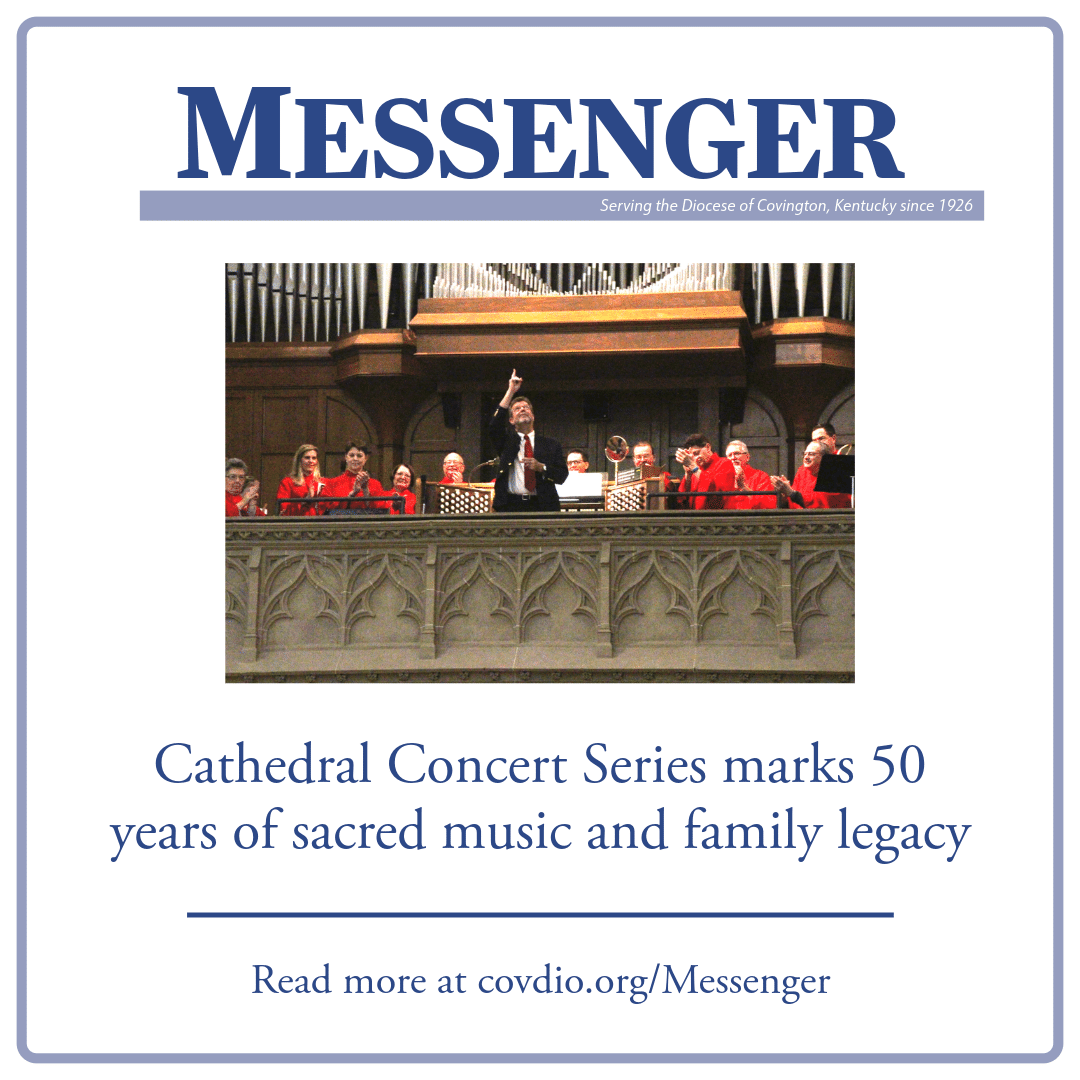
Musica Sacra will open the 50th anniversary season of the Cathedral Concert Series, Oct. 25. Musica Sacra has been the lead performer for the series since its inception, making the Cincinnati ensemble a fitting choice to begin a milestone year at the Cathedral Basilica of the Assumption in Covington.
The bond reaches back to the series’ founders, the late Dr. Robert and Rita Schaffer, and Musica Sacra’s founding conductor, Dr. Helmut J. Roehrig. Their friendship grew into a partnership rooted in a common belief — sacred music belongs in sacred spaces, where it can serve both artistic excellence and spiritual life.
Dr. L. Brett Scott, Musica Sacra’s conductor and professor of ensembles and conducting at the University of Cincinnati College-Conservatory of Music, said the ensemble’s connection with the cathedral began very early.
“My understanding is that our founding director, Helmut Roehrig, and the director of music at the Basilica, which was Greg Schaffer’s father, were close friends,” Dr. Scott said. “As a result of that, Musica Sacra has been involved in the concert series, if not from the very first year, from very, very early on in its history.”
“Dr. Helmut Roehrig was actually one of Dad’s assistants at the cathedral very early on, and they were very close friends,” said Dr. Greg Schaffer, son of Robert and Rita. “The music of Sacra is the quintessential example” of the sacred music the series promotes.
That early relationship was more than a convenient collaboration. Musica Sacra was founded because Roehrig saw a need in Cincinnati for an ensemble devoted to the great sacred choral-orchestral works. Dr. Scott said the group’s purpose “was to perform these sacred pieces in the spaces for which they were intended.” The cathedral series offered precisely that kind of setting.
“We really do focus exclusively on sacred music,” Dr. Scott said, often presenting larger choral-orchestral works. “The type of repertoire that we do is a perfect fit for the Basilica,” he added. “With such a visually stunning place, it’s always a wonderful opportunity for us to perform this music in such a wonderful location.”
The Schaffers approached the concert series with a similar sense of mission. Dr. Greg Schaffer, now director of the series as well as principal organist and choir director at the Cathedral Basilica of the Assumption, Covington, said his parents were accomplished concert performers with strong ties throughout the organ community. They wanted to present music from the Western liturgical tradition in what their mission statement called “a suitable environment.”
That phrase, Greg said, almost understates the experience. “Attending a concert at our basilica is really — I can’t think of anything to compare it to on a local or regional level, visually or acoustically,” he said.
Robert and Rita also insisted that the music remain accessible. “They felt quite motivated to make this available to the community, but without any financial concern,” Dr. Schaffer said. “No matter what your disposition is, you’re able to come and witness these programs free of charge.” The series has continued through basket donations and occasional larger gifts rather than ticket sales.
Dr. Schaffer sees that openness as part of the cathedral’s ministry. “I see it as community outreach, opening the doors to the general public,” he said. People are welcome regardless of denomination or spirituality.
Dr. Scott sees that loyalty when Musica Sacra opens the season. “The place is always packed,” he said. “I think it shows that people still have a desire and a thirst to hear this music — to hear this sacred music.”
The longevity of both organizations — 50 years for the concert series and more than 60 years for Musica Sacra — also reflects enduring regional support.
Behind the public success is a family story. Dr. Schaffer remembers dinner-table conversations in which the concert series was being quietly “hatched.” In the early years, Robert and Rita led the work while their children watched; later, the children were enlisted to perform or help. “It was definitely a family effort spearheaded by Bob and Rita,” Dr. Schaffer said.
Dr. Schaffer said that his older brother Mark, who is now deceased, was especially talented and joined the performances at a very early age. “Mark was just a natural fit because he had been studying organ and was much more motivated as an adolescent, 15 and 16 years old, spending his summer doing scales in the basement,” he said. “He was just capable of doing that at an early age.”
Continuing that legacy is joyful, but not light work. “It’s scary in a good way,” Dr. Schaffer said. “It’s big shoes to fill because I’m filling essentially four pairs of shoes at the same time.” With help from his sister, Rebecca Schaffer Wells, he manages the artists, promotional materials, accounting and business details. “My goodness, what a labor of love,” he said. “To be able to present this program of concerts year after year — I can’t express in words the joy it gives me.”
Still, Dr. Schaffer said the greatest reward comes after the final chord. “The real payoff to me is seeing the people’s faces at these concerts,” he said. He notices first-time visitors immediately: they enter through the north door, look upward and drop their jaws.
After five decades, that sense of wonder remains the series’ most convincing measure of success. “If we’ve made a difference in one person’s day or their life and uplifted their soul in some way, then that has fulfilled our ministry and mission,” said Dr. Schaffer.