
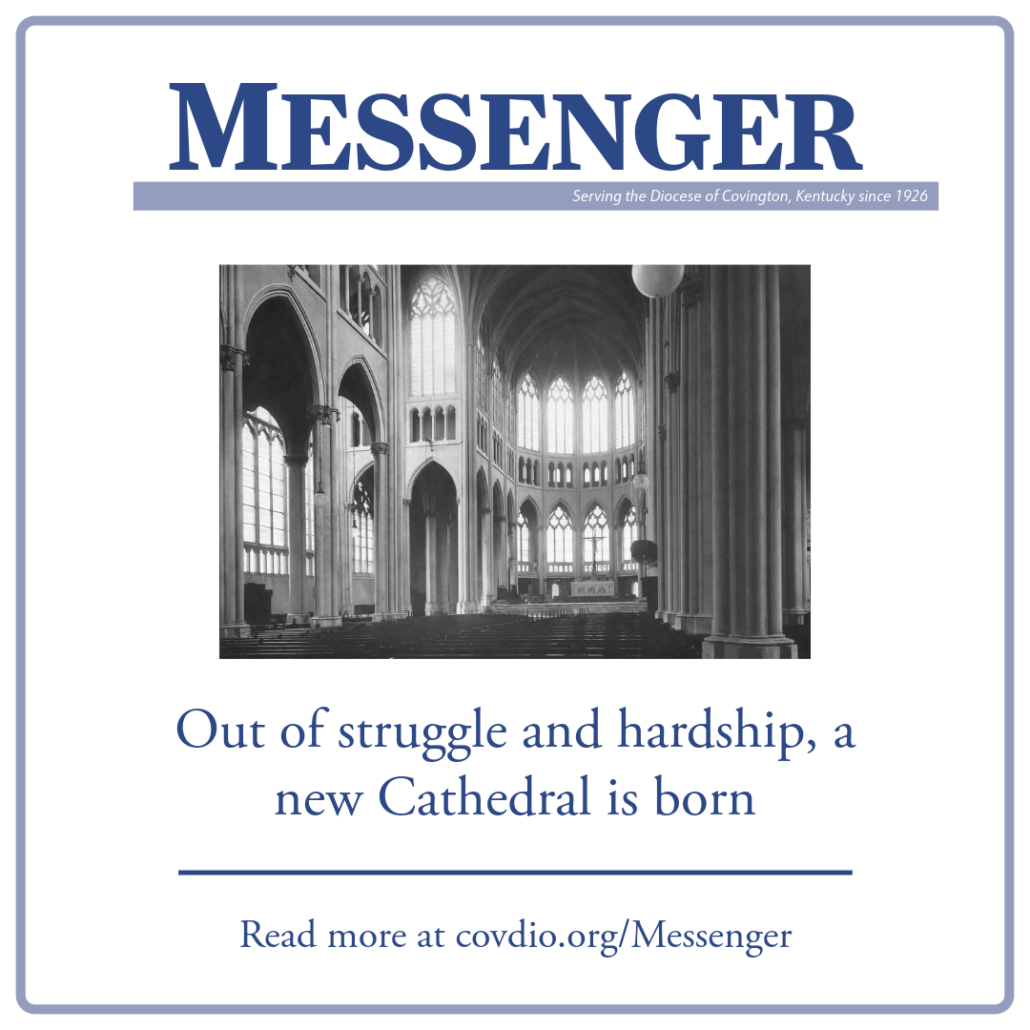
Out of struggle and hardship, a new Cathedral is born
Stephen Enzweiler
Cathedral Historian
This is the fourth in a four-part series celebrating the Quasquicentennial (125th) anniversary of the Dedication of St. Mary’s Cathedral (Cathedral Basilica of the Assumption) on January 27, 1901.
In the spring of 1894, there was every reason for Bishop Camillus Maes to be optimistic. The architectural plans for the new cathedral were in hand and construction was about to begin. Yet he knew from his own experience that building any structure the size and complexity of a gothic cathedral came fraught with unexpected twists and turns. He knew there might be delays in materials delivery and construction, or plans changes caused by other unforeseen conditions. He experienced it when as a pastor he built St. John the Baptist Church in Monroe, Mich., and he experienced it dealing with the finances of building new parishes when he was chancellor of the Diocese of Detroit. Architect Leon Coquard also knew about the unforeseen. But neither man expected the kind of emergency that threatened to kill the St. Mary’s Cathedral project entirely.
“I have been thinking,” Coquard wrote Maes less than six weeks before the May 1, 1894 groundbreaking. “As Covington is so hilly and rocky, it might be possible that solid rock may not be far below the surface. Could you find out to a certainty the nature of the ground at the site?” The bishop didn’t know the answer to his question. But the initial excavations of the ground and the sudden discovery of “a wet, marshy soil with deep layers of sand and clay” surprised both men completely.
“The whole lot is endless and bottomless sand!” the bishop lamented. “About 8 ½ feet deep there is a layer of clay of seven inches in thickness, and at a depth of 15 feet another of about the same thickness. The men who worked it…assure me it is the same all over, for blocks and blocks.”
Coquard was just as surprised as the bishop. “It is impossible for me to say just what should be done,” he replied. “I have allowed about 2 ½ tons per square foot of footing. Of course, this will not do if you have the bottom which you describe.” He asked if the excavations had been made elsewhere on the property. They had. But the further borings only confirmed that no cathedral of the planned size and weight could be built on the site without risking disaster.
The ever-inquiring Bishop Maes felt confident there must be another way to approach the problem. For that he contacted Gustave Bouscaren, a Paris-trained civil engineer living in Cincinnati who the Enquirer said “had the reputation of being one of the great civil engineers of America.” He worked for Cincinnati Southern Railway for 25 years, held patents for dozens of inventions, and built most of the bridges spanning the Ohio River. He also was once appointed by President Cleveland to evaluate the Brooklyn Bridge.
After inspecting the building site, Bouscaren sent his report to the bishop. Based on his initial findings, he concluded that the allowable load capacity was easily half of what architect Coquard originally calculated, indicating the ground as it was could never support the size and weight of the cathedral as he had designed it. The bishop wrote to Coquard saying the conclusions made it “too deep to reach for foundations and unfit for draining.” Yet Bouscaren wasn’t finished. “Upon the engineer’s recommendation,” Maes wrote, “we proceed today to a test of the bearing strength of the ground.”
Bouscaren dug a well 25 feet down into the ground and built a mechanical load-bearing test apparatus at the bottom. On it he systematically placed 6,000 pounds of weight and waited to see conclusively how much weight the sandy soil could actually support. So interested was Bishop Maes in the outcome, he even assisted Bouscaren in the process, taking readings himself over the planned four-day test period. In the end, Bouscaren wrote to the bishop on July 16, noting that the result was “somewhat more favorable than I had anticipated” and advised that the tests only justified “a maximum allowance of three thousand pounds per square foot,” rather than the 6,000 pounds Coquard planned for.
Embarrassed at his miscalculation, Coquard tried to make up for it by proposing he increase the footings in size as an added precaution. But the bishop replied that he was “perfectly satisfied” with Bouscaren’s results and directed Coquard to adjust his plans accordingly. Willis Kennedy, the Covington City Engineer overseeing the process, agreed. “Hence,” the bishop wrote Coquard, “only increase the footings so as to get a bearing area of 3,000 lbs. per sq. ft.” The matter seemed to be settled after that. Two days later, Coquard’s redrawn plans arrived and construction resumed.
But the relationship between the bishop and his architect became increasingly more strained as the work progressed. Coquard’s difficulty in fitting such a massive structure into the tiny lot Maes had procured was a constant source of discussion and disagreement between the two. “If your lot were at least two hundred feet square,” he wrote, “I would not be obliged to calculate down to every inch, and could get along much faster. I am trying to arrive at the very best possible arrangements under the circumstances, and I hope that you will not force me to send out plans which are not sufficiently studied, just to gain a few days’ or even week’ time, at a cost of years of regret and dissatisfaction.”
By the spring of 1895, the steam shovels had finished their work and were replaced by block and tackles, swarms of stone masons, carpenters, brick layers, and horse-drawn wagons clattering about the streets. By late summer, the brick and limestone walls had risen to a height just below the windows.
Sunday, September 8, 1895, the feast of the Nativity of the Blessed Virgin Mary, had been chosen as the date for the laying of the cornerstone. Thousands from Covington turned out and more than 10,000 came from Cincinnati, with as many from each of the surrounding cities. All told, there was an estimated 20,000 attending the event. The newspapers reported a street parade beforehand “which completely eclipsed anything ever witnessed in Covington.” They dubbed it the “monster parade.”
“Never in the recent history of Covington has such a religious demonstration been witnessed on the streets,” reported the Kentucky Post. The parade was four miles in length with more than 4,500 men, boys, clergy and public officials participating. It took hours to arrive at the cathedral site. When time came for the blessing of the cornerstone and the walls, with the priests kneeling, facing a wooden cross, they chanted the litany of the saints led by Bishop Maes, who rose to perform the dedication. It was then that everyone noticed her.
“As the assemblage of bishops and priests climbed the steps,” the Enquirer reported, “a little golden-haired girl, dressed in pure white, and reflecting from her face religious faith and innocence, clung to the cornerstone and hung there during the ceremonies.” Bishop Maes in particular could not help noticing her. Neither could every other bishop and priest there. For Maes, her presence clinging to that cornerstone had the same unusual quality as did another little girl he encountered some years earlier who handed him a silver dollar and tasked him to “build a cathedral in Covington.” As he ascended the wooden steps, Bishop Maes carried in his hand a copper box, among whose contents was the same silver dollar she had given him. He placed the box inside the cornerstone niche and mortared it in place with a sterling silver trowel. None of the bishops, priests or attendants told the little girl to leave.
The cornerstone laying that Sunday continued the community’s great pilgrimage toward the new cathedral’s eventual completion and dedication. As the days and months passed, residents watched in fascination as the beautiful French gothic edifice rose incrementally toward the heavens. No one had ever seen anything like it before. With its progress, enthusiasm of the parishioners and the city residents mounted. Everyone from the wealthy of Covington to the poorest of the poor realized they were to have a House of God “which would rank architecturally among the notable cathedrals of the country, an edifice eminently worthy of its sacred purpose and at the same time a great honor to the city and the State.”
“Splendid Edifice Now Nearing Completion in Covington” said the headline in the Cincinnati Enquirer on the morning of Nov. 5, 1899. “Bishop Maes lays no claim to as superb an edifice as the grand cathedrals that grace England and the continent of Europe,” the article said. “He is convinced that his is the finest temple of purely gothic architecture in America.” Indeed, it had been a herculean effort, and it came at a personal price. When Camillus Paul Maes began construction, he was still a robust man, his black, curling hair showed only a few scattered flecks of grey. But looking into the mirror in the days before the cathedral’s dedication, it was completely white.
The original estimated cost of the new cathedral had been $150,000 in 1893. But by the time of the dedication, that amount had ballooned to $250,000. By the spring of 1900, funds for further construction had again run out. “My debt is so large now that I may not add another hundred dollars to it,” he wrote Coquard. “Let me know immediately what hope of completion of the job is held out.” By that summer, it was obvious the façade would have to wait, so the bishop ordered the architect to brick up the front wall temporarily until he “had the means to erect the towers and front entrances.”
By January 1901, the construction crews were gone, and the streets of Covington filled with a feeling of quiet excitement as the big day approached. On January 7, Maes sat down in his office and penned a final note to Leon Coquard in Detroit. “The Dedication will take place on Sunday, January 27th 1901,” it said simply. “You are kindly invited to attend.”
January 27 dawned cold and cloudy, with flecks of snow drifting in a brisk north wind.
Bishop Maes, accompanied by “the venerable and revered Most Rev. William Henry Elder, Archbishop of Cincinnati,” a dozen other bishops and dozens more priests, celebrated Holy Mass one final time in the old cathedral on Eighth Street, then moved in procession through the cold to the new cathedral.
“The majestic and devotional ceremonial of the Catholic Church was never before displayed in Covington as on yesterday,” wrote the Cincinnati Commercial Appeal. “A ceremonial ancient, yet ever new, and in which every act and every vestment, every prelate and every priest, every psalm and every ceremonial portrayed to the faithful the passion, the death and the glorious triumph of Christ, the Son of God.” A magnificent musical program was rendered by the full Cincinnati Symphony Orchestra, augmented by a choir of four hundred voices. In the congregation was a subdued but happy Leon Coquard. In his own words, he said he had designed it “with the idea in mind that it should stand for centuries as a monument, and symbolical of the strength and purity of the Christian faith.”
When Bishop Maes approached the completed interior for the first time, he remarked, “As I walked down the aisle and saw the white marble steps of the sanctuary, I felt I was at the gate of heaven!”
Now with the work completed, the long pilgrimage ended, the job finished, Bishop Maes looked upon his accomplishment with a bittersweet reflection. He had hoped to complete the cathedral during his lifetime, but now out of funds, he longed to start work on the facade. It seemed to him he might never live to see it. But the winds of Providence still graced the effort, and not a few years would pass before work would begin again to that purpose.
