TMU Biology Field Station receives national recognition and grants towards conservation of Kentucky’s state amphibian
Maura Baker
Staff Writer
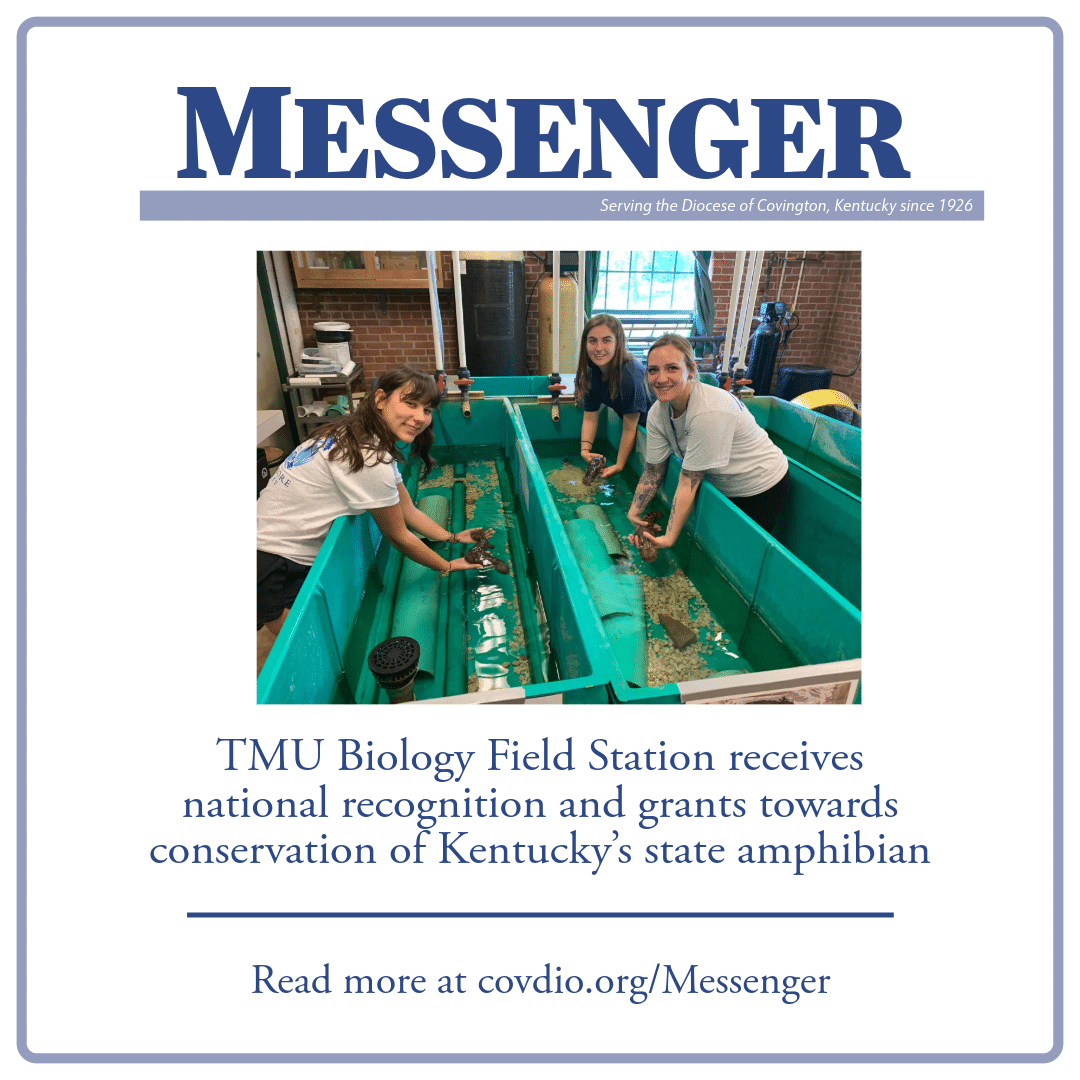
Thomas More University’s Biology Field station has been awarded two grants for its ongoing conservation efforts and research along the Ohio River. These grants — provided by the National Science Foundation, National Wildlife Federation and Mutual of Omaha’s Wild Kingdom — will help to fund and support the field station’s efforts to protect the eastern hellbender, a vulnerable species native to the Eastern United states, from the Ozarks to Appalachia.
The eastern hellbender is the largest salamander and amphibian native to North America. The species, described as “charismatic” by Kristy Jones, wildlife and nature education director for the National Wildlife Federation (NWF), is a keystone species in its environment — serving as an apex predator in nocturnal freshwater stream ecosystems and an important indicator of clean, healthy waterways.
When choosing programs to fund, the NWF aims to support a wide variety of species — from insects, to birds, to mammals — and the charismatic hellbender caught the NWF’s attention as a unique species that “a lot of people are not even aware of,” according to Ms. Jones.
“It’s a species that I really felt needed attention,” she said, complimenting TMU’s “strong student engagement” and “hands-on learning” with their conservation programming.
Chris Lorentz, the field station’s director, says that the grants will help to “elevate the field station’s ability to raise these animals from eggs,” allowing them to expand their facilities to raise, and eventually release, eastern hellbenders — with the population having declined by 77 percent in their native range.
Renovations to the field station to allow for this expansion will begin in October, with hopeful completion by the end of the year. Thomas More University anticipates receiving larvae for the program from Kentucky Fish and Wildlife in January 2027.
These grants and expanded programming tie in well with this year’s special Jubilee of St. Francis, patron of ecology, but also to the late Pope Francis’s encyclical “Laudato Si’,” according to Mr. Lorentz, emphasizing the “care for our common home,” which includes care for both humans and the environment. “All are connected,” Mr. Lorentz said.
“It’s important for animals to have a healthy environment,” Ms. Jones commented on the importance of conservation. “What’s healthy for animals is healthy for humans — clean air, clean water, thriving native species. There’s a balance within the ecosystem.”