The desire for glory
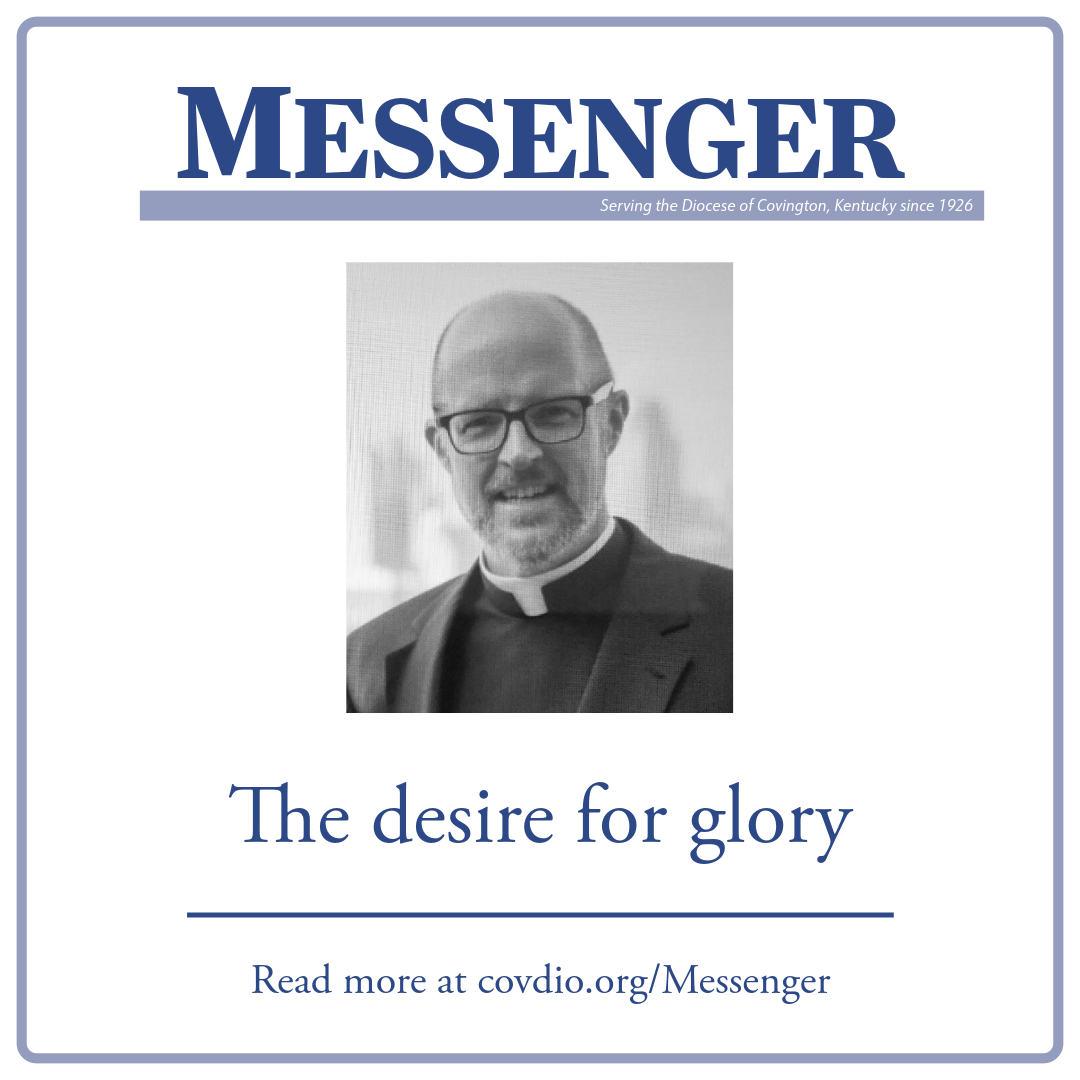
Father Phillip DeVous
Guest
What are we to make of those powerful, yet mysterious words of St. Paul, “those he justified he also glorified?”
The justification of which St. Paul speaks is a true reconciliation with God that occurs the moment one believes and receives Baptism. This justification is a dynamic, ongoing event of reconciliation with God, in which the Christian, acting in cooperation with this grace of reconciliation, becomes progressively perfected in divine charity after the pattern of Jesus Christ in the power of the Holy Spirit. Thus, we understand that one comes to be saved, by which we mean no longer alienated from God, both at the beginning AND throughout the arc of one’s whole life.
Grace is a reality given at precise moments but is also a yeast that fosters a leavening of holiness throughout life. The dynamism of the grace of justification moves in the direction of glory, which St. Paul understands to be a complete and total sharing in the fullness of the being of the Trinitarian God. This grace of justification leading to glory is given at precise moments — the Holy Sacraments. The dynamic relationship of justification and glory within a person is developed through the agency and action of the Holy Sacraments, received, of course, with faith.
St. Thomas Aquinas in reflecting on this relationship between justification and glory recalls that grace has five primary effects: healing the soul, making it so the soul wills the good, working in such a way that the willed good be effectively carried out, persevering in the good, and finally reaching eternal glory. This is why the Holy Sacraments of the Church are essential to salvation, for it is in and through them we personally receive the Trinitarian life, which is the glory of which St. Paul speaks.
In contemplating these mysteries of the faith, the issue of desire arises. C.S. Lewis was a keen observer of things divine and the longing, or lack thereof, for the spiritual. He passionately believed in the primacy of the spiritual; yet he noted that for modern man, enthralled by materialism, the vision of things divine was dimming and the desire for the spiritual was waning:
“It would seem that Our Lord finds our desires not too strong, but too weak. We are half-hearted creatures … when infinite joy is offered us, like an ignorant child who wants to go on making mud pies in a slum because he cannot imagine what is meant by the offer of a holiday at the sea. We are far too easily pleased.”
To be too easily pleased by the passing things of the world is a species of what is called acedia or sloth in the spiritual life. There are many ways to understand it, but the most fundamental is one loses the sense of the reality of God; one’s “desire” for the holy withers; and one becomes apathetic towards the spiritual. Consequently, we chase after things to consume or to distract. Inevitably this devolves into a destructive boredom which settles over everything. It is one of the great ironies of our day that we are ruled by an empire of desire without limits, yet so very little really excites us.
“No longer a vice afflicting individuals only, acedia has become a cultural reality” writes R.J. Snell in “Acedia and Its Discontents.” He further notes that “nestled deep in the roots of our ways of acting and living, sloth seeps into our loves and lives in virtually every domain, before finally transforming itself into boredom and nihilism.”
This is deadly for the Christian! We are meant to seek the Kingdom of Heaven with the passion of someone who finds a treasure buried in a field and who then goes out and sells everything he possesses to obtain that field to the exclusion of all others. Further, we are enjoined to have the eye of a merchant seeking the finest pearls, excitedly looking for the finest of them all, because one desires this object of great beauty and perfection. And when found, we give up everything to obtain this impeccable jewel.
Grasping the contemporary struggle with acedia, a cause of our cultural affliction and a sickness of our soul, we pray with faith and fervor, “that through the powerful working of your grace these most sacred mysteries may sanctify our present way of life and lead us to eternal gladness.”
Father Phillip W. DeVous is the pastor of Sts. Peter and Paul Parish in California, Ky.