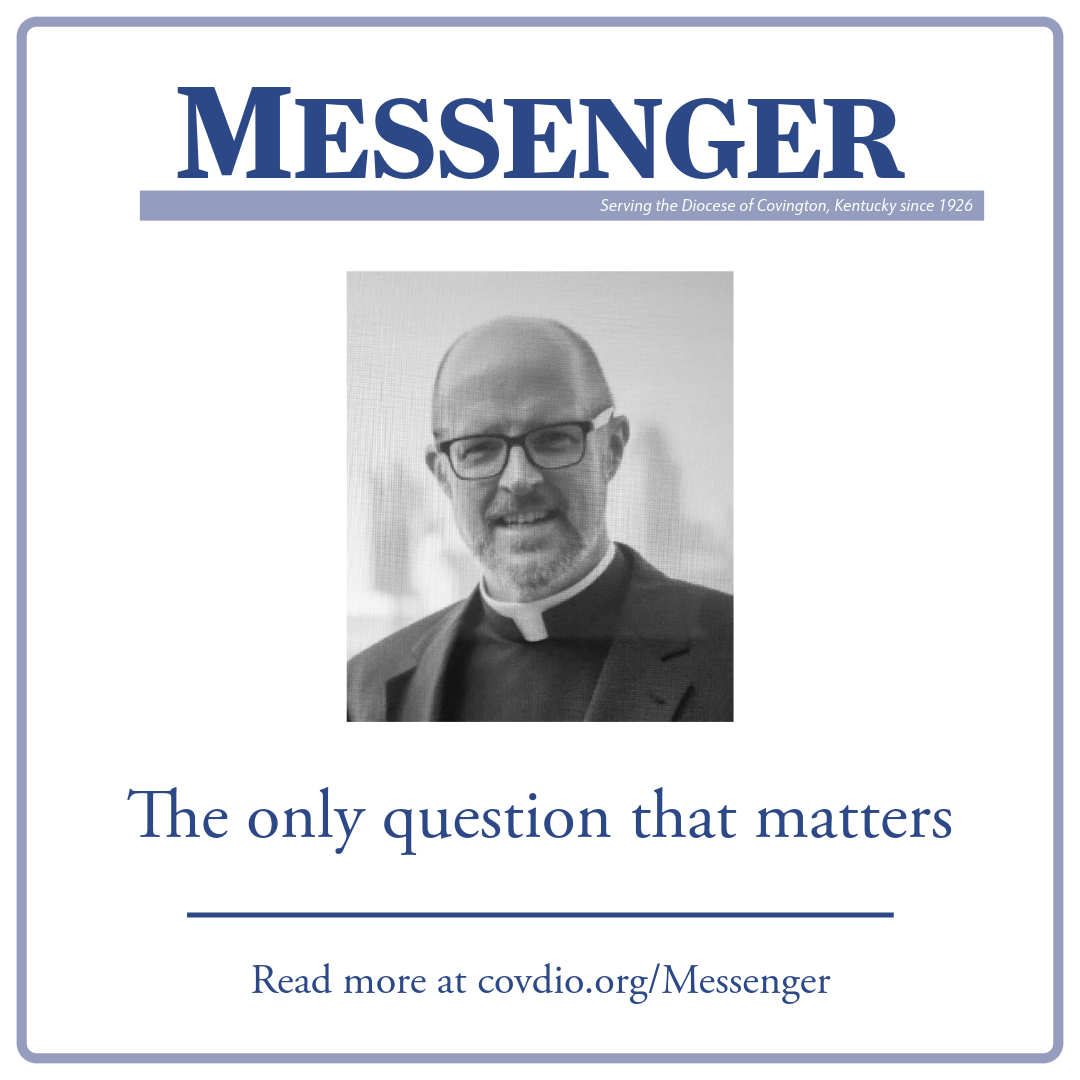
The only question that matters
Father Phillip DeVous
Guest
The intertwined questions of what is true, and how do I live in truth, are the two most important questions in life to answer, no matter how urgent other matters might appear. We are confronted in our proclamation of the holy Gospel with both of those questions when Jesus asks the disciples, “but who do you say that I am?”
We are now immersed in a post-Christian moment in history. In this post-Christian moment, we are dealing with a culture-wide situation where knowledge of Jesus Christ is no longer “common knowledge,” much less a cultural norm. We are dealing with a situation where it is simply the case that many people no longer have a personal faith in Jesus and no longer practice the faith. I think something fundamental has changed and we must reckon with it.
The late Pope Benedict XVI insightfully described this situation when he observed: “A particularly dangerous phenomenon for faith has arisen in our times: indeed, a form of atheism exists which we define, precisely, as ‘practical,’ in which the truths of faith or religious rites are not denied but are merely deemed irrelevant to daily life, detached from life, pointless. So it is that people often believe in God in a superficial manner, and live ‘as though God did not exist.’ In the end, however, this way of life proves even more destructive because it leads to indifference to faith and to the question of God.”
The situation of post-Christian man is that he cannot conceive that he is in anyway separated from God because the question and the reality of God have been nullified. That means voided or invalidated as legitimate questions for serious consideration. One might even say God has been liquified — everything is God, nothing is God or whatever.
This age of the nullification of God is a total paradigm shift in the consciousness and culture of the western world, leading to a profound reorientation of our souls. The consequence is that we now live within a formative cultural, educational, economic, personal, political and social situation that is fundamentally, not merely unbelieving, but anti-theistic in a radical way — right down to the very unconscious assumptions of every aspect of contemporary life and living.
Contemplating our situation, we see the Lord directs his gaze toward us, asking, “but who do you say that I am?” His disciples are meant to know the answer to the question. It is not a test. It is a call to profess our faith! After all, in our worship and prayer, we are the ones who swim up to the very heart of God and put our lips to his blood. We are meant to know. After all, the Word of God is made for our heart, and our heart is made for the Word of God.
In recognizing that we live within a situation where God’s existence is not so easily assumed and the presence of Jesus Christ not so readily recognized, we also consider the question, “Lord, where did you say you would be?”
Our Blessed Lord did not just leave us with mere memories of him that would degrade over time. He left us his Word and his presence in the Holy Sacraments and the Church. The Church and sacraments continue the work of Jesus’ incarnation, within us and among us. As St. Leo the Great has taught, “what was to be seen of our Redeemer has passed over in the Sacraments so that faith might be more perfect and more firm.”
In the Gospel passage we proclaim this Sunday, Peter’s answer is meant to be our own: “You are the Christ, the Son of the living God.” And in response to his answer, Jesus gives Peter the keys to the kingdom of heaven.
Those keys of the kingdom are the Holy Sacraments. If you want to access the kingdom of the divine life of God, the sacraments, most especially the Holy Eucharist, are the keys. The Holy Sacraments build up the Body of Christ, bringing the Holy Spirit’s power to us to transform us into living images of Jesus Christ. They are how Jesus Christ shares his holiness with us. They are the means by which the gaze of our whole existence is oriented to Jesus Christ above all things and in all things.
“But who do you say that I am?”
Our answer to that question determines everything, not just for us, but the very life of the world.
Father Phillip W. DeVous is pastor of Sts. Peter & Paul Parish in California, Ky.