
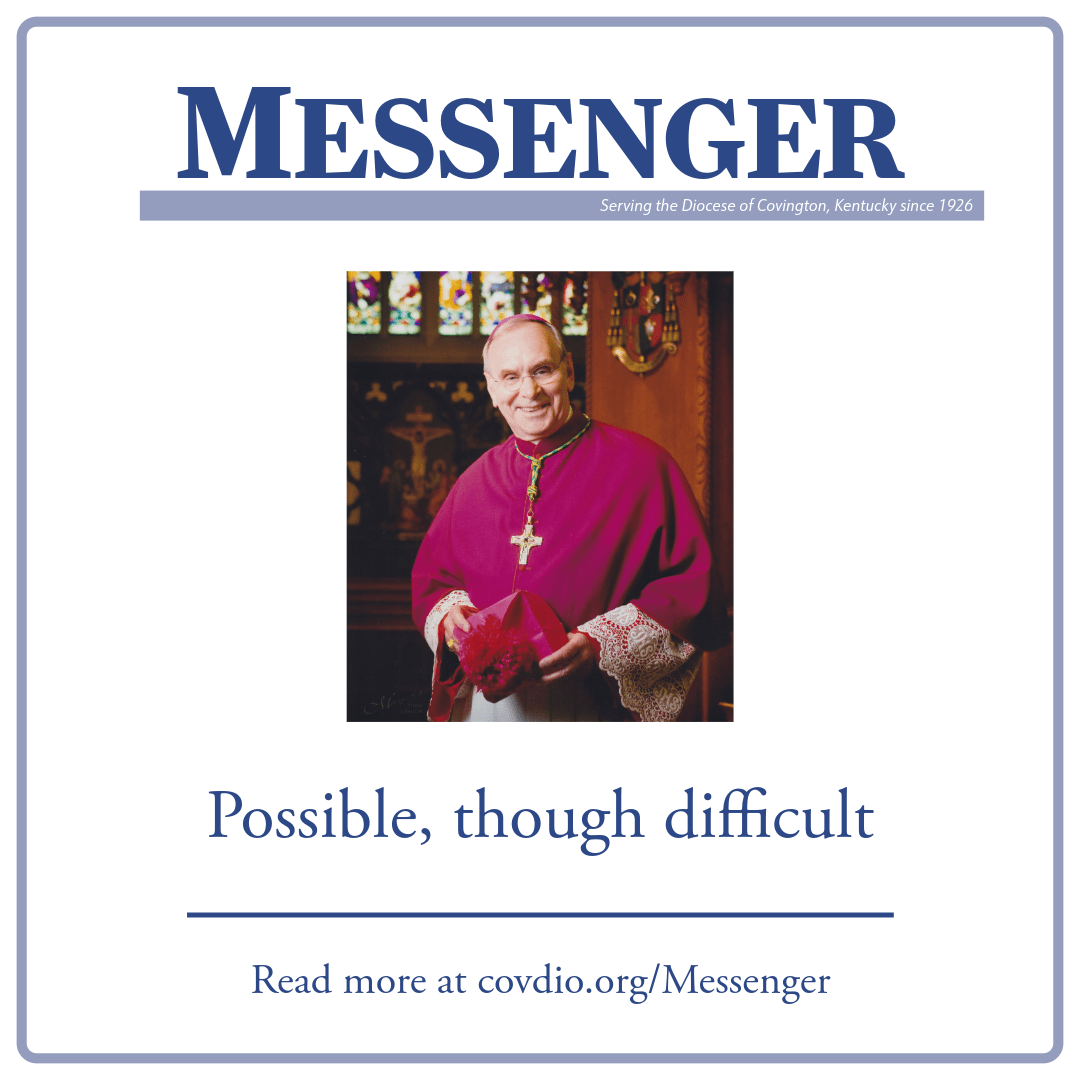
Possible, though difficult
Bishop Emeritus Foys
Guest
Jesus has asked His disciples what people were saying about Him. Who do they say that He is. They answer that some think He is John the Baptist come back from the dead or one of the great prophets or Elijah come back to earth. But YOU, Jesus says — who do YOU say that I am. Silence, broken by Peter, who proclaims that Jesus is the Messiah, the one who is to come, the Savior of the world! Jesus commends Peter which must have made Peter feel honored indeed. He’s riding high!
Then, Jesus tells His disciples that they are on the way to Jerusalem where Jesus will suffer and die. Well, Peter was having none of that. Absolutely not! He had just been singled out as the rock upon which Jesus was going to build His Church and Peter was to play an important role in that. Jesus suffer and die? Preposterous, It didn’t fit Peter’s narrative. After all, this was a glorious moment. Jesus was going to lead the disciples to a great victory over those oppressing them.
And what was the response of Jesus to Peter’s outburst that “no such thing will ever happen to You?” (Matt 16:22) “Get behind me, Satan! You are an obstacle to me. You are thinking not as God does, but as human beings do.” (Matt 16:23) Wow! Talk about a quick fall from favor. One minute Peter is going to be the leader of (in Peter’s mind) a great revolution and in the next minute he is told to get behind the master because he doesn’t grasp the reality of who Jesus really is.
Jesus then goes on to tell His disciples that those who want to follow him must deny themselves, take up their cross and follow Him. (Matt 16:24) Jesus was very clear that following Him would entail sacrifice. The love that Jesus has for His Father in heaven and that Jesus has for us is a sacrificial love. Jesus gave his life up — literally and figurately — for the love of His Father and for love of us. Can we do any less?
Peter was not a bad person and was certainly dedicated to Jesus and to His mission. But, as Jesus told him, he was thinking as human beings do and not as God does. Jesus’ words and the prediction of His suffering and death did not fit Peter’s narrative, did not fit his image of who Jesus is and what Jesus ought to do.
Do we sometimes do the same regarding the Lord and other people? We pray, thinking that God needs to answer our prayers in the way we think He should. And should God not answer them in that way we become discouraged, disheartened, and maybe, just maybe, angry. We think like human beings and not like God Who always has our best interests at heart.
And what about our perception and expectation of other people? What expectations do we have of them. Do they measure up to the person we think they should be? Do they fit our narrative? And if they don’t, how do we respond? Do we try to change them? Do we write them off because they are not who we think they ought to be? And how would we feel if someone did that to us?
Jesus tells us that if we want to come after Him we need to deny ourselves, take up our cross, and follow Him. That cross will take many forms. At times it will seem too much for us to bear. At times it will mean accepting people and loving them and caring for them where they are. It will mean accepting the Lord without reservation and making Him our first and only priority. It will mean denying ourself and becoming selfless instead of selfish. It will mean thinking as God does and not as human beings.
Possible? Certainly. For all things are possible with God. Difficult? Sometimes. Worth it? Without a doubt!
Most Rev. Roger J. Foys, D.D. is Bishop Emeritus of the Diocese of Covington, Ky.