
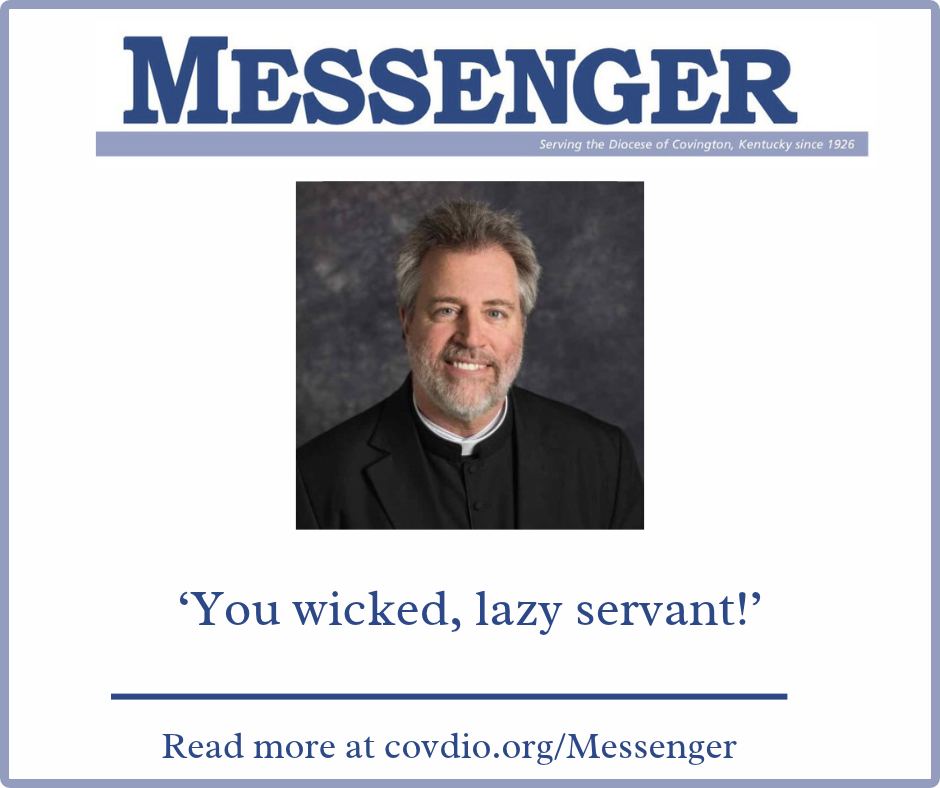
‘You wicked, lazy servant!’
The readings for the Thirty-third Sunday in Ordinary Time — Cycle A — are: Proverbs 31:10–13, 19–20, 30–31, 1 Thessalonians 5:1–6 and Matthew 25:14–30.
The striking word in what the master says to the third servant in this weekend’s Gospel may be not “lazy” but “wicked.” But how is being lazy wicked?
It is not a mistranslation, because the Greek word used here — <<poneros>> — does in fact mean “wicked” or even “evil.” Laziness, for us, is not something desirable, we may even despise people who are lazy, but we do not think of them as evil, or even as sinning.
We even use the word as a sometimes-acceptable thing, as in, “I was feeling a little lazy, and just stayed home and read.” We are even expected to be lazy at times, as on vacation, and if a person is never lazy, we might accuse them of being a workaholic. What is going on here in Jesus’ parable?
The parable is teaching about what the Church calls <<acedia>> or <<sloth>>. The Church not only considers it sinful, but one of the seven capital sins. (Called capital because they engender other sins, other vices. CCC #1866) We know the first six — pride, avarice, envy, wrath, lust and gluttony — and understand what is wrong about them, but we do not often speak of sloth.
The Catechism defines sloth as “a culpable lack of physical or spiritual effort.” (CCC, Glossary) Read “physical” here not as I never go to work or exercise, but as I do not do acts of my religion, for example, go to Mass, pray, tithe, do the corporal works of mercy. Notice that the heart of the sin is not that I do not act, but that I do not even try. It is a sin because it is a “culpable” lack of effort. I could do them, but I just do not want to do them.
The Catechism categorizes sloth as a sin against God’s love. Paragraph #2094 lists various aspects of this sin.
It shows indifference: a person neglecting or refusing to reflect on divine charity.
It shows ingratitude: a person failing or refusing to acknowledge divine charity and to return love to God.
It shows lukewarmness: a person hesitating or neglecting to respond to divine love, as in refusing to respond to the prompting of the Holy Spirit.
And it shows a person refusing the joy that comes from God, even being repelled by divine goodness. It is interesting that the Catechism uses the word “joy” here. What does the master in the parable say to the first two servants? “Well done. … Come, share your master’s joy.”
Sloth is not dryness in prayer, or difficulty in the spiritual life. That is God acting in a way to strengthen our relationship with him. Sloth is a kind of spiritual laziness on my part and is a sin of omission, as opposed to the other capital sins, which are sins of commission. And in fact, the third servant does nothing; he does not even put his master’s money in the bank, which would involve little effort and no creativity.
The result is the opposite of sharing his master’s joy: he has the talent taken away from him, and he is thrown into the darkness outside to wail and grind his teeth.
The Church gives us a foil to sloth in the first reading. The “worthy” wife is not idle. “She obtains wool and flax/ and works with loving hands./ She puts her hands to the distaff,/ and her fingers ply the spindle./ She reaches out her hands to the poor,/ and extends her arms to the needy.”
Various writers have commented on the presence of sloth in the modern world. Karl Barth, the great Protestant theologian, thought that sloth was the distinctive sin of our time, pointing out that modern man has time and energy for earthly things, but little for spiritual things. Pope Benedict XVI is well known for his comments on the “dictatorship of relativism,” among other things the thought that one religion is as good as another, that you can think what you think and I can think what I think, a disposition that leaves us spiritually listless, indifferent and uncaring.
What is the antidote to sloth? If sloth, or acedia, is a kind of spiritual depression brought on by “lax ascetical practice, decreasing vigilance, and carelessness of heart,” (CCC 2733), the antidote is fairly straightforward: to do our spiritual practices and think often about what God has done for us to gin up gratitude and a desire to return God’s love. And it would seem particularly antidotal to ask ourselves these questions: What gifts (talents) has God given me, and (how) am I using them?
The lesson of the Scriptures today is clear: “For to everyone who has [and uses], more will be given and he will grow rich; but from the one who has not [and does not use], even what he has will be taken away.”
Let us discover and use our spiritual gifts, that we may one day share together in our Master’s joy.
Father Stephen Bankemper is pastor, St. Catherine of Siena Parish, Ft. Thomas, Ky.