
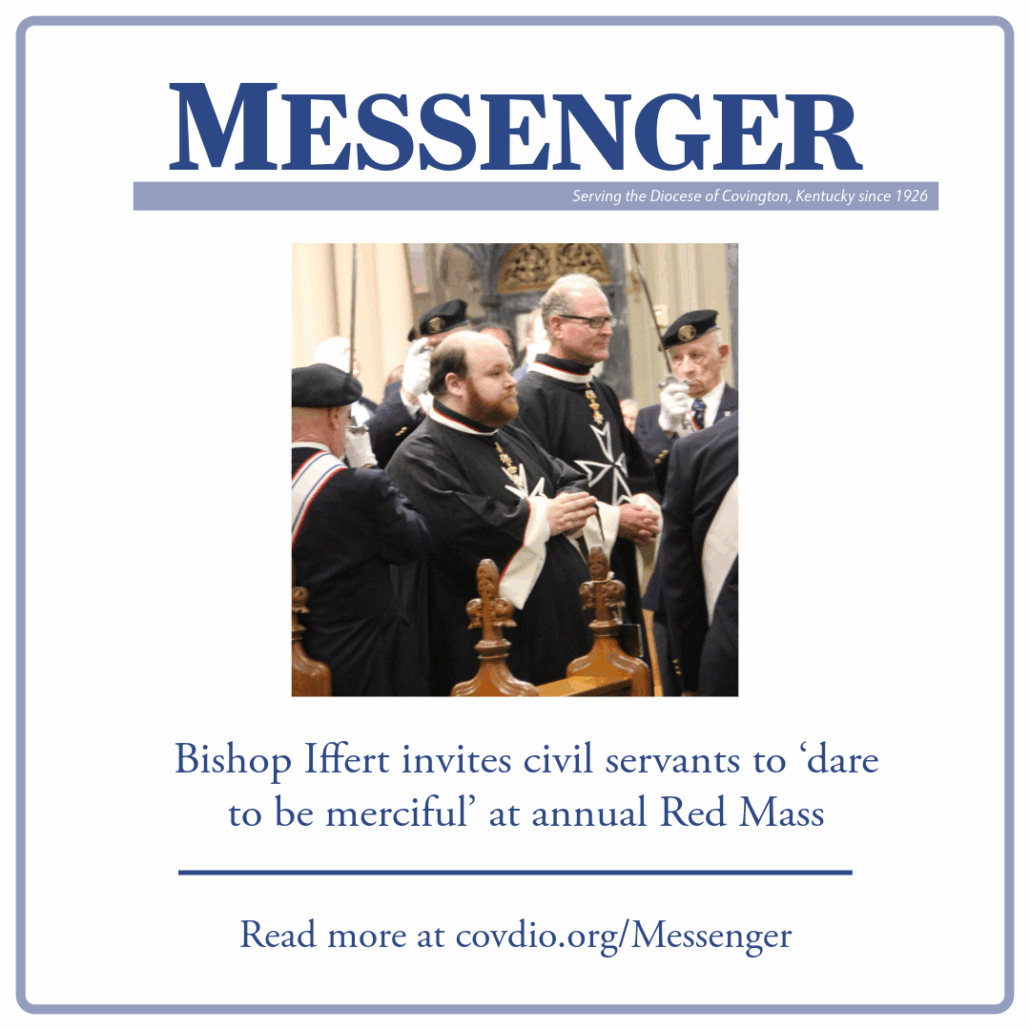
Bishop Iffert invites civil servants to ‘dare to be merciful’ at annual Red Mass
Maura Baker
Staff Writer
Civil servants came together for the annual Red Mass, held Sept. 18 at the Cathedral Basilica of the Assumption, Covington.
Organized and sponsored by the St. Thomas More Lawyers Guild of Greater Cincinnati, the Red Mass is a tradition celebrated throughout the United States and Europe, through which lawyers and public officials seek to “invoke God’s blessing and guidance on the administration of justice.”
Bishop John Iffert was the celebrant and homilist of the Mass. In his homily, he spoke on humility, recounting the Gospel reading that accompanied the service.
In the reading, a woman, described as sinful, falls to the ground to anoint Jesus’s feet and washes them with her hair. When the Pharisees question this, Jesus asks them a simple question; “Do you see this woman?”
He’s not asking if they “see” her in the ordinary sense, Bishop Iffert said, but rather if they have taken her into account. “Have you noticed her, or is she just the sum total of her public reputation?” He elaborated, “Have you stopped to think about her, who she is, how she came to be at this point, how desperate she was to hear the good news?”
Bishop Iffert then went on to reference a 2017 TED Talk from the late Pope Francis, given at a conference discussing “how technology might reflect ethical decisions.”
In that context, Bishop Iffert says how Pope Francis questioned, with the many people facing hardships in the world, “Why them and not me?”
This falls in to the second question in the Gospel reading that stood out to Bishop Iffert, the question of “Who even dares to forgive sins?”
“Now,” Bishop Iffert said, “we who stand 2,000 years after these events, we have memorized these answers. We can answer with credo formulas — God from God, Light from Light, true God from true God.”
After a pause, he asks again, “‘Who is this man?’ still rings as the question in our ears. Who dares to forgive? Who dares to be merciful? Who dares to notice and see one another? … Is he a cover we use to justify our own opinions, a kind of argument that we project into the world? Or, is he a living, acting friend of ours?”
“Luke poses that question,” Bishop Iffert said.
He goes on to reference the same TED Talk by Pope Francis, in which the pope also called for a “revolution of tenderness.” He drew from it a quote; “Tenderness is not weakness. It is instead fortitude.”
“It is the path of solidarity, the path of humility,” he said, “The more powerful you are, the more your actions will have an impact on people, the more responsibility you have to act humbly. If you don’t, your power will ruin you, and you will ruin the other.”

