
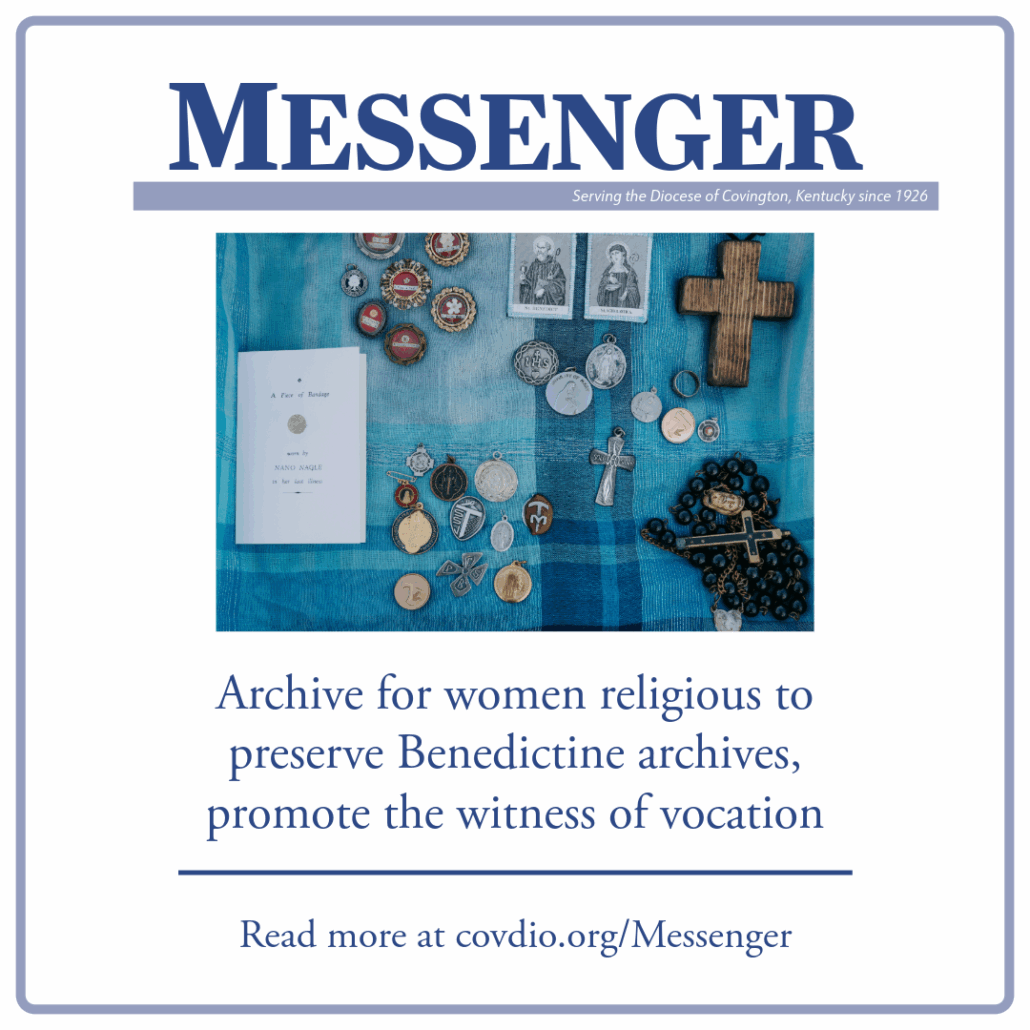
Archive for women religious to preserve Benedictine archives, promote the witness of vocation
Maura Baker
Staff Writer
National conversation sparks among religious congregations: historical collections, stories and legacies hang in the balance as an increasing number of religious communities and congregations are coming to completion, as members age with no new novices to replace the population. As a result, some of these important archives would end up lost, or thrown out, according to Ursuline Sister Susan Durkin, asking the questions: “How do we preserve them properly? How do we make them available in a responsible way for research?”
These questions are sought to be answered by the Women Religious Archive Collective (WRAC) — which, spearheaded by the work of Sister Susan, broke ground on the campus of St. Vincent Charity Medical Center, Cleveland, in July of this year.
The $24 million project will support the archives of 44 congregations across the United States and Canada, with capacity to host up to 75 — among these congregations is the Diocese of Covington’s own Benedictine Sisters of St. Walburg Monastery.
The Benedictines came to the Diocese of Covington in 1859 with three German sisters dedicated to teaching the German children of St. Joseph Parish. For more than 160 years, the Benedictine Sisters have been ingrained in the culture of the Northern Kentucky area, with their missions contributing to education, and care for the sick, poor and elderly. They founded Villa Madonna College (which has become Thomas More University), Villa Madonna Academy and Madonna Manor. These contributions and their histories are just part of the important stories that will be held in the collaborative archives.
The property for the project was purchased from Cleveland’s Sisters of Charity, who have served the city of Cleveland since 1865. “We wanted to be in a space where sisters have historically served,” explained Sister Susan, who additionally said that the WRAC also wanted the building to be “close to a freeway and accessible from an airport. We wanted to be within a nexus of institutions.”
This concept is realized due to the location being within a 20-mile radius of seven colleges and institutions, which ties into the space’s secondary mission to be an “investment to the community.”
“It’s really about preserving the history of the Catholic sisters and making it accessible in a variety of ways,” said Sister Susan. “It’s about inspiring people to know that the issues and problems that they may meet in their time are something that Catholic sisters have repeatedly overcome time and time again … Our center is going to be able to inspire and give real time example to the Gospel call of passion.”
Besides housing archives and records for the various congregations the archive is partnering with, the space will also include permanent and temporary exhibits and meeting spaces — with hopes to house students and researchers alike. “There’s going to be all kinds of possibilities for us once the building opens,” Sister Susan said.
The archives are currently projected to be opened in the fall of 2027, and the successful campaign has so far raised over $20 million of the $24 million goal.
The most important aspect of the project is the “witness value that a center like this will bring,” said Sister Susan, “with having this many collections in the various charisms, this really is a promotion of the witness to mission and faith-driven service — the importance of a vocation.”

