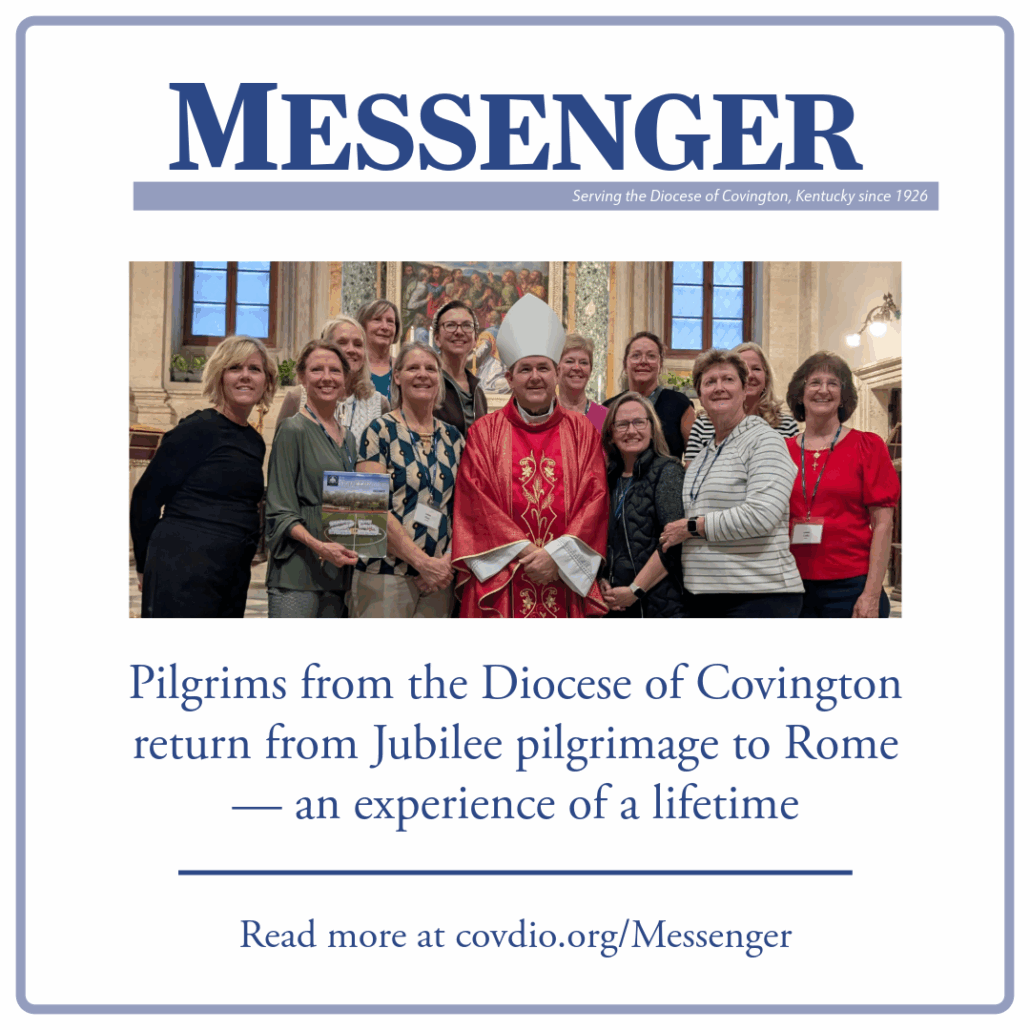
Pilgrims from the Diocese of Covington return from Jubilee pilgrimage to Rome — an experience of a lifetime
To celebrate the Jubilee Year of Hope, Bishop John Iffert and 70 pilgrims from the Diocese of Covington, made a pilgrimage to Rome, Oct. 22–Nov. 1, to visit historical spiritual sites, pass through the Jubilee Holy Door and to attend the Angelus and General Audience in St. Peter’s Square to listen to Pope Leo XIV. Upon their return, the Messenger caught up with Bishop Iffert and pilgrims, Father Joseph Gallenstein, Michael and Christina Weller and Marybeth Bosko to hear about the experience.
Bishop Iffert enjoys witnessing the joy and connection among pilgrims
Laura Keener
Editor
Bishop Iffert uses a saying to differentiate pilgrims from tourists. “Tourists expect, pilgrims accept.” True to this point, the Rome pilgrimage was not without moments to accept, like the missed visit to the Basilica of St. Anthony of Padua in Venice due to heavy rains and traffic.
“That’s a disappointment. But the folks did a good job of saying, ‘Well, I hate that we missed that, but it was the right decision,’” said Bishop Iffert.
But there were even more moments of acceptance that were welcome surprises, moments of meaningful spiritual experiences and joy. A standout for Bishop Iffert was a visit to the Tre Fontane Abbey, Rome. It is the site where St. Paul was beheaded. It is also a site where a mass grave believed to be of 10,000 Christian martyrs, persecuted in the Third Century under the Roman emperor Diocletian.
“They talk about two groups of people persecuted under Emperor Diocletian. One would be Christian workers who were forced to work on the construction of the Diocletian baths. And the other would be soldiers, where Diocletian was trying to rid the Roman legions of Christians,” said Bishop Iffert. “That was a very spiritual place, a very moving experience. I had never heard of that place and so it just snuck up on me how powerful that was.”
Celebrating Mass at the major basilicas — St. John Lateran, which is the Cathedral of the Diocese of Rome; the Basilica of St. Paul Outside the Walls and in a special way, the Basilica of St. Mary Major.
The Basilica of St. Mary Major is home to an icon of Blessed Mother known to be a favorite of Pope Francis. It is known as “Protectress of the Roman People,” and is one of the oldest in existence, being attributed to St. Luke. Also inside the Basilica is a bas-relief depicting the story of Our Lady of the Snows, a rare summer snowfall which, according to legend, fell on Aug. 5, 352, on the Esquiline Hill, one of the famed “Seven Hills” of Rome. On the anniversary each year, the Basilica reenacts the “miracle of the snows.” In Bishop Iffert’s home diocese of Belleville, there is a shrine to Our Lady of the Snows.
“To have Mass there with the pilgrims in that place, those liturgies, were highlights for me,” he said.
Bishop Iffert said he delighted in watching his fellow pilgrims in St. Peter’s Square as Pope Leo XIV passed by just feet away. And he was moved by the connectedness the pilgrims created in just a few days.
“I heard so many people on Saturday night as we were saying goodbye, and on Thursday as the group kind of divided into two, who really talked about how sad they were to leave their new friends,” said Bishop Iffert. “People talked about not only to encounter these holy sites and holy places, but to do that with a group of fellow believers and like-minded folks. It just really meant a lot to people. I think I was surprised by that a little bit.
“I am so blessed to be able to live my life in the heart of the Church, and to see that every day — to have those supports and encouragements every day. But for the pilgrims who joined the trip, there was a great testimony to that, to be able to travel and to see these sites and to make new friends. Some of them said that they felt like people they’ve only been traveling with for a couple of weeks, that it felt like they had been friends forever. And that’s a wonderful thing.”
Pastor reflects on unity, youth, upon returning to diocese from Rome
Maura Baker
Staff Writer
Accompanying Bishop John Iffert and pilgrims to Rome, Father Joseph Gallenstein, pastor of St. Mary of the Assumption Parish, Alexandria, reflected on the pilgrimage as a “wonderful trip” with “wonderful people.”
Fond memories such as concelebrating Mass with Bishop Iffert in various places, especially the papal basilicas, were just some of the experiences that Father Gallenstein highlighted about his experience across the ocean.
“I really enjoyed going to Assisi,” Father Gallenstein noted, “… what I did not realize until I was there was that Carlo Acutis is entombed in one of the churches there. That was a very moving experience.”
Being a pastor of a parish with a fairly large grade school, visiting the entombed saint stood out to Father Gallenstein. “My thoughts immediately went to young teens … As I was going through and passing his tomb, I was thinking and praying especially for our young folks who are fast approaching the Sacrament of Confirmation.”
Another stand out memory was at the Basilica of St. Sebastian over the Catacombs, where, while concelebrating Mass, other pilgrims and tourists joined in on Communion.
“It was evident that other people, moved by the fact that we were having Mass, wanted to receive the Eucharist,” said Father Gallenstein, recalling how other travelers joined the line for Communion line and were coming up to the alter to share it with them.
“So many other people wanted to receive the Eucharist,” Father Gallenstein said. “That was strangely moving to me. We were there as our own pilgrims, but yet there were millions of pilgrims coming on any given day. And those few had been moved by the Spirit and joined us in that Mass, at the table of the Lord. It really speaks to how big and diverse our Church really is.”
Pastor reflects on unity, youth, upon returning to diocese from Rome
Bella Bailey
Multimedia Correspondent
After a whirlwind 10 days in Rome on a pilgrimage during the Jubilee Year: Pilgrims of Hope, the 70 Diocesan pilgrims have all made safe arrival back to the Diocese. While on their spiritual journey the pilgrims enjoyed the sights of early Catholicism, including the catacombs and centuries-old basilicas, while also enjoying the newer sights like St. Carlos Acutis’ resting place.
It was these tangible aspects of the Church and those early Christians that made the trip so impactful for pilgrims Michael and Christina Weller and Marybeth Bosko.
“Just connecting with the faith of Christians that came before us a millennia ago, seeing the Holy Doors and knowing that they were built around the fourth century and connecting with the faith of the people before us,” is what made the trip impactful said Mr. Weller, parishioner of St. Augustine Parish, Covington.
“You had a feeling of history in the sense of the permanence of these basilicas,” said pilgrim Marybeth Bosko, parishioner at St. Barbara Parish, Erlanger. “As you’re walking through the Holy Doors you get this feeling like ‘how many people and how many saints actually walked through these doors that I’m walking through right now.’”
For Mr. Weller it was the Abbey of the Three Fountains, or Abbazia dele Tre Fontane, where St. Paul was martyred, that stood out above the rest.
“Just the fact that St. Paul was there, and you could see his jail cell and where he was executed, and the road, the place was very powerful,” he said. “We all have our own St. Paul moment where we know we have to shape up a bit, I feel like that’s pretty tangible.”
For Ms. Weller, also a parishioner of St. Augustine Parish, Covington, it was a similar connection to Catholics before that made an impact, however the saint she felt connected to was not so far removed.
“We went and we saw St. Carlos,” she said, “I really liked that because I feel like seeing a saint who’s so close to our age, this guy worked on computers, it’s something so tangible to our generation.”
“I can definitely see why so many saints came from that region where Assisi is because it’s very peaceful,” said Ms. Weller, remembering her newfound fondness of the Assisi region.
For Ms. Bosko the Santa Scala, or Holy Stairs, was the most impactful. The stairs were brought over from Jerusalem by St. Helena and were originally in front of Pontius Pilate’s house. They have since been encased in wood and in order to further protect them pilgrims must “walk” up the stairs on their knees.
However, this was not a deterrent, “as you head up the stairs and the pain becomes more and more real, you’re focused only on Christ and his pain. When you complete it, you’re standing in front of this painting of Jesus on the cross, you get a sense of that you did something for him as he died for us,” said Ms. Bosko.
These experiences cultivated in the Diocesan pilgrims not just a newfound appreciation for Rome and early Christians, but a renewal of heart.
“It was not just a trip to Italy,” said Ms. Bosko. “It was a spiritual journey.”

