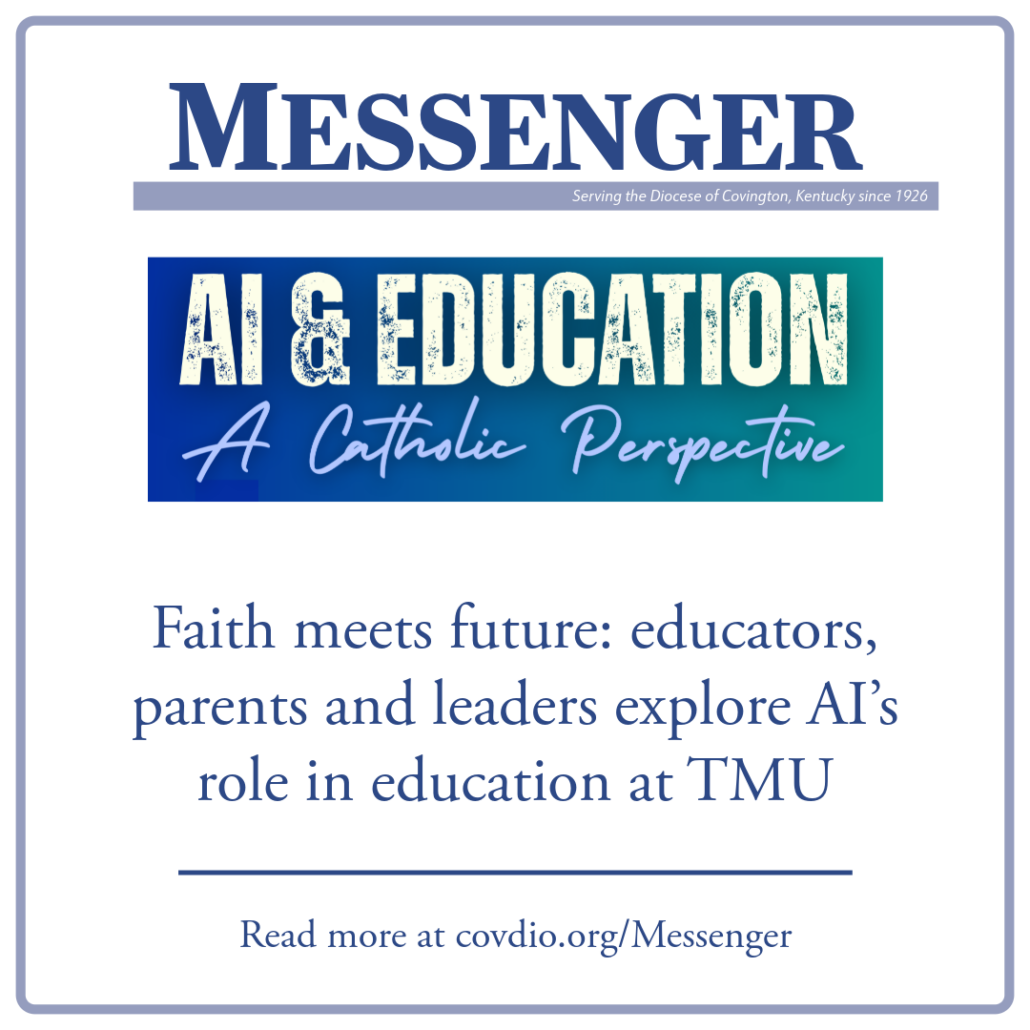
Faith meets future: educators, parents and leaders explore AI’s role in education at TMU
Laura Keener
Editor
As the global society comes to understand and manage the use of Artificial Intelligence, the Catholic Church, first under Pope Francis and now Pope Leo XIV, encourages bishops, priests, religious and lay faithful, especially educators and parents, to “dedicate themselves to this critical subject with care and attention.” (Dicastery for the Doctrine of the Faith, Antiqua et nova, §5)
As a regional education leader, Thomas More University is hosting an AI summit, entitled “AI & Education: A Catholic Perspective,” Jan. 24. The day will begin 9 a.m. with Mass with Bishop John Iffert at Mary, Seat of Wisdom Chapel on the TMU campus. The presentation will follow in the neighboring Zeigler Auditorium. Everyone is welcome to attend, especially educators and parents — Catholic and non-Catholic.
With all its promise and potential, AI carries with it the specter of misuse and abuse. “…there is broad consensus that AI marks a new and significant phase in humanity’s engagement with technology, placing it at the heart of what Pope Francis has described as an ‘epochal change.’ Its impact is felt globally and in a wide range of areas, including interpersonal relationships, education, work, art, healthcare, law, warfare, and international relations.” (Antiqua et nova, §4)
Of most concern to the Church is “ensuring that its applications are used to promote human progress and the common good.” (Antiqua et nova, §4)
Keynote speaker for the TMU’s AI summit is Matthew Harvey Sanders. Mr. Sanders is CEO of Longbeard, a company founded in 2015 to build AI in service to the Catholic Church. Among its products is the popular Magisterium AI. Unlike ChatGPT, which is an open-source AI platform, Magisterium AI is a closed system sourcing from its own and trusted Catholic organizations in order to provide users accurate information. The Holy See is among its clients.
Dr. John Rudnick, professor at TMU, will also give a presentation on his participation at the 2025 Builders AI Forum in Rome last November. The Forum discussed ways AI can help the Church’s mission of evangelization.
In a letter to participants of the Builders AI Forum, Pope Leo XIV wrote, “Whether designing algorithms for Catholic education, tools for compassionate health care, or creative platforms that tell the Christian story with truth and beauty, each participant contributes to a shared mission: to place technology at the service of evangelization and the integral development of every person.”
Following the presentations, a panel of local educators, a Catholic communicator, and a psychologist will field questions and lead discussion.
“Artificial Intelligence is an enduring reality that will continue to shape our world,” said Dr. Rudnick. “As members of the Catholic Church, we share a profound responsibility to establish ethical frameworks that guide its development and application. This summit is intended to initiate a thoughtful dialogue — one that ensures technology serves the mission of the Church and the common good.”