
Fifth Sunday in Ordinary Time
Father Michael Elmlinger
Guest
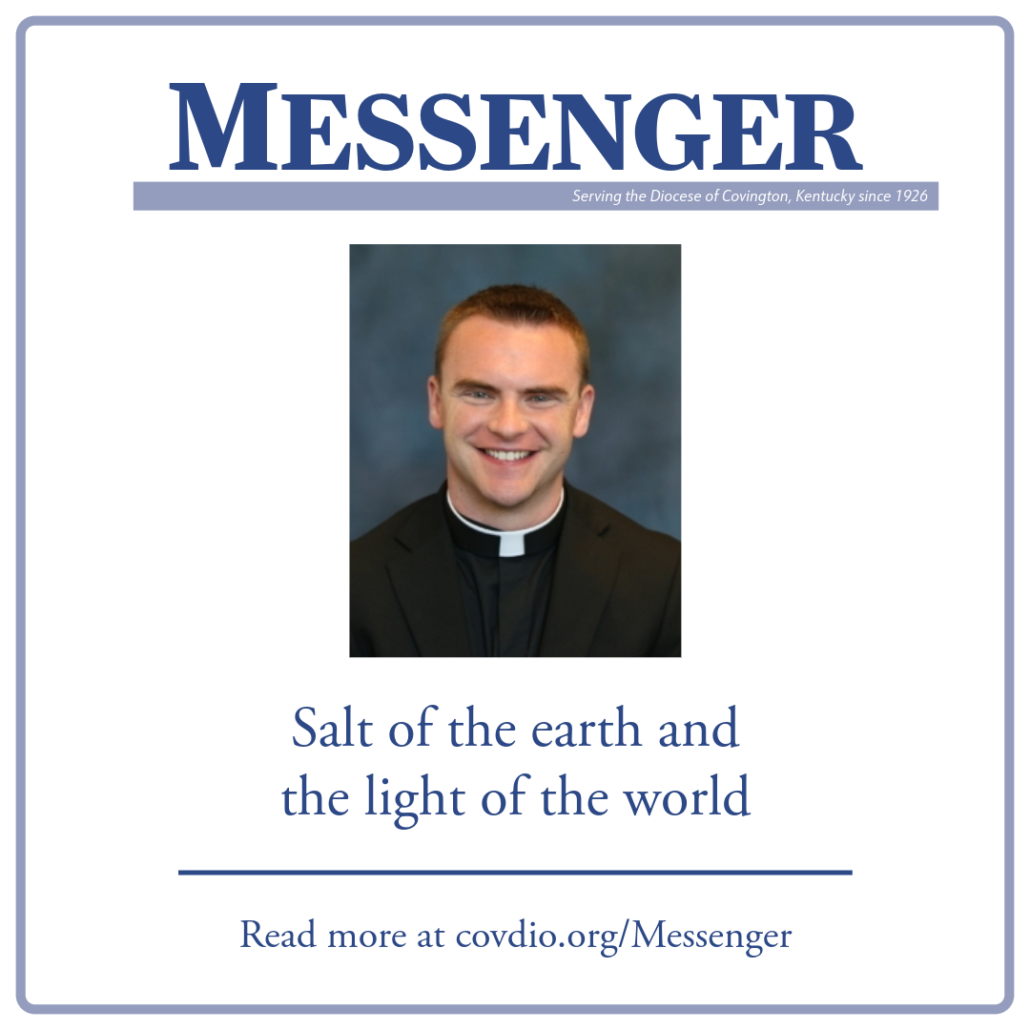
Last Sunday, we entered into Jesus’s famous Sermon on the Mount (Matthew 5-7), and we did so by hearing the equally (if not more so) famous Beatitudes. What the Beatitudes ultimately serve for the remainder of Jesus’s sermon is a sort of framework or foundation upon which and around which he delivers the rest of his teaching. We see this especially in our Gospel for this weekend, where Jesus tells his disciples that they are “the salt of the earth” (5:13) and “the light of the world” (5:14).
To really understand what Jesus is telling his disciples by calling them the “salt of the earth,” we need to think about what salt is used for. Salt on its own is not really useful. In fact, some people can even find salt on its own to be overpowering. Instead, salt is added to food to give it more flavor, as well as to help preserve the food by helping to draw out the moisture so as to prevent the growth of bacteria, thus extending the lifespan of food.
With this in mind, we can begin to see what Jesus is getting at by calling his disciples the “salt of the earth.” What the disciples are meant to preserve in the world is not food, but goodness. How do they do this? By living according to the Beatitudes that Jesus just delivered, all of which show a different aspect of the life of Christ, who himself was and is poor in spirit, meek, righteous, merciful, clean of heart, a peacemaker, mourns and was persecuted for the sake of righteousness.
By living in the same way that Christ lived on earth, the disciples of Christ are also preserving goodness in the world by drying up evil in the world just as salt dries up the moisture in food. In a world where there is constant war, violence, oppression, and many other evils, the disciples of Christ are to be the very ones through whom goodness continues to live by living according to the way Christ, who is goodness itself, lives.
That then leads us to Jesus telling his disciples that they are “the light of the world.” One of the vocations of Israel through the Old Covenant established through Abraham and Moses was that Israel was to be “a light to the world” (cf. Isaiah 60:1-3). The way they are to be so is by the very instruction that we see in our first reading from Isaiah: “share your bread with the hungry, shelter the oppressed and the homeless; clothe the naked when you see them, and do not turn your back on your own. Then your light shall break forth like the dawn…” (58:7- 8). As we just discussed previously about the salt of the earth, there is much evil in the world, and this shows that the Kingdom of Darkness still reigns in the world. Christian disciples, however, are to be the light that shines in the darkness, showing to the world the love that God has for us by loving one another as he has loved us (cf. John 13:34).
To conclude this reflection, I would like to share a quote from a homily by St. John Chrysostom that I came across during my research for this passage which I believe sums up what it means for Christians to be the salt of the earth and the light of the world beautifully: “Assuredly there would be no heathen, if we Christians took care to be what we ought to be; if we obeyed God’s precepts, if we bore injuries without retaliation, if when cursed we blessed, if we rendered good for evil. For no man is so savage a wild beast that he would not run forthwith to the worship of the true religion, if he saw all Christians acting as I have said.”
Father Michael Elmlinger is a priest of the Diocese of Covington, Ky. Father Elmlinger is currently studying Canon Law at the University of St. Paul, Ottawa, Canada.

