
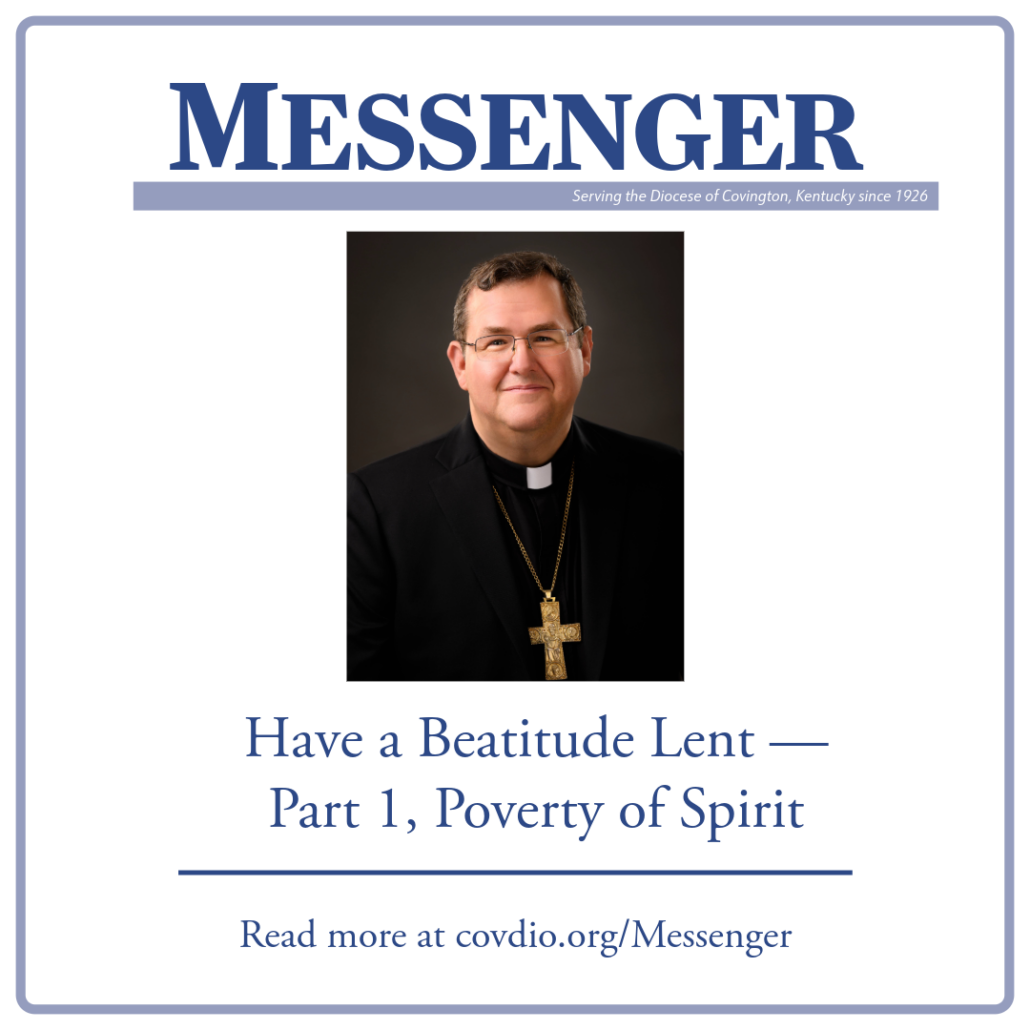
Have a Beatitude Lent — Part 1, Poverty of Spirit
Most Rev. Bishop John Iffert
Bishop of Covington
My homilies and pastoral reflections are almost always a product of what I have seen and heard in the days and weeks prior. It is true again as I sit to think with you about how to enter the season of Lent in 2026.
This past Sunday I joined with others to pray for peace during a Holy Hour at the Cathedral Basilica of the Assumption. I was amazed at the number of people who came out to pray late in the afternoon on Super Bowl Sunday with little notice or planning. I was taken by the profuse expression of appreciation I received for providing this opportunity to pray for peace in our hearts and minds, in our families, our Church, our communities, our nation and world. Many people seemed eager for an opportunity to bring their concerns to the Lord and to be led in turning our minds and hearts toward the mind and heart of Christ — who always greets his disciples with assurances of peace.
Just a week before that Holy Hour for Peace, the Church gave us the Beatitudes as the Gospel for the Fourth Sunday of Ordinary Time.
It is with these experiences in mind that I invite myself, and you, to consider shaping our Lenten practice this year by asking how we might contribute to the peace that Christ wishes for his Church and his world. I propose to focus on the first three of the beatitudes as an entry-point for this Lent: poverty of spirit, mourning and meekness of heart. Today I will write about poverty of spirit. Next week’s Messenger will include my reflection about mourning and meekness.
Poverty of Spirt is another way to speak of freely chosen humility. Humility is that virtue that clearly recognizes that every good has its origins in God and gives due deference to the debt of gratitude and worship owed to God for his graciousness. It works against the corrupting influence of pride, self-aggrandization and entitlement that can eat away at the individual, the community or the nation that indulges in self-promotion. In the end, it works against the kinds of idolatrous attachments to honor, greed, power and pleasure that lead to a “We-They” oppositional and acquisitional view of the world. It works against the kinds of attachments that can be taken as causes for (I might say excuses for) self-assertion, manipulation, violence and war.
We might focus on humility this Lent by adding the Litany of Humility to our daily prayer. Perhaps we could fast from something we take particular pride or delight in. It might be a type of food or drink that is luxurious, but it might also be a piece or type of clothing for which we get particular compliments, our impressive pen than draws attention in business meetings, or anything that speaks to us of high status or our own accomplishment.
We might take up a daily practice of gratitude, identifying each day an additional reason to be grateful for a gift that is important to us and our success, that ultimately came to us as gift — like a supportive family, educational opportunity or being born into a society that respects the rule of law. As an expression of gratitude and devotion, we might make a sacrificial gift of talent or treasure to assist those who have not so benefited.
It has been said that the virtue of humility is first in Jesus’ list of Beatitudes because it is the virtue that is necessary for the development of all other human virtue. It works for the establishment of the Kingdom of Peace by fostering a healthier sense of self that is not in competition with others for honor, respect or any other good. It is the foundation for the edifice of temperance, prudence, fortitude and justice.
Next week I will write about the virtues of mourning with those who grieve loss and embracing meekness. Whatever Lenten observance we choose, may it lead us to become instruments of the peace Christ wills for his people and his Church. May the Holy Spirit guide you and pour out blessings upon you in this sacred time.

