
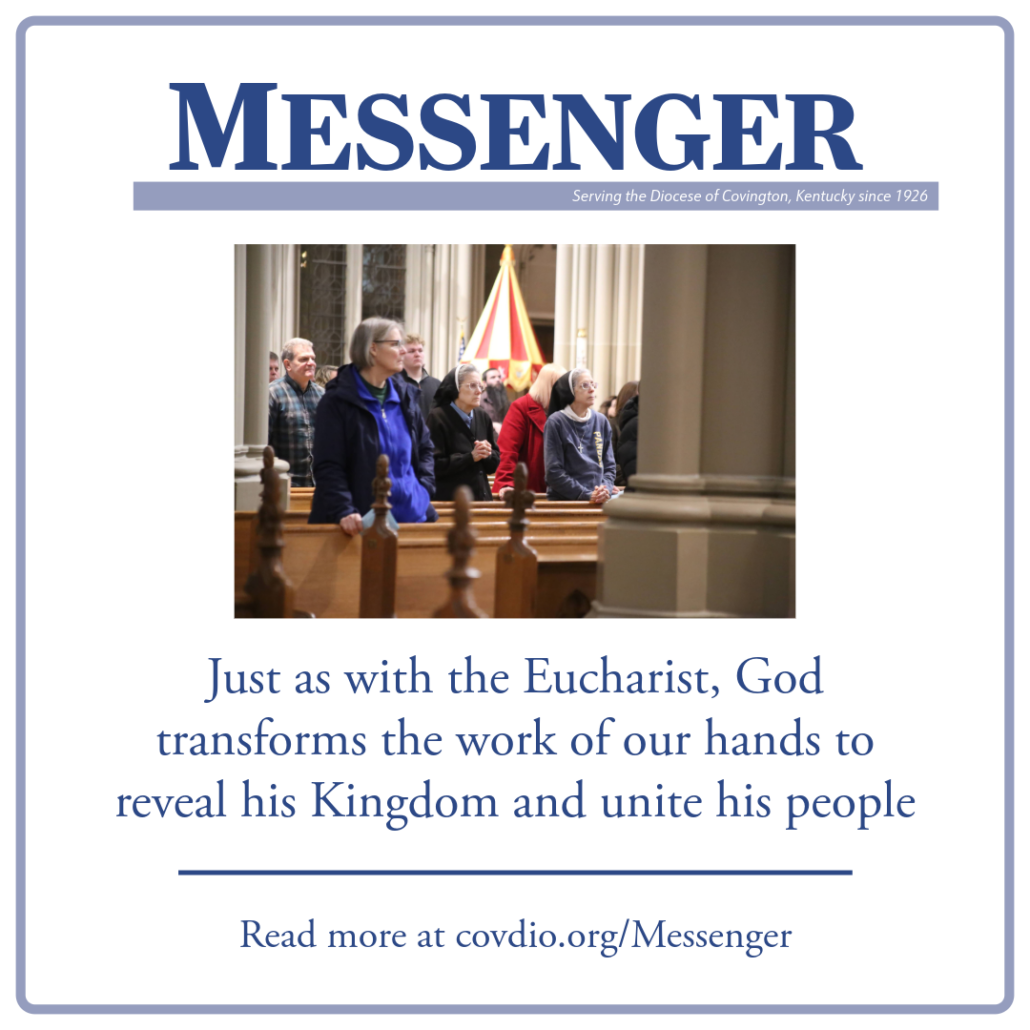
Just as with the Eucharistic, God transforms the work of our hands to reveal his Kingdom and unite his people
Laura Keener
Editor
During a Holy Hour for Peace, Feb. 8, at the Cathedral Basilica of the Assumption, Covington, Bishop John Iffert offered a reflection on what true peace means for Christians and for the world today. He began by reminding those gathered that peace is God’s desire for every person. When Jesus appeared to his disciples after the resurrection, his first words were, “Peace be with you.”
Bishop Iffert said that the peace Christ offers is different from the peace the world promises. The world often views peace as the result of power or domination, he said, but such peace is “no peace at all.” Instead, true peace comes from becoming part of the Body of Christ and learning to set ourselves aside so that Christ may grow within us.
The Holy Hour was a part of a national prayer effort in response to increased violence within the United States and in the world. Archbishop Paul Coakley, president of the United States Conference of Catholic Bishops, Jan. 28, invited all bishops and priests in the United States to offer a Holy Hour for peace, “for reconciliation where there is division, for justice where there are violations of fundamental rights and for consolation for all who feel overwhelmed by fear or loss.”
At the Holy Hour in Covington, Bishop Iffert encouraged the congregation to pray not only for peace but also for the return of Christ, who will gather all people into His kingdom.
“The only way we can have peace is by sharing the body of Christ, being drawn into his body and by the gift of his Spirit, to take the Father’s Will as our will in Christ; to put ourselves aside, to decrease so that he can increase; to become small, so that he can become all. This is the only way, we pray, that peace will move in our world. It’s the same thing as saying we pray for Jesus to return,” said Bishop Iffert. “We pray for Jesus to come gain. To draw us to himself and to gather us into his kingdom”
Until then, he said, Christians must work to live as brothers and sisters and make their communities signs of God’s kingdom on earth.
“We pray in the meantime that our efforts to be peaceful with one another, to live as real brothers and sisters to one another and to our neighbors, that these efforts will be a real sign of the Kingdom of God that can lead to the development of people; the gift of a real human, joyful, life shared together,” he said.
As part of the Holy Hour, Bishop Iffert read from “Sollicitudo Rei Socialis,” an encyclical written by Pope St. John Paul II in 1987. The document reflects on the development of people and the barriers that keep many in poverty and hardship despite global efforts to improve economic conditions. It also explains that peace and human development are deeply connected with the Church’s mission and with the common good.
The encyclical teaches that even though no earthly achievement can be confused with the Kingdom of God, Christians must still care about people’s real needs in society. Knowing that the poor will always be among us is not an excuse to ignore suffering or injustice.
“Even though we know that economic growth, that political freedoms, are not themselves the goal of the Christian life or the Kingdom of God, there is no excuse that can be found in the Christian gospel for ignoring the needs of others, what they need to grow and develop and be educated and share these blessings with their children. There’s no excuse in the Gospel for ignoring that,” said Bishop Iffert.
Instead, every effort to improve human life — however small or imperfect — can be used by God for good. “However imperfect and temporary, all the things that can and ought to be done through the combined efforts of everyone and through Divine Grace at any given moment in history in order to make people’s lives more human,” he said. “Nothing will be lost.”
Bishop Iffert emphasized that the Eucharist shows most clearly how God uses human work for his purposes. In the Mass, the simple gifts of bread and wine, “the work of human hands,” are transformed into the Body and Blood of Christ through the Holy Spirit. In this way, God uses ordinary things to reveal his kingdom and unite his people with himself and with one another.
This same pattern, the bishop said, applies to efforts for peace.
Just as God transforms bread and wine, he can transform our actions — our advocacy, our service and our care for the poor — into something greater than we could achieve alone, he said. Because of this, Christians should never give up working for human dignity, fighting injustice or resisting violence, even when progress seems slow or discouraging.
“We are not to be discouraged when the forces of the world work against human dignity,” said Bishop Iffert. “We are to see and we are to continue to work for the building up of that dignity precisely because we know that God will take the work of our hands, he will bless them. He will break them. He will offer praise over them. He will unite those efforts to the power of his Spirit and our shared life together in God will be plenty for all the world.”
Bishop Iffert concluded by reminding those gathered that every act of love and every effort for peace will bear fruit when united with Christ. “We never give up praying for peace,” he said, because God will use the work of our hands to bless the world.

