
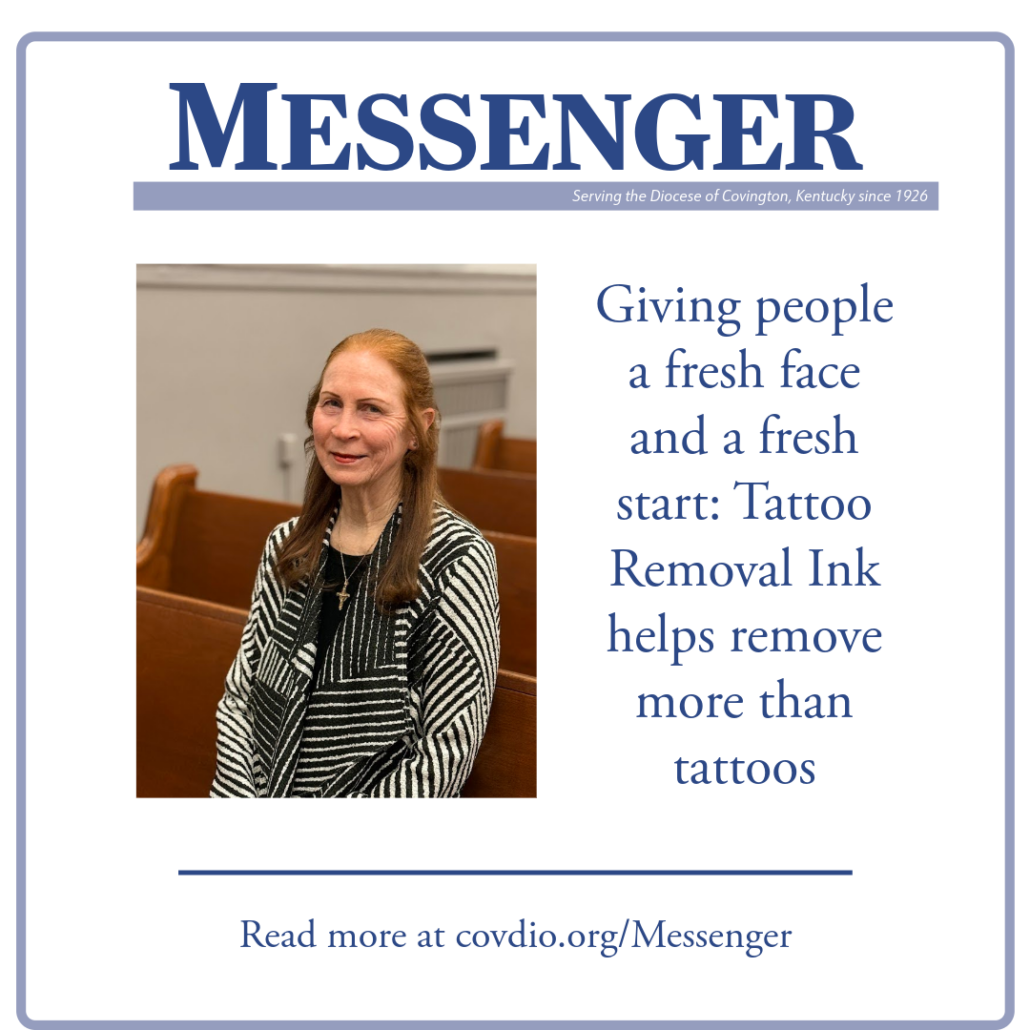
Giving people a fresh face and a fresh start: Tattoo Removal Ink helps remove more than tattoos
Laura Keener
Editor
When Jo Martin, a parishioner at St. Henry Parish, Elsmere, retired after a 30‑year professional career, she never imagined she would spend her retirement helping people remove tattoos. She certainly did not picture herself working inside a jail. But today, she runs a nonprofit tattoo‑removal program, Tattoo Removal Ink, that is changing lives across Northern Kentucky.
Her story shows how one small “yes” can grow into something much bigger.
After retiring, a friend from church asked Mrs. Martin if she would tutor people studying for the GED at the Campbell County jail. Her first reaction was, “no.” She admitted, “I did not want to tutor in the jail. I was afraid of going in there.”
But her friend gently pushed her to fill out the paperwork, and a week later the jail called. Soon, Mrs. Martin found herself walking down long concrete halls, knees shaking. But what she discovered surprised her: “They weren’t scary. They were just people — just like me,” said Mrs. Martin
As she tutored, Mrs. Martin noticed something else: many young people had tattoos across their faces, hands and necks. She wondered, How will they ever get a job when they leave here? That question planted the first seed of an idea.
A friend told Mrs. Martin about Homeboy Industries, an organization in Los Angeles that helps people leaving gangs and prison. Begun in 1988 by Father Gregory Boyle as a way of improving the lives of former gang members Homeboy Industries has evolved into the largest gang intervention, rehab and re-entry program in the world. Tattoo removal is a part of Homeboy Industries services.
Mrs. Martin traveled to the University of Findlay, Ohio, to hear Father Boyle talk about his work. He invited her to come to California to learn more. Father Boyle encouraged her to start something similar back home.
“I said, ‘How?’ And he said, ‘Figure it out.’” Mrs. Martin remembered. “So that’s what I did.”
She spent months reading government forms, writing a nonprofit application, and gathering a board of directors. Finally, she received her official nonprofit status. “I wasn’t the brightest,” she joked, “but every single step worked.”
Next, she needed a laser. Using money from her late husband’s life insurance, she bought one for $55,000. “Eight years later, the business paid me back,” she said. “But I wasn’t even thinking about that at the time.”
Located inside the Life Learning Center in Covington, Tattoo Removal Ink — now nine years old — removes visible tattoos for people who are trying to rebuild their lives. Many clients come straight from jail or prison. Others are survivors of human trafficking.
“They are branded,” Mrs. Martin said. Recalling the case of young woman who came in to have the name of her trafficker removed, she was told that five other woman have identical tattoos placed near their breast. “That’s exactly what they do is they brand them.”
Other clients “are simply adults who regret choices they made when they were younger,” she said.
For many clients, tattoo removal is a lifeline. Tattoos like gang symbols, hateful words, or names of abusive partners can keep people from getting jobs or feeling safe.
One young man had “KILLA” tattooed across his eyebrow when he came in. Another had devil horns on his forehead. Several had full-face tattoos. “They’re not going to get hired with that,” Mrs. Martin explained. “People judge them immediately.”
Tattoo removal doesn’t just open doors — it restores self-respect. Mrs. Martin told the story of a mother who cried during a video call with her son in jail when she saw that one of his tattoos had been removed. “It was so sweet,” Mrs. Martin said. “He was too young and too innocent to be in jail.”
Another client wrote Mrs. Martin a letter explaining that he had to relive his trauma every morning when he looked in the mirror. Removing those tattoos helped lift that emotional burden.
Tattoo removal is not easy. Mrs. Martin explains it simply: the laser breaks up the ink, the white blood cells carry it to the liver, and the body gets rid of it. But it hurts.
“It’s a different kind of pain,” than getting a tattoo, she said.
Still, many keep going because they want a better future.
Not everyone gets their tattoos removed for free. Paying clients help fund the nonprofit’s work. Even for paying clients Tattoo Removal Ink is a low-cost option. Prices start at $70 for a small tattoo and go up to $300 for larger ones. “Our bottom line is helping people,” Mrs. Martin said. “Not making money.”
Still, the nonprofit has real expenses: laser maintenance, insurance and supplies. Mrs. Martin and her fellow co-worker Gail work entirely for free. “We’ve been doing this for nine years for fun and for free,” she said.
Although Mrs. Martin is 74, she isn’t slowing down. In fact, she has a new dream: a mobile tattoo‑removal unit that could park outside prisons.
“It’s a great idea,” Mary Stutler, board member, said with a smile. “But we’ll need volunteers and another laser.”
She hopes new volunteers — especially retired nurses or doctors — might step up to learn the laser work. But she emphasizes that anyone with compassion could help.
“They might look scary,” Mrs. Martin said of the clients, “but they’re just people.”
Mrs. Martin never expected to spend her retirement this way. But looking back, she sees something bigger guiding her.
Like many Catholics, the 25th chapter of Matthew’s Gospel has informed her faith. Jesus said, “For I was hungry and you gave me food, I was thirsty and you gave me drink, a stranger and you welcomed me, naked and you clothed me, ill and you cared for me, in prison and you visited me.” (Matt 25:35–36) Throughout her life, most of these works of mercy came easy for Mrs. Martin. The verse about visiting those in prison. “I could never check that one,” she said. “But now I can.”
Her work is more than removing ink — it is restoring dignity and opening doors. It is giving people a chance to build lives they can be proud of.
Mrs. Martin says, “Every step worked. And now I’m here, doing something I never imagined — but something that really matters.”

