
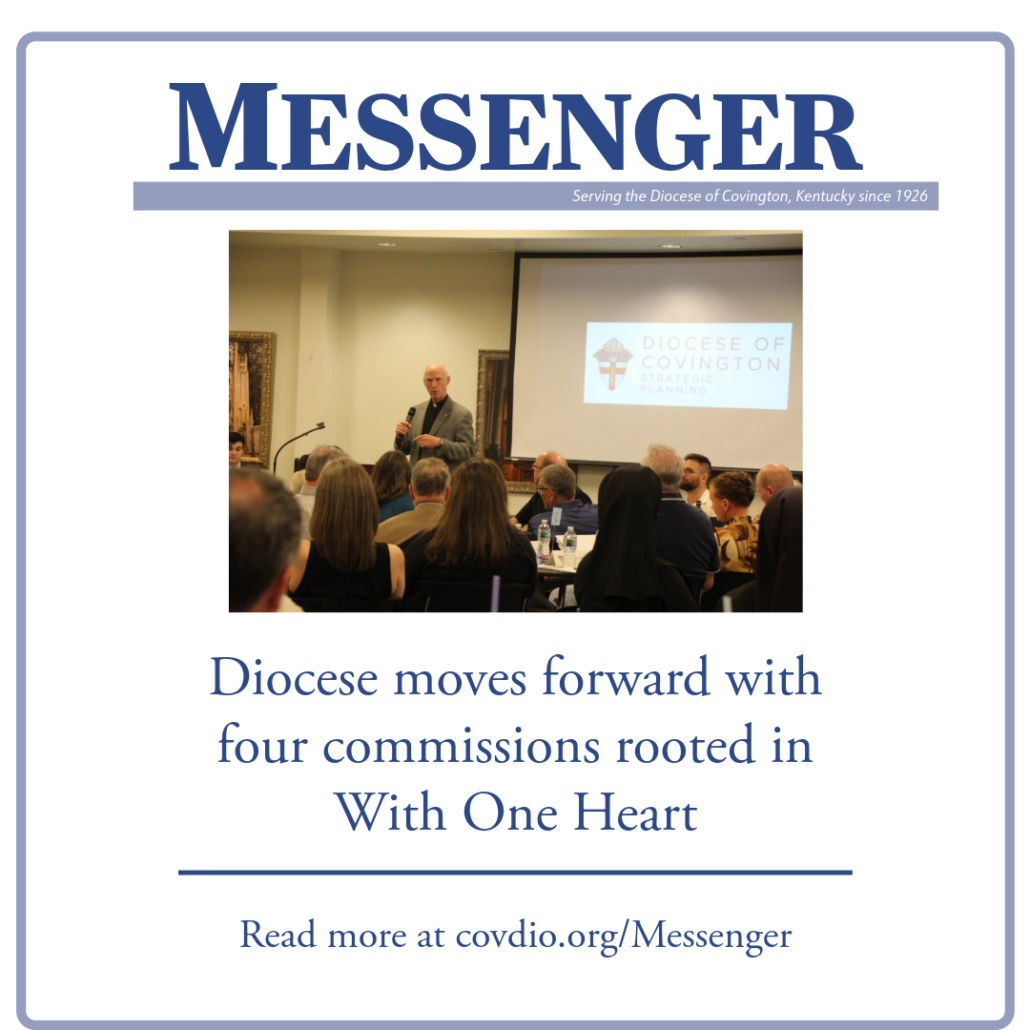
Diocese moves forward with four commissions rooted in With One Heart
Laura Keener, Editor
As the Diocese of Covington ends its contractual business relationship with the Catholic Leadership Institute, the diocesan priorities identified in the With One Heart pastoral plan continue. This time, guided by consultants of L’Etoile Development Services, and through the establishment of four planning commissions.
Four years ago, as Bishop Iffert celebrated his one-year anniversary as shepherd of the Diocese of Covington, he announced the With One Heart pastoral planning initiative. The process was led by the Catholic Leadership Institute and funded by generous anonymous benefactors.
The multi-year WOH planning process began with a Disciple Maker Index survey, where every parishioner in the Diocese was asked to complete a 72-question survey reflecting “on their journey of discipleship and their parish’s effectiveness in supporting that journey.” Additionally, listening sessions were held in parishes throughout the Diocese.
Hosting the listening sessions, gathering and analyzing data into an identifiable and workable pastoral plan became the work of the Pastoral Planning Commission, a group of 11 people including clergy, religious and laity. From the data, the Planning Commission identified three diocesan priorities — Faith Formation, Evangelization and Leadership Development.
Over the course of the last four years, Bishop John Iffert, Deacon Jim Fortner, Jamie Schroeder, chancellor, and CLI consultant, Carla Molina, worked with a group 10 people — the WOH Core Team — who provided feedback and helped keep the implementation of the strategic plan on track.
During Lent 2026, a second DMI survey was conducted. Parishes throughout the diocese will use the data from this second survey to determine how well parish pastoral plans were implemented and what opportunities remain as they develop a new pastoral plan for their parish.
At the Diocesan level, four commissions have been established — Schools Commission, Catholic Charities Commission, Foundation Commission and Diocesan Governance Commission — to work on the development of its new strategic plan.
These commissions and their subcommittees did not emerge in isolation, said Deacon Fortner. Rather, they are the latest expression of the With One Heart pastoral planning process, which identified three perennial priorities for the local Church: faith formation, evangelization and leadership development.
In a recent interview, Deacon Fortner reflected on how the work underway today grows directly from that earlier discernment. What may appear to be a new set of initiatives, he said, is actually “building on what we’ve got in place,” as the Church continues to respond to the foundational priorities first named through With One Heart.
Those priorities provided a framework for recognizing where sustained attention and broader participation are needed. Faith formation remains visible in the continuing work of schools, catechetical efforts and parish formation. Evangelization has shaped outreach through service and ministries that invite people into deeper relationship with the Church. Leadership development has underscored the need to cultivate structures, resources and people capable of carrying ministries forward.
“We come back to the lay faithful and ask, based on these strategies, what’s our priority here now going forward?” Deacon Fortner said.
Deacon Fortner pointed to several examples. The ministries of Catholic Charities, he noted, are not only a work of mercy but also a pathway to evangelization, especially when younger people encounter the Church through service and volunteerism. Schools continue to play a central role in faith formation. Efforts tied to foundations and governance, meanwhile, highlight the importance of leadership development and stewardship for the future.
The current commissions and their subcommittees can therefore be understood as an extension of that pastoral vision. In areas where earlier priorities were only partially realized, these bodies now provide the structure to carry the work further. Rather than abandoning the original plan, the diocesan process is deepening it — bringing more people into discernment, sharpening strategy and translating pastoral priorities into ongoing action.
“This process, with all these people involved, that is a step change difference,” Deacon Fortner said pointing to the 373 planners involved with the commissions. “I think it is going to help really take us to a whole other level; this is breakthrough thinking,” he said.
That continuity also offers an important message for the lay faithful. As new strategies are introduced, the Church is not starting over. Instead, it is returning to the core priorities that have guided the pastoral plan from the beginning and asking how they can be lived more fully now. The commissions are one way of answering that question — creating focused avenues for collaboration, accountability and long-term mission.
“I’m pretty excited about that,” said Deacon Fortner as he realizes how the Holy Spirit has been guiding the pastoral planning, and now the strategic planning, process.
Seen in that light, the commissions are not separate from With One Heart; they are one of its clearest fruits. Their work, and the work of their subcommittees, represents the ongoing effort to realize the pastoral priorities of faith formation, evangelization and leadership development in practical, sustainable ways across the life of the Diocese.

