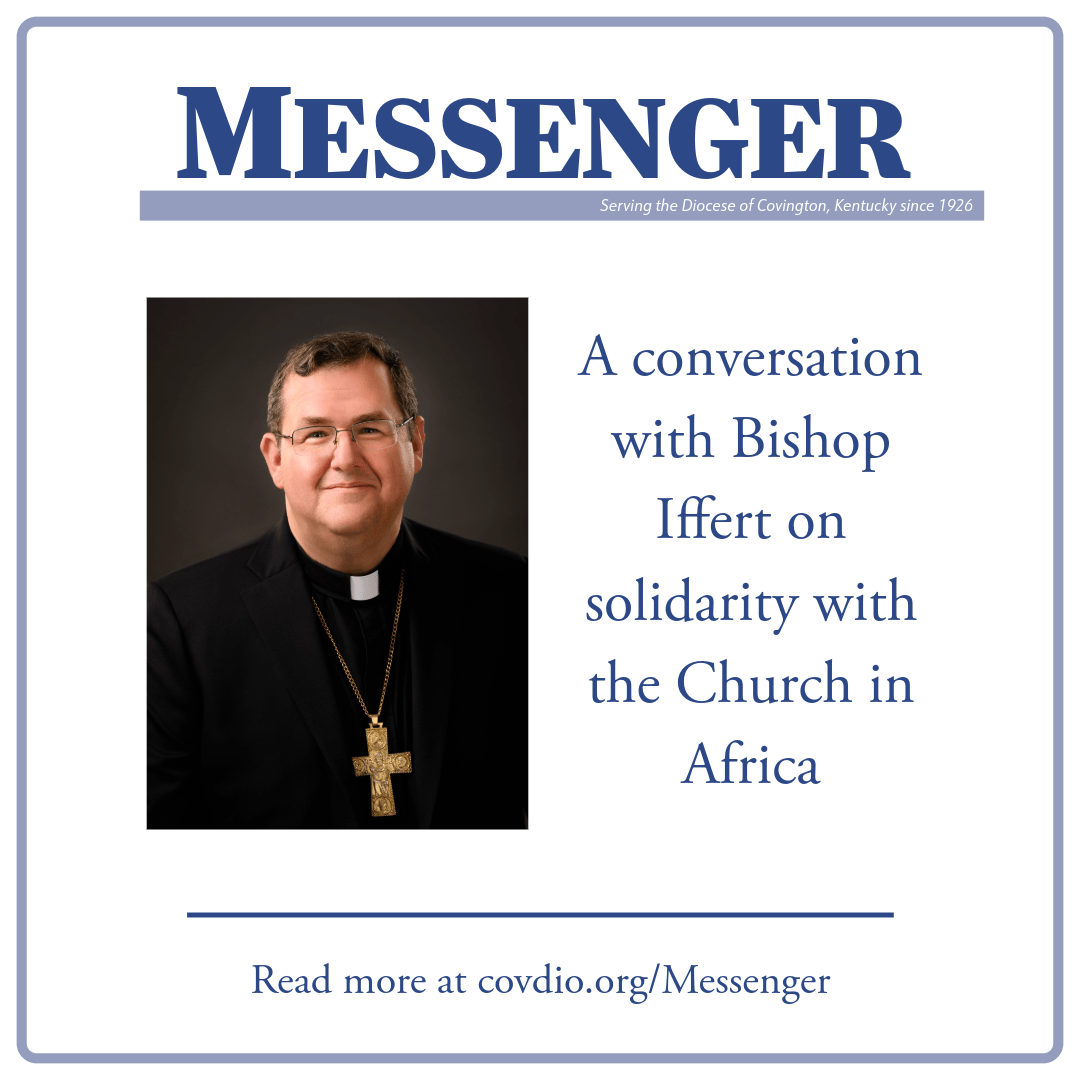
A conversation with Bishop Iffert on solidarity with the Church in Africa
Laura Keener
Editor
When Bishop John Iffert’s weekly schedule appeared unusually short in the July 10 edition of the Messenger, there was a reason: he was preparing to travel to Nairobi, Kenya and Madagascar on behalf of the United States Conference of Catholic Bishops’ Subcommittee on the Church in Africa. Before leaving, he spoke about the trip, the work of the subcommittee, and why solidarity with the Church in Africa matters to Catholics in Covington and beyond.
Q: Where are you headed?
Bishop Iffert: I am getting on an airplane July 16 and traveling first to Nairobi, Kenya, and then to Madagascar. I will be there on behalf of the United States Conference of Catholic Bishops’ Subcommittee on the Church in Africa. In Nairobi, I will attend the AMECEA (the Association of Member Episcopal Conferences in Eastern Africa) bishops’ conference, which includes countries in northeastern Africa such as Kenya, Ethiopia, Eritrea, Sudan, South Sudan and Uganda. Afterward, I will travel to Madagascar for that bishops’ conference as well.
Q: What will the bishops be discussing in Nairobi?
Bishop Iffert: The bishops are beginning a dialogue in which they are accompanying and listening to young people, especially young men. They want to understand the difficulties young people are experiencing, including a lack of opportunity, and how those struggles can contribute to instability and violence. The hope is to find ways for the Church to help young people make a successful transition into adulthood and to advocate for policies that create more opportunities and reduce violence and sectarianism.
Q: How long have you served on the subcommittee?
Bishop Iffert: This is my second year. I became involved after talking with Archbishop (Thomas) Zinkula, who chairs the committee, about my plans to travel to Ghana to visit the families of priests serving here. He invited me to serve. The work has been some of the most positive and reaffirming committee work I have done.
Q: What does the subcommittee do?
Bishop Iffert: The subcommittee is part of the Committee on National Collections and focuses on the Church in Africa. Through an optional national collection, it provides small grants, up to $50,000, for projects submitted through bishops’ conferences. The requests are carefully reviewed by regional bishops, staff and technical experts before the bishops on the subcommittee make the final review.
Q: What kinds of needs have stood out to you?
Bishop Iffert: One grant application from South Sudan has stayed with me. The bishop there has lived in the midst of civil war for 10 years, and every one of his priests has either witnessed or been the subject of traumatic violence. He requested funds to bring counselors to help his priests cope with trauma so they could continue serving the people. Reading an application like that gives you a sense of the Church in the broader world and of our unity in Christ.
Q: Is it dangerous for priests in parts of Africa?
Bishop Iffert: In some places, yes, especially where there is conflict between radicalized Muslim populations and strong Christian communities. Those conflicts can be very dangerous. But I do not want to contribute to the idea that the entire continent of Africa is dangerous or struggling. There are beautiful, developing and thriving nations and societies in Africa. There are also dangerous places where radicalization has taken hold.
Q: Why should Catholics in the United States care about solidarity with the Church in Africa?
Bishop Iffert: Because we are a universal Church. We are not fully the Church we are called to be if we are separate. Charity may begin at home, but I cannot be charitable to my own family if I do not also see how the whole human family is connected as children of God, and how Christians are connected as brothers and sisters in Jesus Christ.
The bishops are concerned about the Church in Eastern Europe, Latin America and Africa because the way those churches grow and form affects the whole Church. The way we respond to the needs of our brothers and sisters also affects the way Christ grows in us.
The vocation of bishop, you know, we serve. This is something we need to get across more. We are not Congregationalists. We are Catholics. Every pastor, while he is entrusted with the care of souls in a certain parish, he has responsibility for the whole diocese as well. He shares with me a responsibility for the evangelization and the sustenance, and the sanctification of the whole diocese. That’s what we mean when we say that priests form a college around the bishop.
The same is true of bishops. We have responsibilities for a particular local Church. My responsibility is for the apostolic ministry in the Diocese of Covington, but I also share with all my other brother bishop’s responsibility for the whole Church. I share that responsibility with my brother bishops and the Holy Father, the Bishop of Rome. If we fail to support one another, then we’re failing Christ. We’re failing the apostolic witness that went out to the corners of the world.
Q: How does that connection show up here in Covington?
Bishop Iffert: There is a fundamental unity and a fundamental missionary impulse that is essential to the life of the Church, and right now we’re seeing it work in both directions. We see it in priests from Africa who serve here. Priests from Ghana and Uganda have come to serve our communities because their dioceses know that we do not have the number of priests we have been used to. They come to us as missionaries. At the same time, we say to the Church in Africa, “Here are the resources we have. How can we help you?” There is more than an economic exchange. If we do not serve one another, we fail to be the Body of Christ we are intended to be.
Q: Do you have an agenda for the trip?
Bishop Iffert: Yes. The AMECEA group has a detailed agenda for us. The meeting itself runs during the first part of the trip, and afterward we will have meetings, guided tours and time with Church leaders in Nairobi. There is also an agenda in Madagascar, though I do not yet know all it will include. I know the day I am arriving, the day I am leaving and the people I am trusting myself to. We will see where it goes from there. I hope to visit with the Sisters of Divine Providence who have a provincial house in Madagascar.
Q: Anything else you hope to see?
Bishop Iffert: I told them I definitely want to see the lemurs in Madagascar.
Q: What has serving on the subcommittee meant to you personally?
Bishop Iffert: I love being part of this committee. It has been very fruitful — fruitful for me and for my own spirituality.