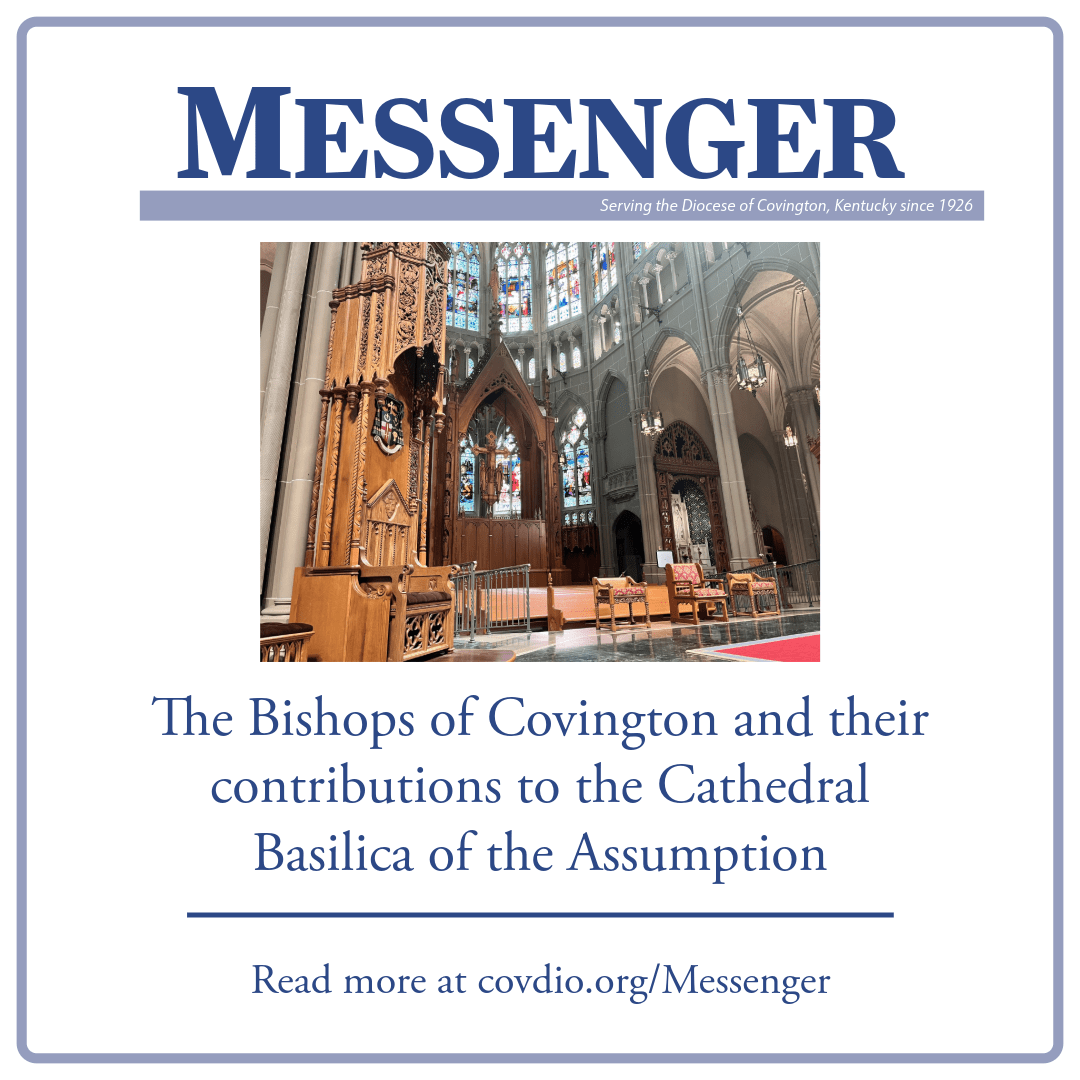
The Bishops of Covington and their contributions to the Cathedral Basilica of the Assumption
Bella Bailey
Multimedia Correspondent
When Bishop Maes built the Cathedral Basilica of the Assumption, Covington, many projects were left unfinished, like the façade and stained-glass windows. Over the last 100 years the Bishops of the Diocese of Covington have each added to the interior of the Cathedral, contributing to the vision and hope of Bishop Maes to have a Cathedral worthy to be the house of God.
Bishop Camillus Maes, the third Bishop of the Diocese of Covington
– Erected the Cathedral Basilica of the Assumption including the original chimera and gargoyles, as well as most of the façade.
– Installed many of the large stained-glass windows in the Cathedral, with few being left unfinished due to the first world war.
– Bishop Maes left instructions to his Vicar General (and future Bishop) Father Ferdinand Brossart to install mosaic stations of the cross.
Bishop Ferdinand Brossart, the fourth Bishop of the Diocese of Covington
– Coordinated the logistics and managed the money for the Cathedral under Bishop Maes.
– Installed the mosaic stations of the cross as directed by Bishop Maes.
– Completed the installation of the stained glass windows.
Bishop Francis Howard, the fifth Bishop of the Diocese of Covington
– Added a baptistry to the side of the Cathedral, making the baptistry the only structure of the Cathedral not present during Bishop Maes’ lifetime.
– Installed the Wicks pipe organ which is still in use today.
Bishop William Mulloy, the sixth Bishop of the Diocese of Covington
– Attempted to repair the damaged chimera with concrete and rebar.
– Installed much of the wood detailing seen in the Cathedral today, including the large crucifix, baldacchino, choir stalls, pulpit, cathedra and decorative wood screens around the Mary and St. Joseph altars.
– Restored the Duveneck artwork in the Blessed Sacrament chapel.
– Enlarged the sanctuary to fit the choir and organ, with a new altar being situated just in front of the baldacchino.
– Installed new communion railing.
– Cleaned and repaired the entire interior of the Cathedral, including the ceiling, windows and walls.
– Replaced original electrical wiring and installed the light fixtures seen today.
Bishop Richard Ackerman, the seventh Bishop of the Diocese of Covington
– Created the Sacred Heart altar.
– Brought the Schwab Organ, which resides under the rose window, to the Cathedral.
Bishop Robert Muench, the ninth Bishop of the Diocese of Covington
– Completed major renovations to the interior of the Cathedral including the addition of the baptismal pool, the reconciliation chapel, air conditioning, ramps up to the altar.
– The renovations included moving the altar forward to be in the architectural center of the Church, a new altar which was fashioned from Bishop Mulloy’s altar and communion rails, reconfiguring the pews, cleaning of the interior and exterior of the building and upgrading the sound system.
Bishop Roger Foys, the tenth Bishop of the Diocese of Covington
– Completed the façade which Bishop Maes was unable to complete with the addition of 24 saint statues representing the parishes of the Dioceses, and the tympana over the north and south portal doors.
– Fashioned the reliquary altar using the same type of wood Bishop Mulloy used for the baldacchino.
– Commissioned the stencil work which is seen behind the Mary, St. Joseph and Sacred Heart altars, as well as behind the tabernacle in the Blessed Sacrament chapel.
– Recommissioned the old baptistry to be the final resting place of Bishop Maes, and returned Bishop Maes’ remains to the Cathedral.
Bishop John Iffert, the eleventh Bishop of the Diocese of Covington
– With the completion of the Restored in Christ restoration, Bishop Iffert will have many notable contributions to the Cathedral attributed to his episcopacy.
– These include the restoration of the chimera and gargoyles, the cleaning of the entire edifice and façade, the restoration of buttresses, piers, belt courses, balustrades, colonnades, stained glass, tracery and delicate decorative elements.