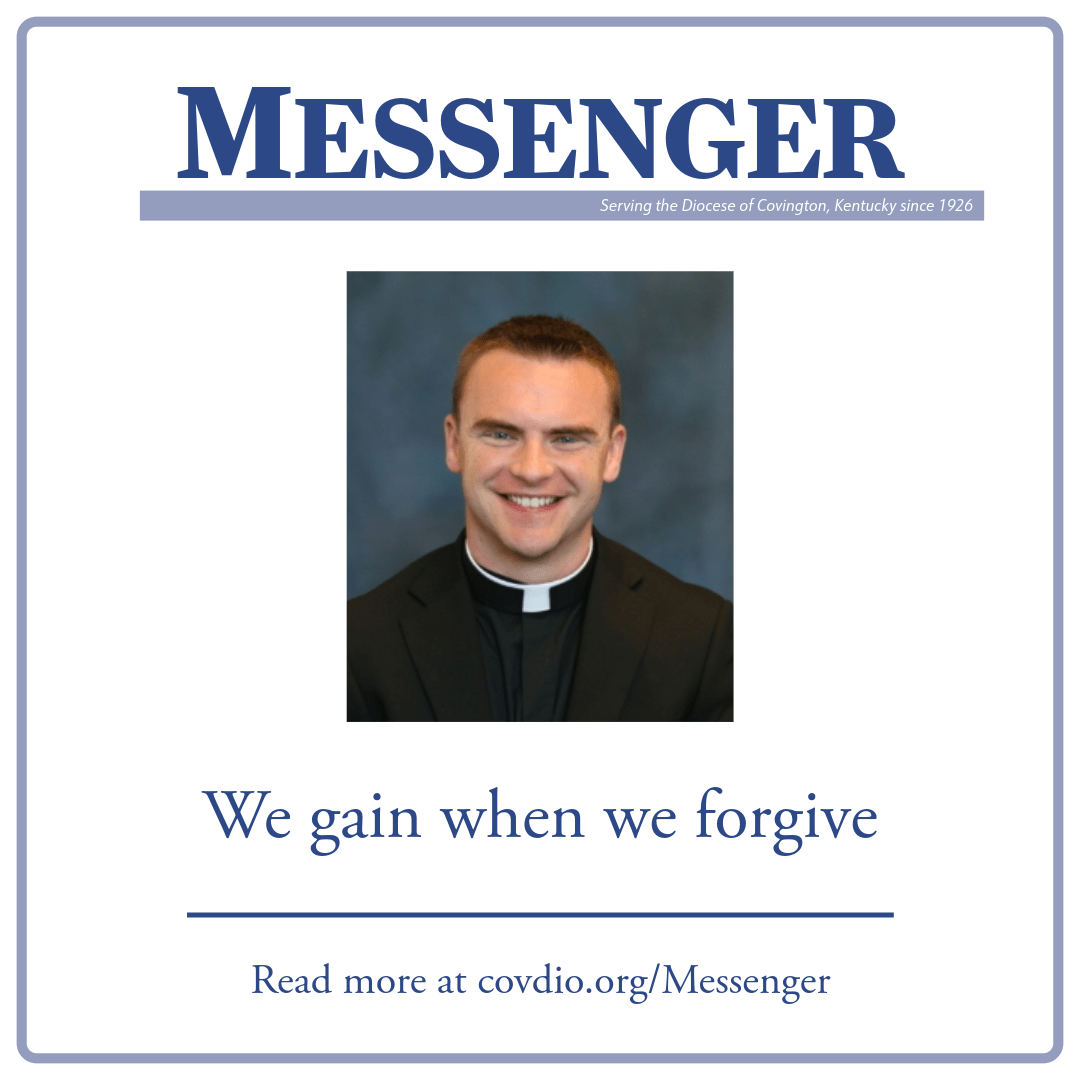
We gain when we forgive
Father Michael Elmlinger
Guest
One of the most difficult things Christ to do for one another is to forgive one another. There can be a desire to hold onto that grudge, because the person has done something so horribly to us and is not deserving of our mercy and forgiveness. They have caused a wound within us that may never fully heal, or at the very least will leave a nasty scar. While it is true that some wounds take so long to heal (if they ever fully heal at all), nevertheless, we are still called to forgive all who have wronged us, because God has chosen to forgive us of all the wrongs that we have done, as well as the fact that when we choose to forgive, our hearts are set free from the imprisonment that wrath and resentment causes.
This is the essential teaching in our readings this weekend, particularly in our Gospel reading from Matthew 18:21-35. In this passage, Peter asks Jesus how often we must forgive those who wrong us. “As many as seven times?” he asks (18:21). Now, we have to keep in mind that in Peter’s eyes, as well as the eyes of the Jewish audience to whom Jesus is speaking and Matthew is writing, forgiving someone seven times is already seen as extremely generous. At this time, many rabbis considered forgiving someone three times to be sufficient. However, Jesus goes even further. He tells Peter, “not seven times, but seventy-seven times” (18:22; also translated as “seventy times seven”). By using this extremely high number, Jesus is not intending to put a hard limit on the number seventy-seven or four hundred ninety. Instead, it seems more likely that he is using hyperbole that would have been even more emphatic at his time to emphasize the need for a limitless mercy for those who have wronged us.
That is when he goes into one of the most beautiful parables of Matthew’s Gospel: the parable of the Unforgiving Servant, where we hear about this servant who owed his master “a huge amount” (18:24), but was forgiven of his debt by his master. In the original Greek for this passage, it actually says the amount that the servant owed and is translated in other versions of this passage: “a myriad of talents.” A myriad was the equivalent of the number 10,000, while a talent was a unit of measurement for denarii. The denarius was the equivalent of a day’s wages. Now, a talent was worth 6,000 denarii, so that meant that this servant owed his master 10,000 talents, which equates to 60,000,000 denarii. That is the equivalent of over 160,000 years of wages that he owed! He was never going to pay that back, and yet the master chooses to completely forgive him of the debt when the servant begs him to give him more time. That is an incredible act of mercy on the part of the master!
However, when this servant met another servant who owed him “a much smaller amount” (only 100 denarii), rather than showing that same mercy he received, instead, he forces the servant to pay him what he owes. The master is not happy when he hears this news and tells the servant, “I forgave you your entire debt because you begged me to. Should you not have had pity on your fellow servant, as I had pity on you?” (18:32-33). He then throws him in prison until he is able to pay back the full debt, which is ultimately never.
When we choose not to forgive those who have wronged us, the truth is that we are very much like this unforgiving servant. In reality, while our neighbor can certainly do some horrible things to us, the debt that they owe us pales in comparison to the debt that we owe God when we sin against him, who is an infinite God. Our sins against that infinite God thus bear infinite value, and yet, God still chooses to forgive us. That is the same mercy we are to show to one another.
That said, there is another thing that choosing to forgive our neighbor does for us: it frees our hearts from the prison of resentment and wrath. Ultimately, what do we gain when we choose to hold a grudge against someone and refuse to forgive them? We do not gain anything. In fact, we lose something: the peace that is meant to reign within our hearts. We allow that person’s sin against us to have power over us. However, when we choose to forgive someone of the debt that they owe us, we reject that power and instead choose to live in the freedom of the children of the Father. We choose to look past the evil the person has done and ask God to intervene in their lives to transform them into the person that he wants them to be. We gain nothing in refusing to forgive one another. We gain everything when we choose to forgive as the Lord himself has chosen to forgive us.
Father Michael Elmlinger is a priest of the Diocese of Covington, Ky. Father Elmlinger is currently studying Canon Law at the University of St. Paul, Ottawa, Canada.