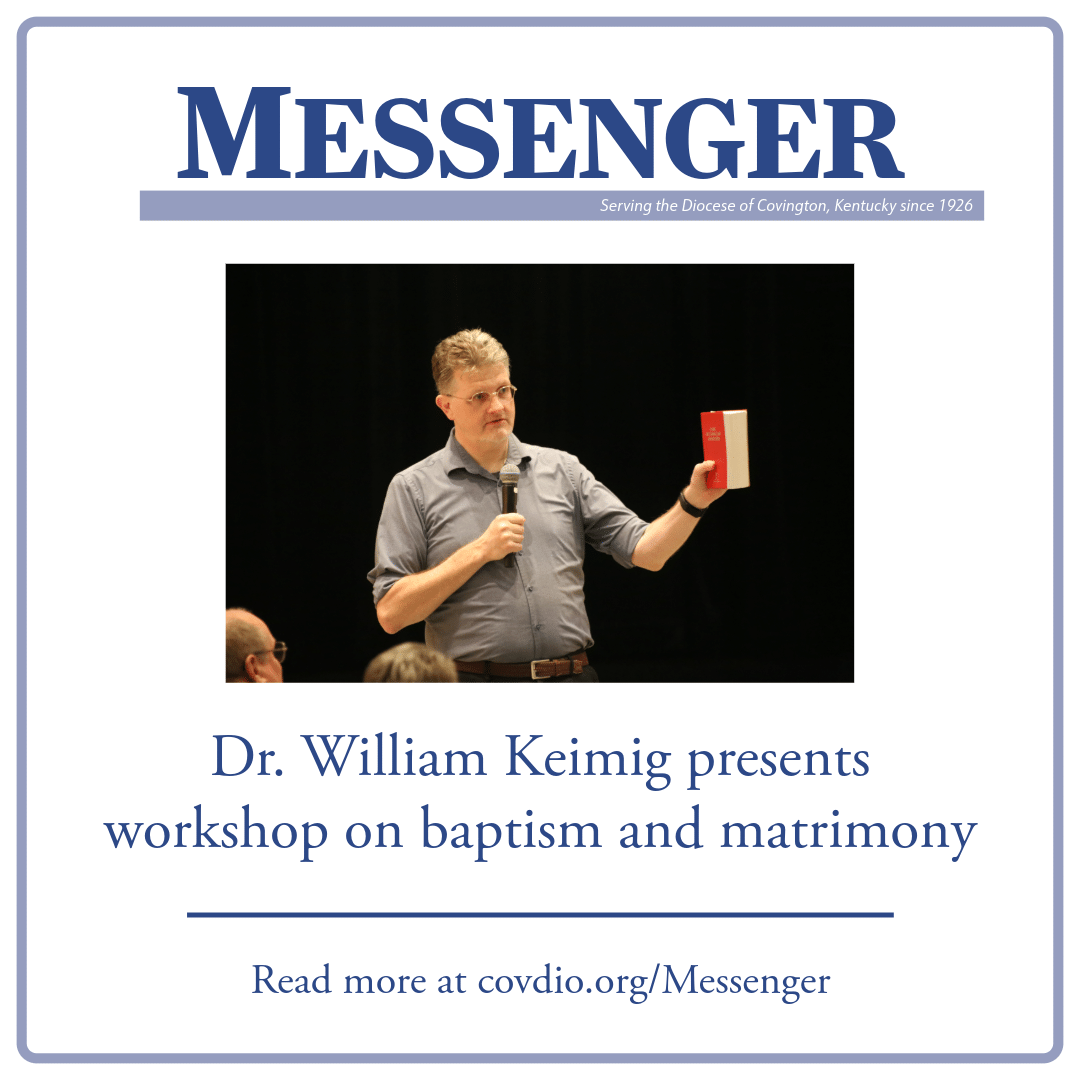
Dr. William Keimig presents workshop on baptism and matrimony
Bella Bailey
Multimedia Correspondent
Dr. William Keimig, director, Catechetical Institute at Franciscan University, Steubenville, visited the Diocese of Covington to host an OCIA workshop, Sept. 19. OCIA coordinators from across the Diocese attended the workshop, which focused primarily on the Code of Canon Law surrounding the sacraments of Baptism and marriage. The workshop was held on Thomas More University’s campus, Crestview Hills, in the Ziegler Auditorium. Isaak Isaak, director of the Office of Catechesis and Evangelization for the Diocese, welcomed the attendees at the top of the day’s program.
“Today we gather to learn together, grow together and deepen our understanding of the OCIO pastoral and canonical issues, so that we may better serve those who seek Christ and his Church as Catholic leaders, parish volunteers, clergy and members of the faithful,” said Mr. Isaak. “We share an important mission entrusted to us by the Church and the founder of the Church in Jesus Christ.”
The workshop consisted of four presentations from Mr. Keimig, one of those presentations was on the canonical baptismal process, while the other three focused heavily on marriage, specifically the sacramental nature of matrimony, its nullification process and the canon law surrounding it.
Holding a red covered book up so the audience could read its title, Dr. Keimig dropped the bound Code of Canon Law on the table in front of the audience, resulting in a loud and defining thud which reverberated across the auditorium.
“This,” he said, “is the entirety of our law for an institution that runs in the United States: 178 dioceses that are Latin Rite, and about another 15 that are Eastern Rite; 17,000 parishes, and about 5,000 schools, hundreds of hospitals — and that’s just America.”
The institution Dr. Keimig was referencing being the Catholic Church.
“This is an extraordinarily succinct work,” he said referencing the Canon Law book. “It is an extraordinary efficiency of communication of law … It has to adapt to every culture on earth, every circumstance of the human condition.”
The Code of Canon Law has two remarkable qualities, said Dr. Keimig. The first is that it is a succinct work and the second is that “it expresses mother’s heart, meaning Mother Church. It expresses mother’s heart, where she wants us to think about things,” he said.
With newfound understanding on the work of the Code of Canon Law, the OCIA coordinators spent the day with Dr. Keimig learning and growing in formation.