Brother Abraham Reeder makes first vows

Staff Report

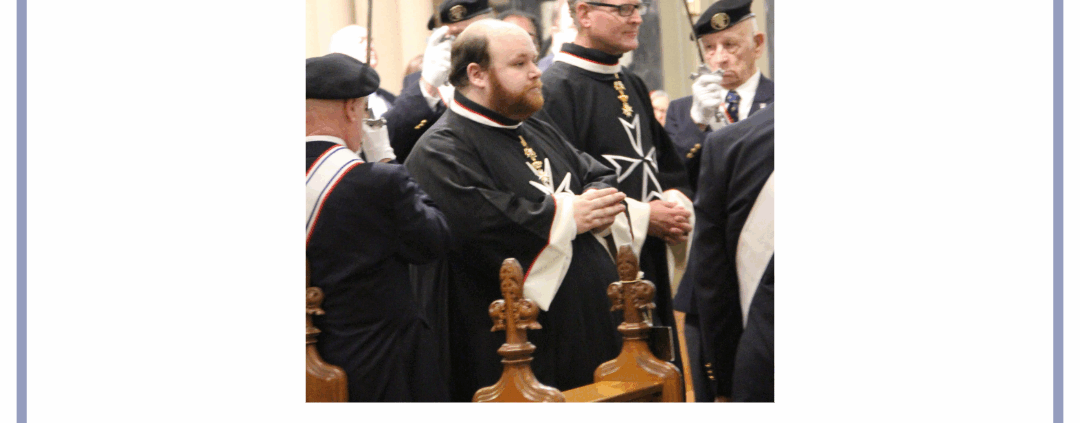
After a year of discernment as a novice at St. Vincent Archabbey, Abraham Reeder, now Brother Abraham, of Park Hills made first or simple profession of monastic vows on July 10 before Archabbot Martin de Porres Bartel, O.S.B., in the Archabbey Basilica, Latrobe, Penn. To become solemnly professed, Brother Abraham will spend three years discerning as a junior monk before being considered for vows for life. Brother Abraham attended Thomas More College and Franciscan University, from which he graduated in 2024 with a degree in theology. His parents (PLACEMENT) are Michael and Kelly Reeder.

Diocesan daughter among 10 celebrating 25 years as Dominican Sisters of St. Cecilia

Staff Report

Sister Maria Fidelis Gray, O.P., celebrated her Silver Jubilee, July 13. She was one of 10 Dominican Sisters of St. Cecilia celebrating 25 years of religious profession.

A native of Ft. Wright, Ky., Sister Maria Fidelis is the daughter of Tevis and Theresa Gray, also of Ft. Wright. Sister Maria Fidelis made her first profession of vows on August 10, 2000. She has served in both teaching and administrative roles at schools in Nashville, Tenn.; North Beach, Md.; Denver, Col.; Carmel, Ind.; and Providence, R.I. Additionally, Sister served as Coordinator of Villagio Betania Retreat House in Bracciano, Italy. Sister Maria Fidelis is currently teaching second grade at St. Catherine of Siena Catholic School in Kennesaw, Ga.

In 1860, the Congregation of Dominican Sisters of St. Cecilia was established in Nashville, where its Motherhouse is located. The Sisters of St. Cecilia are dedicated to the apostolate of Catholic education. The community of over 300 sisters serves in 55 schools throughout the United States and abroad, with mission houses in Sydney and Melbourne, Australia; Vancouver, British Columbia; Rome and Bracciano, Italy; Elgin, Scotland; Sittard, The Netherlands, and Limerick, Ireland. For more information on the Dominican Sisters of St. Cecilia Congregation, visit www.nashvilledominican.org.

New National Blue Ribbon School sign is ‘symbol of the traditions … beacon to the future’ at Holy Cross District High School

Bella Bailey

Multimedia Correspondent

Holy Cross District High School, Covington, was recognized as a National Blue Ribbon School in 2024, making them one of only 356 schools selected in the 2023-2024 school year.

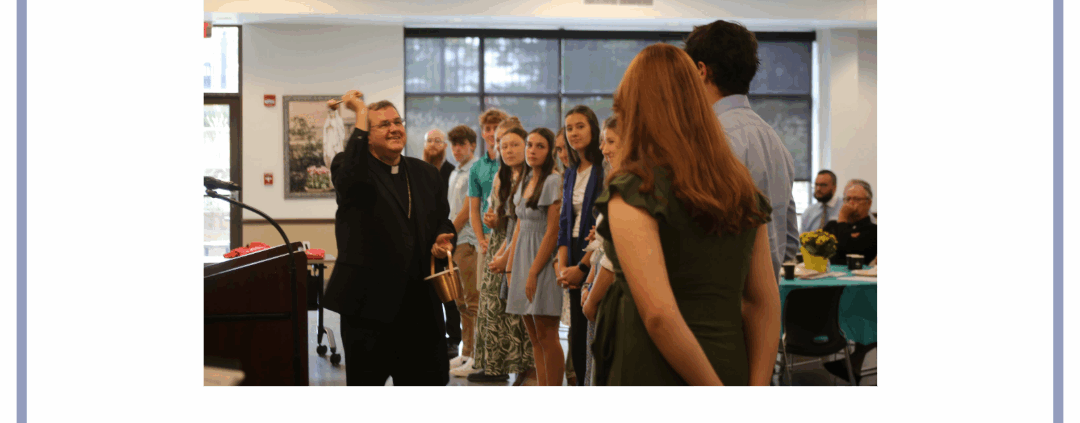
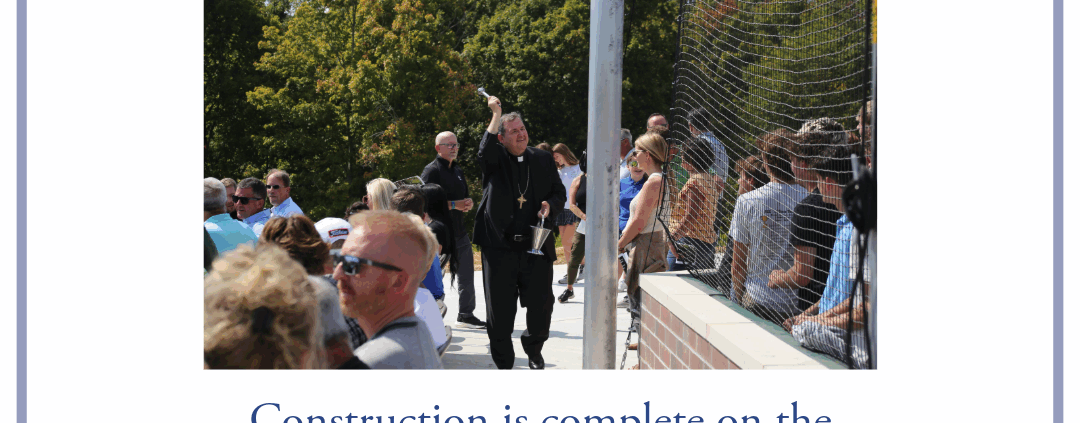
This tremendous accomplishment is now permanently affixed to the face of two buildings on the campus of Holy Cross District High School, serving as a beacon of academic excellence for all who drive down Church Street. Bishop John Iffert joined the students, faculty and staff of Holy Cross for Mass and a blessing of the new signage.

In his blessing of the sign, Bishop Iffert said, “It will be an open invitation to all who pass by it to come inside and hear the good news of Christ, to see through our actions, our witness to Christ and be welcome as members of the Body of Christ.”

“For over 100 years,” said Rob Knox, principal of Holy Cross, “Holy Cross has stood for the opportunity of urban Catholic education in the Diocese of Covington. Holy Cross, I am beyond proud to say, received its blue-ribbon award as an exemplary achievement gap closing school.”

The recognition of being an exemplary achievement gap closing school sets apart Holy Cross as not only a model of secondary education, but one that meets students where they are and helps them rise above.

This achievement, says Mr. Knox, means that “we live up to our philosophy of being a place for all. We pride ourselves on the achievement and success of our students that some in society believe should succeed less. But we believe, with faith-filled hearts, that every student who walks through our doors deserves the best Catholic education we can give them.”

In his remarks, Bishop Iffert recalled a paper he wrote regarding the true value of a university education; however, the remarks remain true for the work of Holy Cross High School.

“To really know the value of a university education, you have to look at where the students coming in are and what they’ve managed to gain in those four or five years that they spend in university,” said Bishop Iffert.

He continued saying, “Holy Cross is carrying a vision that is so important to me, to know that schools help people achieve, help people overcome educational obstacles, and help them move from grade-level parity to a grade level ahead, that’s the goal.”

Mr. Knox highlighted that not only is this achievement the work of those students in the 2023-2024 school year, but it is the work also of all those who came before, “the Blue Ribbon is a testament to our past, our present, but most importantly, our future, a future thriving, a Holy Cross community where students and families from all walks of life receive a world-class education, a call to be faithful servants and messengers of God, and a place they can call home.”

“These beautiful signs,” Mr. Knox continued saying, “are a symbol of the traditions of excellence at Holy Cross, but also a beacon to the future of our school and community.”

Second presentation on immigration tackled social teaching, immigration law — importance of human dignity and mercy the keystone

Maura Baker

Staff Writer

Once again, the Curia’s Bishop Howard Memorial, Covington, found itself full of people of all ages — including both high school age students and seniors — for a presentation by the Intercommunity Sisters Peace and Justice Committee, titled “Immigration: The Catholic Perspective, Part 2.”

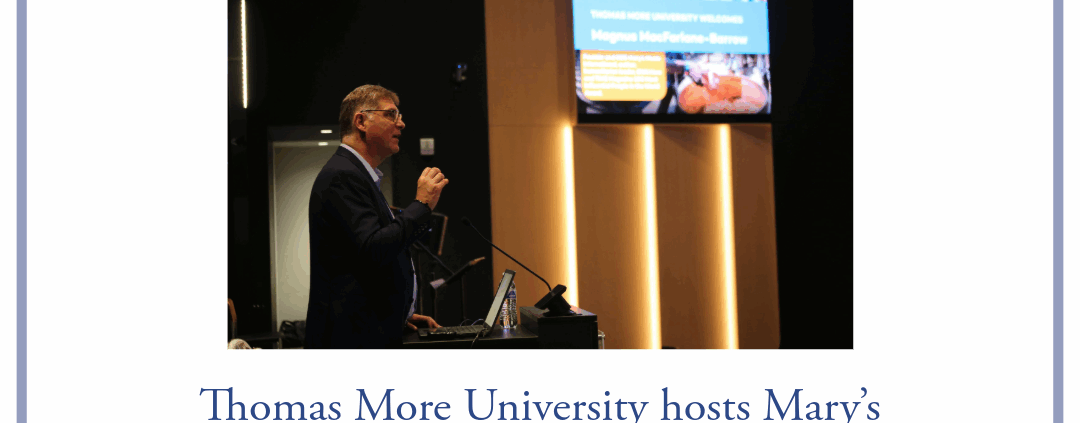
Following the success of the previous part in the series of presentations, Part 2 provided attendees with further detail on both the Catholic teaching and the law surrounding the topic of immigration in the United States. After an introduction by Sister Kay Kramer, CDP, and an introductory prayer from Bishop John Iffert — keynote speakers Hannah Keegan, Director for Thomas More University’s Center for Faith, Mission and Catholic Education and Jessica Ramos, an immigration lawyer and manager of the immigration legal team for The Legal Aid Society of Southwest Ohio, LLC, took to the podium.

Hannah Keegan, who previously gave an overview on Catholic teachings, particularly Catholic Social Teaching, at the first presentation, this time gave a “deeper dive” on the intricacies of the subject.

“The Catholic social doctrine is trying to help us to under the Church’s responsibility in society,” Mrs. Keegan explained, “What does the life of faith compel of me in the world? How does it change or inform or challenge my actions in life?”

Perhaps the most crucial part of Catholic Social Teaching, as Mrs. Keegan described is the importance of human dignity, “which is that every human person is created with an intrinsic value,” she said.

“The Catholic social doctrine is saying that the person has a right to migrate. The state has a right to regulate its borders,” said Mrs. Keegan, “but it must regulate its borders with justice and mercy. And so, the more we regulate the borders without a consideration of mercy, the less we respect the dignity of the person.”

“When we speak about the issue of immigration, we are fundamentally addressing the movement of people,” Mrs. Keegan quoted Bishop Mark Seitz, bishop of El Paso, Tx., “Human persons created in the image and likeness of God, each one of them a brother or sister to us all.”

Following Mrs. Keegan, lawyer Jessica Ramos took to the podium to describe, in depth, the pathways to legal immigration in the United States — and the associated challenges that often face migrants seeking U.S. citizenship. While facing hardships such as economic instability, psychological trauma and language barriers — many immigrants, particularly though unauthorized or undocumented, are described by Ms. Ramos as “undocumentable”. This term, coined by a colleague, means that many prospective migrants lack a legal pathway to immigration status.

Achieving a “green card” in the United States — the first step to citizenship — typically requires one of two avenues; employment, which is mostly restricted to individuals with higher education in specialized fields, and family, which is restricted to immediate family and categorized based on the type of relationship — with waitlists for familial green cards ranging from 4 years to 150 years. And, while avenues for asylum seekers and refugees exist, the specific discrimination conditions for asylum and the United States’s limited refugee acceptance number of 125,000 individuals also makes these routes inaccessible for most.

The current administration, according to Ms. Ramos, is “taking away the opportunity to apply for asylum, and putting people in what is called ‘expedited removal’ — which is where they say if you were ever caught at the border, or if you have been in the country for less than two years, then you are not entitled to talk to a judge about your asylum case … that is what our law says.”

The real issue which arises is many individuals inability to prove on the spot of arrest their legal status, regardless of whether they have a green card or citizenship or not, according to Ms. Ramos, who states that these practices possibly encroach on the rights of everyone, not just migrants.

“How do you prove that you’re a U.S. citizen?” Ms. Ramos asked the crowd, “How do you prove that you’ve lived here for more than two years without due process? This could affect any one of us.”

Following the presentation, Holy Spirit Parish, Newport, pastor Msgr. William Cleves remarked on his experiences hearing confessions at the Campbell County Detention Center — learning from migrants awaiting deportation that many have been cut off from their families and were told that they could not reach out to contact them. Some of them, according to Msgr. Cleves, fear deportation to countries different from their country of origin, as well. He concluded the night with prayer, for mercy and justice for all.

As a tabernacle of Christ, Mary was assumed into heaven, said Bishop John Iffert.

Bella Bailey

Multimedia Correspondent

Bishop John Iffert celebrated the vigil Mass for the Feast of the Assumption of Mary, August 14, at the Cathedral Basilica of the Assumption, Covington. This feast, traditionally recognized on August 15, celebrates Mary’s bodily assumption into heaven.

“Because she was the Mother of God,” said Bishop Iffert in his homily, “because bodily, she became the tabernacle of his earthly existence, her body was preserved from decay, her body was preserved from corruption, her body was preserved from the effect of sin.”

While the assumption of Mary into heaven is a point of distinction between Catholics and other religious denominations, Bishop Iffert defends the validity of the assumption with both anecdotal and doctrinal evidence.

Bishop Iffert, in his homily, recalled a story which happened to a friend who teaches at a university in the Palestinian side of Bethlehem. One day, Bishop Iffert said, this friend of his was taken on a tour by a Scripture scholar, and he was taken to three different locations. Each of which claimed to have the head of John the Baptist.

This friend, moved by disbelief, pointed out to the man displaying the relic at the third location that each of his previous stops also claimed to have the one head of John the Baptist. Bishop Iffert recalled from his friend that the man displaying the relic explained that they had the mature head of John the Baptist, and the village before them had the head of John the Baptist as a youth.

“I share this story not to add cynicism to the world but to point out just how desperate we are to connect to the holy ones who live before us. How desperate these communities are to exercise that claim for a connection to a holy saint … so much so that you end up with three heads of John the Baptist,” said Bishop Iffert.

“Nowhere in the world,” Bishop Iffert said, “do you find a relic of the Blessed Virgin Mary … nowhere in the world do you find a relic of her flesh, nowhere in the world do you find a relic of her bone. They don’t exist.”

The dogma proclaiming the assumption of Mary was defined 75 years ago in the year 1950 by Pope Pius XII, in the apostolic constitution “Munificentissimus Deus.”

“The Lord God preserved this vessel of the Lord Jesus from undergoing the corruption that normally occurs after death of a body. Mary was not allowed to be a corpse. She was always a body filled with life, that is the gift from the Holy Spirit. The Church teaches this, and it has been taught from the early centuries of the Church because it is true and it really happened,” said Bishop Iffert.

While the Church does not teach on whether or not Mary died or was “taken up in a whirlwind,” said Bishop Iffert, it does teach of her bodily assumption.

“Because she was the mother of God, because bodily, she became the tabernacle of his earthly existence, her body was preserved from decay, her body was preserved from corruption,” said Bishop Iffert.

The Deanery Pastoral Council serves as one facet of the body of the Church said Bishop Iffert at DPC orientation

Bella Bailey

Multimedia Correspondent

The annual Deanery Pastoral Council orientation took place August 9, in Bishop Howard Memorial Auditorium, Covington, where new members of the Deanery Pastoral Council learned more about their role as members of the council.

Each parish in the Diocese of Covington is organized into one of five deaneries based on their geographical area: The Cambell County Deanery, The Covington Deanery, The Northern Kenton County Deanery, The Southeast Deanery and The Southwest Deanery. Leading each of these deaneries is a dean, a member of the clergy from within that region appointed by Bishop John Iffert.

The Deanery Pastoral Council is a quarterly meeting of two representatives from each parish within a deanery. Members of the council serve three-year, renewable terms. From each Deanery Pastoral Council, two people are selected by their council peers to represent their deanery at the Diocesan Pastoral Council, which meets quarterly with Bishop Iffert.

The goal of the Deanery Pastoral Council is to discuss and advise Bishop Iffert on issues via their representatives to the Diocesan Pastoral Council. Bishop Iffert likened the hierarchical structure of these councils to that of the body. With the head, in this case himself as the head of the church of the Diocese of Covington, needing to listen to the lungs and heart in order to function properly.

“The head has to listen to the body. The head has to be responsive to the needs of the body. That’s what these councils are all about, to make sure that we are listening to one another and, even more importantly that we are discerning the Spirit of God together,” said Bishop Iffert.

Bishop Iffert recalled a story from his time as a parish pastor, when he provided counseling to married couples. It became to clear him, he said, that these couples did not want to be counseled, rather, the men wanted him to take their side.

“It happened over and over again,” said Bishop Iffert, “and usually they would throw out this thing about the man is the head of the household. They would say the man is to be the head of the household.”

To which Bishop Iffert would respond to them saying, “yes, that works to exactly the degree to which you are a saint,” he said.

“If we’re not saints and we insist on that kind of tight control, we have the potential of giving into our manipulative selves,” he said. Which is why the Deanery Pastoral Council and Diocesan Pastoral Council are structured in such a way, so that the head can easily listen to the heart and lungs.

“All authority in the church is to be exercised as servant leadership. All authority in the church is to be exercised as foot washing, with a gentleness to it, with a servant’s heart. That means we have to take the time to listen. We have to take the time to check our motivations. We have to make sure that we’re considering the good of others in as complete and full way we can,” said Bishop Iffert.

The meetings of the Deanery Pastoral Council are open to the public so that parishioners can voice their concerns and opinions, which will then be taken under advisement by the council. This pipeline from those in the pews to Bishop Iffert through the Deanery and Diocesan Pastoral Councils, allows him to listen to the body of the church of Covington.

“That’s my vision,” said Bishop Iffert, “that we are a family of faith together, our pastors are clearly the heads of those parish families, but none of us are saints, and so we need to be listening to one another and being gentle with one another and being about the work, not listening to my opinions about what things are, but for me, listening to the way the Spirit is speaking to me through the people of God.”

Divine Mercy/St. Bernard Parish Young Adult Group sets an example

Macie Becker

Media Intern

As part of the Diocesan pastoral plan, the diocese has partnered with the Catholic Leadership Institute (CLI). CLI has been working with the parishes in the diocese on long-term pastoral plans for each parish. Divine Mercy and St. Bernard Parishes, Bellevue and Dayton, are a part of Next Generation Parish, a program in which the parish is paired with a CLI consultant to help not only develop but also to implement their plan.

One of the goals for the Divine Mercy/St. Bernard (DMSB) pastoral plan is to increase parishioner involvement in social and service groups within the parishes. DMSB has a thriving young adult community, drawing in people from in and out of the parishes to their events. Father Martin Pitstick, Pastor, refers to it as one of their parish’s “charisms.” Having events almost every day, the DMSB young adults have been an influence on the parish community, setting an example for the pastoral plan.

The young adults within the parish have continued to set this example by getting involved with other aspects of parish life, such as serving Masses and planning after-Mass brunches for the parishioners. Mr. Nienaber says the reason for starting integrated events is for the parishes to be “living and breathing and really healthy going into the next 20, 30, or 40 years.”

They combine the religious and recreational, planning events like Masses and Bible studies, as well as fun events like bonfires and swing dances. That dynamic has drawn in many people, both Catholics and non-Catholics alike. Oftentimes, non-Catholic participants in these recreational events end up being drawn to the Catholic faith by it.

“We always try to find that balance,” says Colin Nienaber, DMSB Young Adult Minister, who continued to say, “we’re having a lot of fun, but we also want to integrate the rest of the parish so that it’s not like two different parishes being made.”

“The young adults are taking on the service role for the life of the rest of the parish to leverage and to be the yeast for helping the rest of the parish,” said Father Pitstick. He continued, saying “no program is perfect, but you take valuable resources from the program, and we’ve done that and it has been very helpful.”

To learn more or get involved with DMSB or their young adult ministry, visit https://dmsbcatholic.com/.

Diocese and intercommunity sisters continue dialogue on immigration with upcoming presentation, continuation of June efforts

Maura Bailey

Staff Writer

This past June, the Intercommunity Sisters Peace and Justice Committee, in a collaboration with the Diocese of Covington, held a presentation attended by near 200 participants on the topic of immigration — the Catholic perspective.

On August 18, the sisters aim to continue this dialogue with the second part of the immigration series, once again to be held in the diocesan Curia, Covington, from 6:30–8:30 p.m.

The August presentation will begin with a “deeper look at Catholic social teaching as it pertains to immigration,” said Divine Providence Sister Kay Kremer, one of the hosts and speakers of the event. “At the first session, Hannah Keegan,” of Thomas More University, “gave more of an overview of those parts of Catholic social teaching … but, this time, she’ll delve deeper into what it means specifically in regards to how we are called to treat migrants, and how we are called to live in contrast to what’s happened to migrants in the country right now.”

Immigration lawyer Jessica Ramos will also be participating in the upcoming presentation. She will be speaking on the “pathways to legal immigration and citizenship in our country,” said Sister Kay, “and how those things have drastically changed in the last six months.”

Attendees will also be supplied with a resource sheet of discussing immigration in the Catholic context, as well as local ways to help migrant populations.

“We want everyone who attends to feel welcome,” Sister Kay continued, “And we want this to be an opportunity for all of us to continue to learn about what the Church teaches about immigration.”

These conversations are important, she explained, as “people are really suffering right now,” Sister Kay said. “The majority of migrants are good, hard-working people who simply want to live their lives in a place where they’re safe and where they can provide for their families, and where their children have an opportunity for a good education. Their hopes and dreams for their lives are the same hopes and dreams that probably all of our ancestors had when they came to the United States.”

Bishop Iffert travels to Ghana to visit family, Church and culture of African priests serving in Covington

Laura Keener

Editor

A little piece of the hearts of parishioners from Immaculate Heart of Mary Parish (IHM), Burlington, now beats in Tepa, Ghana, in the form of the Immaculate Heart of Mary Technology Center. The Center, which is in the hometown of Msgr. Dominic Fosu, pastor, IHM, was made possible through donations and support from IHM parishioners. Bishop John Iffert dedicated the Center on a recent trip Ghana. The Center blessing was part of a larger trip, July 7–23, to the Archdiocese of Kumasi.

Bishop Iffert was accompanied by Msgr. Fosu, four other Ghanian priests ministering in the Diocese of Covington — Father Augustine Aidoo, pastor, St. Patrick Parish, Maysville; Father John Opoku, parochial vicar, St. Agnes Parish, Ft. Wright; and Father Samuel Owusu, parochial vicar, Mary, Queen of Heaven Parish, Erlanger — Msgr. Daniel Vogelpohl, Deacon Jim Fortner and Julie Fortner and nine IHM parishioners. All four of the Ghanian priests are from the Archdiocese of Kumasi, three of the four — Msgr. Fosu, Father Opoku and Father Owusu are from the city of Tepa.

“It was a wonderful, amazing trip. Instructive at every level,” said Bishop John Iffert.

The idea for the trip came from Bishop William Medley of the Diocese of Owensboro, Ky. In a conversation with Bishop Medley during one of the bishop’s meetings several years ago, Bishop Iffert learned that Bishop Medley had made a point of visiting the home dioceses of missionary priests ministering in Owensboro.

“He talked about what a joy it was to meet their families and have Masses in their home parishes. As soon as I heard him talk about that, I just thought, well, that is a good and right thing to do,” said Bishop Iffert in an interview with <<Messenger>> after returning from the trip.

Msgr. Fosu worked out the details of the visit with Archbishop Gabriel Justice Yaw Anokye, who proved to be eager for Bishop Iffert’s visit. Archbishop Anokye even invited Bishop Iffert to ordain five priests during the visit — four priests for the Archdiocese of Kumasi and a Redemptorist priest.

“That became the centerpiece of going there, to preside at the ordination and to visit the Archbishop, and then I also got out to visit the home parishes of these men, and to visit with their families, and to see the kinds of ministries they had done at home, and to learn about where they came from, and just to see them interact with their families and with the Church that they’re most familiar with,” said Bishop Iffert.

The Church in Ghana is “very lively and growing” Bishop Iffert said. The Archdiocese of Kumasi has 212 priests for its 72 parishes, with about another 75 priests serving outside of the country, like the four who serve in Covington.

Bishop Iffert said that the Archbishops of Ghana have taken seriously the call of Pope John Paul II who, on in his 1995 visit to Cameroon, exhorted the young Church in Africa to, “set yourselves on the path of holiness. Only thus can you be a sign of God in the world and relive in your own countries the missionary epic of the early Church. You will also be a leaven of missionary spirit … (Ecclesia in Africa 260) In the Kamasi, with the permission of Rome, priests are assigned secular jobs — professors and teachers at public universities and schools, architects, engineers, lawyers and government workers.

“The whole idea is that they will work in these offices, in these schools, and that they will never take a bribe; never ask for anything … To show up on time, work full days, and, to kind of set the example in ethics, to try to raise the bar for the whole culture,” Bishop Iffert said.

Their efforts are having a positive effect on priestly vocations. “There’s a lot of excitement, a lot of young men in seminary,” Bishop Iffert said, noting that he celebrated Mass for a high school seminary class of first- and final-year young men because the church would not hold all the students. It was estimated that 40 of the senior students would go on to college seminary and that 15 would be ordained priests. “Very lively vocational situation there,” he said.

The liturgies are equally lively. The ordination lasted over 5 hours with Sunday Masses in Tepa typically lasting 2.5 hours, with lots of singing, dancing and drumming.

“They did not just receive the Roman Catholic liturgy as an imported product,” said Bishop Iffert. “It really, at least in the central part of Ghana, they have made it their own.”

Also typical of a Ghana Mass, are several processions. During the offertory, worshipers are called by the day of their birth to dance up the aisle and present their gifts. In another procession, parish groups of women bring food, toiletries, cleaning products and anything they have that the Church would need. The items were brought to Bishop Iffert as he sat in the chair, and he touched each item in blessing. Afterward, the priests and seminarians would place the items under the altar.

“So that when you’re celebrating the Eucharist, you’re literally celebrating all the gifts that everyone had brought forward,” said Bishop Iffert. “Those gifts are used later, some help provide support for the priests and the rectory. Some of it goes out to the seminary. Some of it goes to the high schools to provide for their needs there, and others is kept by the parish to distribute to people in need. Just incredible.”

“If we brought all of that into our liturgy, it would be an import; it would not speak to us, it would be a distraction from the Consecration,” Bishop Iffert said. “But for them, it’s not. For them, it’s an expression of who they are and how they come to recognize Jesus. It’s really quite beautiful. That inculturation is part of what is encouraging the growth of the Church, is encouraging the growth in vocations, is encouraging young men and women to consider consecrated life as a real option. It’s, it’s amazing.”

A highlight was visiting the families of the priests in Tepa and Father Augustine’s family in Kumasi. “It was just a joy to visit them in their home… it was really a lovely, lovely gathering and to get to know their parents,” Bishop Iffert said.

The group also took time for some cultural experiences enjoying the local food, crossing a rope bridge, visiting art and cultural centers, the palace of the Ashanti King and meeting local artisans — weavers, printers and carvers. An especially haunting and moving was a tour of Elmina Castle — the first European slave trading post in sub-Saharan Africa.

“It was a slave dungeon, and it was where millions of people from that West African area were held captive and eventually shipped off on that middle passage. Probably half of the people who went through there died. Others were enslaved and became the beginnings of generations of chattel slavery in our country and others,” said Bishop Iffert. “It was just, it was very eye opening, and this made us aware of the other half of that equation. That was very, very moving.”

In the next year or two, Bishop Iffert plans to visit the home dioceses of the priests from India ministering in our diocese.

“I hope to make those visits and to meet their religious superiors and to meet the local churches that they’re from, and meet their families,” said Bishop Iffert. “It was well worthwhile.”

The new chimeras have arrived ready to take their spots atop the Cathedral Basilica of the Assumption

Bella Bailey

Multimedia Correspondent

Two years ago, the twenty-six chimera which lined the top of the Cathedral Basilica of the Assumption, Covington, were removed as part of the Cathedral restoration initiative. Now, their new and improved counterparts have arrived, ready to reclaim their spots atop the Cathedral.

The new chimera, perfect replicas of the ones removed, were made by Boston Valley Terra Cota, New York, and arrived in late July. In order to perfectly replicate the ones removed, 3D scans were taken, and from those scans foam molds were made, which were cast to make a hollow mold, from which they created the new chimera.

“There’s a lot of hard work,” said Don Knochelmann, director, Buildings and Properties Office for the Diocese of Covington, “there’s a team of artists that put all the really fine detail; the wrinkles in the elephant’s skin and all the different things, that’s all done by hand.”

Father Ryan Maher, rector, Cathedral Basilica of the Assumption said about seeing the new chimera, “I was excited to see them up close, to see the incredible level of detail that the artist put into replicating the former chimera.”

Previously, each chimera weighed approximately 270 pounds, having at one point been filled with concrete. Each new chimera weighs only 170 pounds and are hollow. Mr. Knochelmann, suspects the old chimera, which were originally hollow as well, were filled in an attempt to elongate their life.

“Our understanding from the design team is that doing that actually shortens their life,” said Mr. Knochelmann, “because the concrete and terracotta didn’t expand at the same rate.”

While the talented team at Boston Valley Terra Cotta created the chimera, Trisco Construction will be the ones installing them.

“The workmen, to see day by day the details that they pay attention to do this restoration, every millimeter matters, every inch matters. Being here every day and being able to see them exercise the care, the diligence, the hard work, using their expertise, their God given talents, to do these small, very important restoration pieces, I’ve really enjoyed seeing that unfold,” said Father Maher.

He continued saying, “we’re doing something for the Lord, for all the Catholics in the area, all of the non-Catholics in the area, anybody who comes. We’re doing a great work of service in the Lord with his help to make sure this cathedral is here for generations, and that this type of work doesn’t have to be done for a long time.”

The replacement of the twenty-six chimera is one piece of the larger Restored in Christ Campaign, which seeks to restore the Cathedral façade and architectural structure. To learn more, go to covcathedral.com/restored-in-christ/.