The one thing that doesn’t end in death is love, said Bishop Foys at annual Mass for Loss of a Child

Maura Baker

Staff Writer

Over 100 people attended this year’s Memorial Mass for the Loss of Child, April 7, at Immaculate Heart of Mary Parish, Burlington. The annual Mass, hosted by the diocesan Pro-Life Office, invites parents, grandparents and others grieving the death of a child to gather to memorialize their child and to surrender to God’s loving embrace. Bishop Emeritus Roger Foys was the celebrant and homilist at the solemn event.

“A child is a child to their parents for as long as they live,” said Bishop Foys. “… one of our hopes, that all of us, please God, being faithful to the Lord, to his word and to his Church, will one day enter the Kingdom of Heaven. We firmly believe that we will join those who have gone before us. So, mothers and fathers can hope to embrace those children who have gone on before them, just as they embraced them in this life. The one thing, St. Paul said, that does not end in death is love. Love remains, that bond of love between parent and child. That is where our comfort comes and hopefully lessens our grieving.”

Annual ACUE donor luncheon thanks donors for their contribution to urban Catholic education

Bella Bailey

Multimedia Correspondent

The mission of the Alliance for Urban Catholic Education (ACUE) is to ensure that all children within the inner-city areas of the Diocese of Covington have access to a Catholic education. This mission is accomplished through administrative and financial means; and it would not be possible without the many donors who donate their time, talents and treasure to the ACUE mission.

It is for their generosity that they are thanked at the annual ACUE Donor Appreciation Luncheon, held this year at Holy Trinity School, Bellevue. The luncheon, sponsored by the ACUE Advisory Board, rotates locations between the five ACUE schools in the Diocese of Covington: Prince of Peace School, Covington; St. Anthony School, Taylor Mill; St. Augustine School, Covington; Holy Cross Elementary School, Covington; and Holy Trinity School. Among these five schools, nearly 500 students are receiving a high quality, Catholic education.

“For decades, Catholic schools have stood out as leaders in education,” said Kendra McGuire, superintendent of schools for the Diocese of Covington. “In addition to our record of academic excellence, we provide an education in the faith, teaching the next generation how to follow Christ and care for their neighbors. Time and time again Catholic schools have seen their graduates succeed in their chosen careers but also become leaders at giving back to their communities.”

Upon arrival to Holy Trinity School donors were met with the smiling faces of students, waiting to meet the people that help make their education possible.

“What it means to be a Holy Trinity student is that we get to get a good education, and not only that, but also a very good Catholic education. We get to learn in a positive and fun environment, and luckily for us, we have great academics and staff,” said one Holy Trinity student.

Mrs. McGuire said to the donors, “For our families, the support that you give eases the fears and worries that parents have when raising children. Education is a necessity, the path to a bright future that every parent wants for their child. In the urban areas, finances often limit their educational options, but your support gives them an opportunity to choose a school where their child is provided an outstanding education, a place where their child is welcome, a place where their child feels safe, and a place where their child is loved.”

As a thank you for their generosity, students from Holy Trinity School performed a medley of songs, accompanied with a chorus line, for the donors. The songs included “There’s No Business Like Show Business,” by Irving Berlin; “Swinging on a Star,” by Bing Crosby; and popular folk song, “Oh Shenandoah.”

“You’re not only transforming the lives of the children today, you’re transforming the community and the future of Northern Kentucky and the Diocese of Covington. So, I hope and pray that God continues to bless you for your kindness and your generosity, and we appreciation your ongoing support for our ACUE schools and their students,” said Mrs. McGuire.

The true testimony for the gratitude felt by ACUE students came on behalf of one Holy Trinity student when she said, “We are extremely glad to have ACUE for several reasons. Without you guys, we wouldn’t have some of the learning resources we have, we wouldn’t have our new playground equipment because we wouldn’t be able to afford it. We wouldn’t even really have enough money to pay bills like heat, electricity, plumbing, so on and so forth, because we just don’t make enough money. And so, that is why we’re glad to have ACUE, because you guys are just so nice to donate to us. We can afford all this stuff. We really appreciate it, so, thank you ACUE donors.”

Catholic schools provide the tools of faith, and the Lord provides the courage, says Bishop Emeritus Foys at high school senior Mass

Maura Baker

Staff Writer

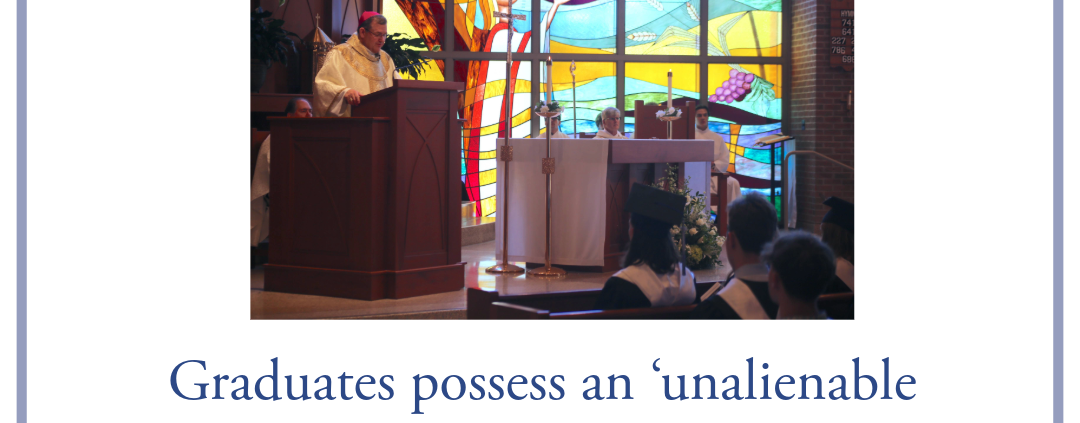
In commemoration of their final year of high school, senior students, alongside their faculty and administrators, gathered, April 4, at Covington’s Cathedral Basilica of the Assumption to celebrate the annual “Senior Mass.”

Bishop Emeritus Roger Foys was the celebrant in the stead of Bishop John Iffert, accompanied by the diocese’s high school chaplains. Students filled the pews of the cathedral with their fellow classmates, denoted by banners hanging by the aisle.

In his homily, Bishop Foys noted the significance that the Mass occurred concurrently to the feast day of St. Isidore of Seville, a Spanish bishop and saint and the patron of students, technology and computers.

“His family, his mother and father,” said Bishop Emeritus Foys, “were intent on providing them (St. Isidore and his brothers and sister) with the truths of the faith. They schooled them, and gave them the best education they could.”

“You’re all still very young,” Bishop Foys said as he addressed the students present, “You have a full life ahead of you, and there will be times in your life where you will need the courage to not only profess the faith with your lips, but to live the faith by your lives.”

“Catholic schools have given you the tools to do that,” he said, “and the Lord will give you the grace to have that courage.”

“You are seniors,” Bishop Foys proceeded, “You’re at the top of the class. Next year, as I heard from one of the students who spoke before Mass, you’ll be back at the bottom,” he said. “That’s life, you know, peaks and valleys.”

“But, through it all, you can rely on the Lord and rely on the gift of faith that was passed on to you by your parents. It is a day of celebration, it’s a day to be sober about our faith and how we intend to live our that faith,” he said, concluding with a quote from St. Paul, “God begins every good gift in us and, if we are faithful, it will bring every one of those gifts to completion.”

St. Joseph Parish rededicates its church and consecrates its altar after years-long capital campaign

Bella Bailey

Multimedia Correspondent

After a years-long capital campaign and ongoing construction, St. Joseph Parish, Crescent Springs, rededicated its church and consecrated the altar, April 5, in a Mass celebrated by Bishop Emeritus Roger Foys, and with a congregation that filled the church to capacity.

The “Living our Faith, Building our Future” capital campaign began after concerns arose over how the existing facilities and buildings were negatively impacting the mission of St. Joseph Parish. Its mission, “to bring everyone in the Villa Hills and Crescent Springs community to the knowledge of Christ’s love,” as it reads on the St. Joseph Parish website, was being hindered by a leaky roof, poor sound system, loud HVAC unit and an austere sanctuary.

Father Eric Boelscher, pastor, St. Joseph Parish, said, “one of the convictions that runs deep in our parish is that every soul in Crescent Springs and Villa Hills is meant to worship God at our altar. This altar belongs just as much to the person who hasn’t yet heard the Good News as it does to those of us who pack the pews each Sunday. The recent consecration of the altar marks the center point and crown of the many blessings and projects that have taken shape across the parish in recent years.”

In the summer of 2021, the capital campaign officially launched with a feasibility study where it was determined that a goal of $5,000,000 was attainable and likely. Since then, the campaign has raised north of $7,000,000 according to campaign chair Paul Ritter.

The needs of the church, such as new, ADA compliant bathrooms, structural work, HVAC unit, the renovation of Noll Hall, a STEAM Lab for the school children and an overhaul of the parish office, were sorted through and ranked in order of absolute necessity.

“Phase one was basically the water issues, the foundation, the roof, gutter system and then the drainage. The HVAC was also in there because that was basically nonexistent,” said Mr. Ritter.

The water issues to which Mr. Ritter was referring was the small stream that formed in Noll Hall every time it rained.

“It [Noll Hall] is where the school children eat their meals and when it would rain, before we had any of that work done, there would be a river of water that flowed from one end of the building toward the parking lot,” said Mr. Ritter.

Phase two of the capital campaign concerned the sanctuary of the church. In the sanctuary, the upper level was removed to create more space, the original altar table and crucifix have been restored and placed. Additionally, shrines for Mary and St. Joseph draw the focus to the tabernacle and the walls have been lined by murals.

The redesign of the sanctuary, Father Boelscher said, is rooted in the early Italian Renaissance, drawing inspiration from Giotto di Bondone and Blessed Fra Angelico, the patron of Catholic artists.

“This artistic period follows the Gothic era that gave rise to the soaring architecture and stained glass seen in our cathedral and other historic churches in the diocese. St. Joseph’s, however, isn’t trying to imitate those spaces — it has its own unique character, and we wanted the sanctuary to reflect that,” said Father Boelscher

Father Eric Boelscher said about the restoration of the sanctuary, “The panels are all hand-painted frescoes on canvas, created specifically for St. Joseph Parish in the style of Fra Angelico. They tell the story of salvation history through the lens of the Holy Family. Each mural is structured around a visual paring of two actions or episodes. For example, the first panel features the Annunciation to Mary paired with the Annunciation to Joseph.

The murals are intended to be catechetical, inviting the viewer intoa sacred narrative. But ultimately, the eye is drawn back to the still point of the sanctuary — the newly constructed altar. Every element was created uniquely for St. Joseph Parish, with the hope that sincerity and intentionality would sanctify the space.” The murals surrounding the sanctuary include the Annunciation of Mary and the Annunciation of Joseph; the flight to Egypt and the return to Nazareth; the nativity of Christ and the death of St. Joseph; St. Joseph the Worker and St. Joseph the Worshipper; and the presentation in the temple and the finding of the temple.

In the center of the sanctuary is the newly restored altar, which, Father Boelscher said, “retains the original relics from the old church, as well as those buried in the foundation of the precious sanctuary. A new, custom reliquary chamber was added, containing relics of more than 20 saints, making the altar not just a place of sacrifice, but a true spiritual treasury for the parish.”

Behind the altar, above the tabernacle, resides the restored crucifix, original to the 1916 church. Surrounding the crucifix is the baldachin which is, “typical of the early Renaissance, when artists and architects were beginning to introduce balance, human scale and light into sacred spaces,” said Father Boelscher.

In his homily Bishop Foys remarked on the beautiful transformation of the church and what makes it a holy place.

“What is it that makes this place a holy place? Is it the artwork or the furnishings, the beautiful marble, the stainglass windows? Its none of those things. What makes this place holy and what make this place sacred are the liturgical rites that we are going to perform … when we conclude this ritual here tonight, that is what this place will be, it will be elevated in service to the Lord. It will be a holy place, a place where the Eucharist, in the tabernacle, the Lord resides. A place where the community gathers regularly and especially Sundays to offer the sacrifice of the Mass.”

For Father Boelscher, it was the very community Bishop Foys talked about that is the driving force behind the restoration of the church.

“There is something wild and beautiful that the Spirit is doing here. Every person I meet, every family I talk to, seems to share the same desire — to build up this parish, to serve our children with love ad excellence, and to discover an ever more sincere and fitting way to worship God and His Church. It has been a profound privilege to witness the generosity, unity and devotion that make this parish what it is. I am deeply grateful to God and to each parishioner. We are truly a parish family, and I’m honored to be the spiritual father called to lead in both worship and work. I pray God continues to bless this parish and all those who call it home,” said Father Boelscher.

Child Abuse Prevention Month kicks off with Blue Ribbon Ceremony

Maura Baker

Staff Writer

April is Child Abuse Prevention Month, and, for the 21st year, the Family Nurturing Center kicks off the month with their annual Blue Ribbon ceremony at Tom Gill Chevrolet, Florence, April 1.

At the beginning of the event, a proclamation declaring Child Abuse Prevention Month was given by Kentucky Representative Stephanie Dietz on behalf of Representative Kim Banta, who was ill and couldn’t attend the ceremony.

“I know that elected officials from Boone, Campbell and Kenton County, along with various mayors from the regions, have similar proclamations today,” said Representative Dietz, “and as important as the official designations are, the proclamations are more than just words on paper. They are a call to action. Every child deserves to grow up in a safe, stable and nurturing environment free from abuse and neglect.”

Like in previous years, local students were invited prior to the event to participate in an art contest, this year following the theme “Be the Light, Build a Future.” The winning student’s artwork is printed on the side of TANK buses in Northern Kentucky during the month of April, and a pizza party is won for their class. This year’s winner was Paige Smith, a student of Villa Madonna Academy, Villa Hills, who was presented her award by Mayor Julie Metzger Aubuchon of the City of Florence.

The special guest speaker for the event was Jeff Thomas, the radio host of the WKRQ morning show. Sharing his story as a victim of child sexual abuse, Mr. Thomas expressed his gratitude for the people gathered.

“This is what’s beautiful about today,” he said, “Here, right now, what we’re doing, every person in this room has the power to turn someone’s nightmare into a hopeful outcome. Every person in this room has the power to help end the cycles of abuse in this community and to provide the necessary resources that offer real hope for healing, not just for the victims, but for the families, too.”

In her closing remarks, Family Nurturing Center president Jane Hermes invited individuals to “take the next step.”

“Help create positive childhood experiences for someone today,” she said, “Support parents so they can provide these on an ongoing basis … share what you’ve learned today, spread the message and expand our circle of care … Thank you all for being here today and for your unwavering dedication to building a future where every child grows up safe, supported and empowered.”

Covington Lenten Pilgrimage will offer pilgrims an opportunity to receive sacraments

Laura Keener

Editor

With only days until the third annual Lenten Pilgrimage to five historic churches in Covington, details have been completed so that pilgrims will have a truly spiritual experience as the Church enters into Holy Week and in preparation for the Easter season.

The self-guided pilgrimage will be held Saturday, April 12, from 9 a.m.– 2 p.m. and includes stops at five Covington churches — Cathedral Basilica of the Assumption, St. Augustine Church, St. Benedict Church, St. John Church and Mother of God Church. A pilgrim walking the entire route would clock 9,000 to 10,000 steps (or about 4.5 miles). Pilgrims may also choose to drive from church to church. There is not one specific route, pilgrims decide at which church to begin and end.

To add to the spiritual nature of the pilgrimage, each church will offer pilgrims the opportunity to obtain sacramental graces. During the entire time of the pilgrimage, at the Cathedral and St. Augustine Church, Exposition and Adoration will be available; at St. Benedict Church and St. John Church, priests will be in the confessionals to offer the sacrament of reconciliation; and at Mother of God Church, the Holy Sacrifice of the Mass will be celebrated at 12:05 p.m. Additionally, confessions will be available at St. Augustine Church from 9:30–11 a.m.

A common question posed to the Lenten Pilgrimage is, “Where do I start? And how do I get back to my car?” Pilgrims can choose to start at any church on the route. Each church has a parking lot, with ample parking available in the lot and on surrounding streets. Pilgrims can also park at the Curia lot, across the street from the Cathedral. The entire route is a loop, with the entire loop — from your parked car back to your parked car — being just under 4.5 miles. Pilgrims will be given a map of the route.

A scalloped shell is an ancient Christian symbol for pilgrimage. The early Church, and in some churches today, a scalloped shell is used to pour water over someone during the sacrament of Baptism. Baptism marks the start of a Christian’s pilgrimage to heaven. During the Lenten pilgrimage, signs bearing the symbol of a scalloped shell will mark the pilgrimage path.

In a recent video about the pilgrimage, Bishop John Iffert said that what he “loves most about this annual pilgrimage is that it was the idea of the people in the pews … from that spark of inspiration we are now in the third year of this annual pilgrimage and every year it has grown. It’s been very important for people as they bring to a close their Lenten practice and move into Holy Week and Easter.” To view the video visit https://www.covdio.org/jubilee.

Also available on the diocese’s Jubilee website is a digital booklet “A Lenten Pilgrimage: Diocese of Covington.” Printed booklets will be distributed at each of the churches. In addition to information about the route, the booklet includes a historical snippet of each church along with prayers and reflections on the Psalms, information about pilgrimages and how to obtain the Jubilee 2025 indulgence.

“I invite you to consider being part of the annual Lenten Pilgrimage in downtown Covington,” Bishop Iffert said.

Phase two of the DPAA concludes with the second kick off dinner

Bella Bailey

Multimedia Correspondent

The second Diocesan Parish Annual Appeal (DPAA) Kick-off Dinner was held, March 20, at Receptions Event Center, Erlanger, where 311 people gathered to learn about the ministries that benefit from the DPAA. The theme of this year’s DPAA, “Pilgrims of Hope, Missionaries of Mercy,” was projected around the room as guests toured the ministry fair, highlighting the work throughout the Diocese supported by the appeal.

“It is the financial generosity of people like you that enable the Diocese to execute the mission and theme of the DPAA … In our 2025 video Bishop Iffert talks about the meaning of our theme and several groups of individuals who are served through DPAA ministries,” said Lisa Knochelmann, leadership gifts chair.

The DPAA video, a message from Bishop Iffert encouraging people to donate, will be shown in parishes across the Diocese on March 23. The video, shorter than in years past, will be shown after the completion of the Communion Rite, rather than replacing the homily.

“We have a committee of pastors,” said Bishop Iffert, “who gave input to us every year. One of the consistent inputs that I’ve heard for three years now is that these pastors really hated losing a Sunday homily during Lent. These readings during Lent are so profound and correspond with the process of initiation; we have all of these folks who are preparing for baptism, for initiation into the life of the Church and these readings are geared toward helping us accompany those people. Then, what would happen, you get to the second or third Sunday of Lent and they’d have to throw those readings out the window and they’d hear the Bishop talking about the DPAA. So that is what we’re trying to do this year, we’re trying to respond to that.”

The goal of the DPAA this year is higher than years past at $2,700,000, with $904,072 already committed by donors in the leadership gifts phase, the first phase of the appeal. The $904,072 raised in phase one surpasses the amount raised in 2024 by $322,000.

“That’s flat out amazing,” said Jeff Jehn, general chair for the DPAA, “Your pledge to the appeal will demonstrate your commitment to priestly vocations, Catholic education, religious formation of adults and children, as well as provide programs to strengthen marriages, promote respect for life, and offer consolation for those who are less fortunate than we are. Especially, it will help those whose needs are greatest — the poor, the vulnerable, and all of those who are underserved in their environment but served with love by the people of the Diocese of Covington.”

Bishop Iffert said the pledges made by those in the pew are, “for the poor, for those who need education, for those who have served us so faithfully, for the elderly, for those that don’t have the housing that they should have, those are the kinds of things that your help, through the DPAA and the help of so many thousands allow the Church to do in your name.”

“I want to invite you to join me in supporting the Diocesan Parish Annual Appeal,” said Bishop Iffert, “when we ask you to give, keep in mind that in the Catholic Church you don’t hear us tell you how much you should give … because what we believe is that you should give whatever you and God are happy with, whatever you believe God is asking you to give, whatever is the right return for you on the blessing that you have received.”

Life on the Borderlands: Thomas More University students experience all sides of the southern wall

Maura Baker

Staff Writer

Every year, a class of students from Thomas More University travels south to El Paso, Tx. In conjunction with the Annunciation House, a nonprofit that serves migrants in the region, the students engage in what is known as a “Border Awareness Experience” — which delves deep into the realities of immigration and life on the borderlands of west Texas.

Dr. James Camp, a member of Annunciation House’s board as well as a professor at Thomas More, leads the class in learning all they can before making the journey west — where students spend their Spring Break living and sharing meals among the guests of Annunciation House.

The class made Casa Vides their home, named for the Vides family who formerly were guests of Annunciation House themselves. One of the many hospitality houses operated by the Annunciation House nonprofit, Casa Vides is described as a “longer-term house of hospitality for guests with ongoing needs, such as political asylum cases, other proceedings or medical situations.”

During their stay, students shared their temporary home with a family of three, as well as another type of guest, the Mexican widows of American citizens who are required by U.S. law to spend a certain amount of time in the United States a year to receive Social Security benefits.

The class started their week exploring the surrounding area — visiting points along the border wall, places they could approach and see the other side, and places they couldn’t, and climbing Mt. Christo Rey in Sunland Park, NM, a point where the wall can not be built, making it a popular crossing for migrants on the southern border — as well as heavily patrolled by mounted border patrol officers. They also found themselves crossing the border to neighboring Juarez, Mexico, and seeing life from the other side.

The rest of the week was spent learning. With immigration, especially at the southern border, becoming (and having been) a divisive topic in the United States, students heard stories from the people of El Paso, ranging from active border patrol agents and migrant guests of the Annunciation House themselves to paint the fullest picture.

One of these storytellers was an attorney representing Estrella del Paso — a ministry of the Diocese of El Paso which provides legal aid to migrants and refugees at zero cost. The attorney taught students about the immigration process and clarified misconceptions about migrants in the United States.

“The rhetoric that immigrants leech off of government benefits is false,” she said, “Even permanent residents do not qualify for these services.” In fact, most social welfare services are only available to naturalized citizens of the United States — earned either through birthright, or after maintaining permanent resident status for five years.

And, while Catholic social teaching teaches compassion towards the migrant, the process of immigration was described as long and often impractical, with waiting times for appointments spanning months to years — a fact that leads many migrant families to desperation.

This reality is harshened by the fact that an individual must be territorially on U.S. soil to apply for asylum — something sought often by migrants from South American countries — “whether or not a person arrives through a valid point of entry,” according to Estrella’s attorney.

The attorney also explained the poor and often harsh treatment of migrants and refugees crossing the border, saying that “the problem arises when government agencies such as ICE and port of entry officers see people crossing the border as a law enforcement problem, entering conversations defensively as if every person is here to harm them or their family. Immigration policy could be improved with just a simple switch in mission — to approach the migrant with humanity,” Estrella’s attorney said.

Border patrol Officer J. Navarro was another individual to share his experience in the borderlands. Officer Navarro noted that border patrol along the southern border is overwhelmingly male — 90 percent — and overwhelmingly minority — 70 percent — with many coming from immigrant families themselves. When apprehending individuals illegally crossing the border, Officer Navarro said that “80 percent–90 percent are good people who just want their day in court, and 85 percent of people arrested by border patrol are good people with no previous criminal record.”

“Immigrants think this place (America) is the best place in the world,” said Officer Navarro, “that’s why they risk everything to come here.”

And risks are extremely prevalent, with Officer Navarro talking about how the illegal smuggling of people across the border becomes trafficking and extortion. The “coyotes,” or individuals who work in the smuggling of people, take advantage of migrants in their vulnerability and extort them for money or use them to mule illegal substances. Officer Navarro mentioned that some coyotes will even purposefully hurt someone or push them over the border wall to distract officers, including “stragglers” like children or the elderly.

These harsh realities met with the stories of the migrants themselves as students spoke to and listened to the guests of the Annunciation House. Nearly every migrant had a harrowing story to tell — either extorted or kidnapped by gangs or criminals, or having to traverse the dangerous, dense and mountainous rainforests of the Darién Gap.

“Most people want to work and be paid fairly,” said one of the guests, “In Mexico, you can work for 10 hours and be paid 10 dollars. Living is expensive. We’re only looking for better opportunities for our families.”

The scouts of the Diocese gather to be recognized with badges and awards

Bella Bailey

Multimedia Correspondent

As part of a long-standing Diocesan tradition, the Cathedral Basilica of the Assumption, Covington, was the site of the annual Scout Mass. A celebration of scouting across the parishes in the Diocese of Covington, which has a dedicated committee to scouting.

“We have a committee on scouting here in the Diocese that helps to guide and direct the scouting here in the Diocese of Covington and to build that relationship between our churches and parishes and the scout organization,” said Bishop Iffert in his homily.

“The relationship between scouting and the Church have been so close because our missions parallel one another. The scouts speak of civic virtues, and in their relationship with the churches, especially the Catholic Church, we cap that program with the virtues of faith to help our young people, to give them guidance, to help them resist the temptations that threaten to bring them down in life.”

The deep relationship between the Church and the different scouting organizations has proved fruitful. The award ceremony following Mass in Bishop Howard Memorial Auditorium, showcased 20 different scouts that earned Catholic scouting awards. These awards are meant to help the scouts grow closer in their own relationship with God and encourage them to spread the good news of the Gospel.

In addition to their scouting patch, each scout in attendance also received a special Catholic scouting badge bearing the crest of Bishop Iffert, signifying the close relationship between these troops and the Diocese of Covington.

Though it was a day honoring the scouts of the Diocese, Bishop Iffert reminded those in attendance of the important guidance troop leaders and parents provide.

“Our kids are wonderful and valuable to us, but they are not angels, they suffer from the same temptations that we suffer from. They need guidance, they need to know the teaching of Jesus, they need to know that he is that Lord of light who will see them through difficulty times,” Bishop Iffert said. “Thank you to everyone who has a part in guiding and directing the lives of our young people and remember, we never outgrow the need for guidance ourselves.”

First step to being a witness of Christ and loving others is to love yourself, says Bishop Iffert at Pro-Life Essay contest

Laura Keener 

Editor

The top 20 finalists of the 2025 Pro-Life Essay Contest gathered, March 13, with Bishop John Iffert and Faye Roch, director, Pro-Life Office, for an evening of celebration and to award the top three finishers. The essay contest is organized and hosted each year by the diocesan Pro-Life Office and is sponsored by the Knights of Columbus. This year, Rick and Celesta Arnold, Culture of Life Couple, from the Knights of Columbus Kentucky State Council and Jan Buchner, K of C, Northern Kentucky Council, were in attendance.

Nearly 250 eighth graders from Catholic schools in the Diocese of Covington submitted an essay for this year’s contest. The theme, taken from the Jubilee Year of Hope, asked students to “describe how you, a young person, can be a witness to others and convert hearts showing that all life is good and worthy of our care and protection.”

“Your being here tonight, you stand above the crowd,” said Mrs. Roch to the 20 finalists. “Your essays were chosen in the top eight percent of the essays received. That’s pretty incredible. We congratulate you on your achievement. You give us inspiration and hope that the tide is turning and that it will be your generation that can make a difference in promoting the culture of life.”

This year’s top finishers are: Kyndall Ruebusch, St. Anthony School, Taylor Mill, first place; Piper Hagley, Holy Cross Elementary School, Latonia, second place; and Ryan Bennett, Villa Madonna Academy, Villa Hills, third place. Each of the top finishers receives a scholarship from the Knights of Columbus to attend a local Catholic high school. Ms. Ruebusch’s winning essay is published on page 5.

Drawing from the theme, Bishop Iffert emphasized the importance of being a witness for Christ.

“We need the witness of committed disciples of Jesus. We need to live that faith out, and that witness is what is so important,” said Bishop Iffert. “So that theme that you had today, ‘how do I witness to the value of life in my life?’ that’s an extraordinary theme, and I hope it’s a question you ask yourself every day. I hope that you’re growing in that understanding every day of your life, because that means you’re growing towards Christ.”

He also encouraged the students to not only see others as a gift from God, but themselves too.

“How do we witness to the value of life? We accept ourselves as God gives us — our bodies, our minds, our spirit, our limits — and we love ourselves. Having loved ourselves, we can truly love others,” he said. “We’re all the same, going through life having received ourselves as gift and trying our best to be truly grateful for the gift we received. Give that witness. Love yourself. Value yourself the way you are. And when you make friends with that process, then you will be able to love everyone else. Thank you for your witness tonight. And please, please, please, know how good, powerfully wonderful you are, how much are loved in this room and beyond. Love yourself truly, not like ‘I’m so great,’ but ‘I am sheer gift from God to the world.’”