St. Augustine celebrates rededication of the parishes ‘temple of living stones,’ blessing of refurbished altar

Maura Baker

Staff Writer

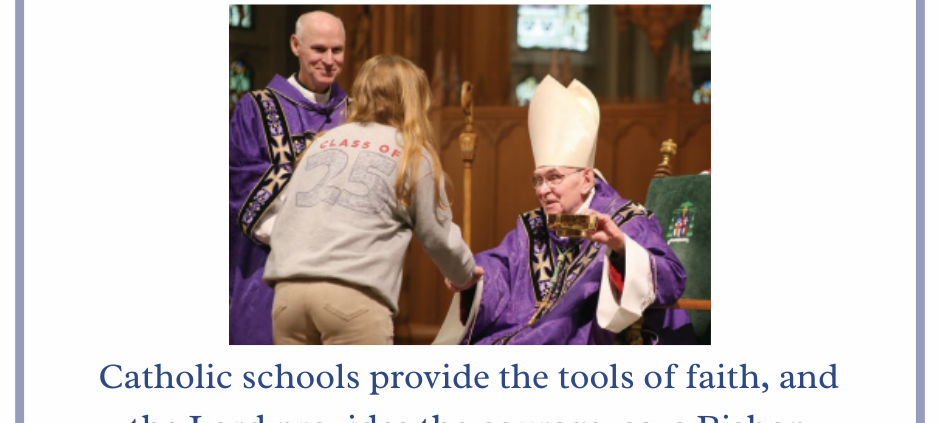
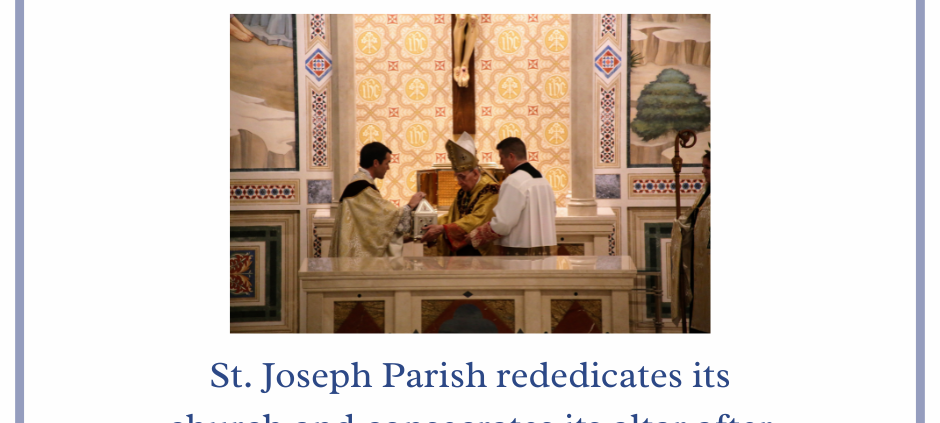
A cold Sunday, January 12, marked a special celebration for St. Augustine Parish, Covington, as the pews were filled in honor of the re-dedication and the blessing of a new altar for the more than 100-year-old Church.

Father Daniel Schomaker, pastor of St. Augustine, began a capital campaign in February of 2018 with the goal of restoration, conservation and renovation of the church and other parts of St. Augustine’s campus. And now, after the trials of COVID-19 which interrupted and delayed parts of the project’s progress, St. Augustine was able to celebrate these achievements with the final piece — a new frontal was added to the Altar of Sacrifice, featuring the Eucharistic symbol of a mother pelican, and the whole of it was accentuated with gold ornamentation and a reliquary vault. First class relics, including examples of those such as St. Andrew, St. John Vianney, St. Pius X were entombed in the reliquary vault as part of the altar’s blessing.

Bishop John Iffert celebrated the Mass as well as blessed the updated altar and rededicated the Church, in choro with Bishop Emeritus Roger Foys and concelebrated with Father Michael Grady, pastor, St. Therese parish, Southgate; Msgr. Kurt Kemo, vice rector of the Cathedral Basilica of the Assumption, and Father Stephen Bankemper, pastor, St. Catherine of Siena Parish, Ft. Thomas. The ceremony was joined by many of St. Augustine’s parishioners participating as well.

In his homily, Bishop Iffert emphasized the importance of Christ’s baptism — a feast day celebrated the same day as the re-dedication. “People were coming from all over the region to be baptized,” he said, “… amid all the people, Jesus is revealed to be the new temple of God and the hope of divine life for all.”

He mentioned how the Holy Spirit descended upon Jesus during his baptism, and that that “same spirit descends upon Christ’s holy people gathered in prayer … it will be made manifest that the same holy people gathered by Christ are the Church. That is the holy people.” Of course, representing the mirror event of the Holy Spirit descending upon the disciples at Pentecost.

“The Church has also been the name given to the buildings in which the Christian community gathers to hear the word of God,” said Bishop Iffert, “and, so, we gather this morning, on the Feast of the Baptism of the Lord, to rededicate this lovingly restored building and the temple of living stones that worships here, and goes out into the world from here to be the living mission of Jesus.”

“May the renewal of this building bring restored life to the temple …remind us to embody St. Augustine’s sacred truth, ‘One loving heart sets another on fire,’ and may God continue to pour out graces upon the people of St. Augustine and the Diocese of Covington … May the Lord make you and me his Eucharistic people and missionary disciples and use us to convey his peace to our neighbors and to all whom seek the truth.”

At the conclusion of Mass, Father Daniel Schomaker, pastor of St. Augustine, Covington, thanked all who came together for the celebration, but, also, in a special way the bishops present — both Bishop Iffert and Bishop Emeritus Foys, who initially gave Father Schomaker permission to begin the restoration project in 2018.

The bishops were presented with gifts from the parish, including ornaments from St. Augustine’s “Be Their Light” ministry, who care for sick and homebound parishioners, but this year honored specifically parishioners who had passed with ornaments on a tree at the front of the Church. The ornaments given to the bishops included the names of both of Bishop Foys’ late parents, and Bishop Iffert’s mother who passed in 2022.

The bishops were also both presented with images of commissioned pectoral crosses that they will soon be receiving on behalf of St. Augustine Parish. The crosses include a shell-engraved image of the Restless Heart of Jesus, a symbol pertinent to St. Augustine’s patron.

Bishop Iffert names three local churches as sacred sites for Jubilee 2025

Staff Report

With every Jubilee year, the Pope grants the faithful the opportunity to receive indulgences. In the Decree for the Granting of the Indulgence During the Ordinary Jubilee Year 2025, Pope Francis calls the indulgence “a Jubilee grace.”

The gift of the indulgence, Pope Francis says, “is a way of discovering the unlimited nature of God’s mercy. Not by chance, for the ancients, the terms ‘mercy’ and ‘indulgence’ were interchangeable, as expressions of the fullness of God’s forgiveness, which knows no bounds” (Spes Non Confundit, 23).

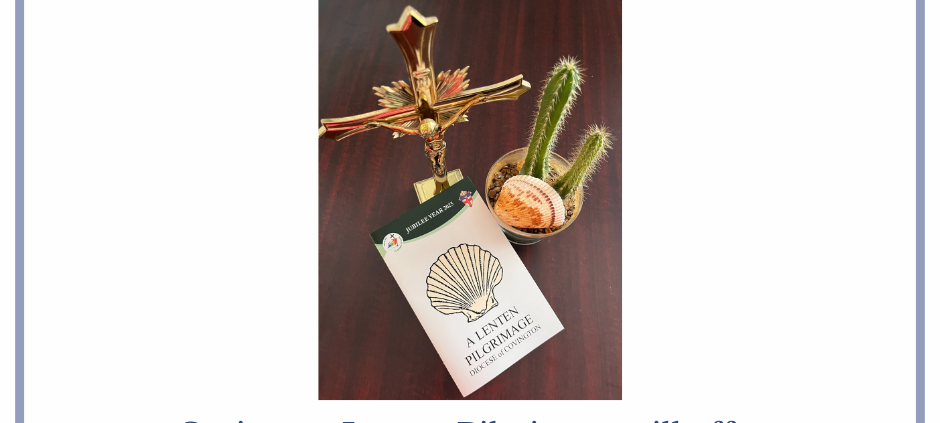
For the 2025 Jubilee Year of Hope, Pope Francis has declared three ways the faithful may obtain a Jubilee indulgence — by making a pilgrimage, through performing works of mercy and penance and by visiting sacred sites designated by the local bishop.

“…the faithful can obtain the Jubilee Indulgence if, individually or in a group, they devoutly visit any Jubilee site and there, for a suitable period of time, engage in Eucharistic adoration and meditation, concluding with the Our Father, the Profession of Faith in any legitimate form, and invocations to Mary, the Mother of God.” (Decree for the Granting of the Indulgence During the Ordinary Jubilee Year 2025)

In the Diocese of Covington, Bishop John Iffert has designated three churches as sacred sites where pilgrims can visit and receive the Jubilee indulgence (see decree below). They are the Cathedral Basilica of the Assumption, Covington; St. John the Evangelist Church, Carrollton and St. Patrick Church, Maysville.

The Cathedral Basilica of the Assumption is the Mother Church of the Diocese of Covington. The Cathedral is open for visitors Monday–Friday, 9 a.m.–3 p.m.; Saturday 10 a.m.–4:30 p.m. Mass and Sunday 11:30 a.m.–5:30 p.m. Mass. Pilgrims visiting the Cathedral will find the Jubilee Cross, which will be displayed during every Mass throughout the Jubilee year.

St. John the Evangelist Church is the Diocese’s western-most church. St. John the Evangelist Parish was established in 1854. Its current church building took 14 years to build and was dedicated on June 25, 1916, by Bishop Ferdinand Brossart. The gothic structure was designed by Leon Coquared, the same architect that designed Covington’s Cathedral, and has been fondly referred to as “the cathedral in the cornstalks.” Mass times at St. John the Evangelist Church are: Saturday 4:30 p.m.; Sunday 9:30 a.m. and 12:30 p.m. Spanish (11:30 a.m. during summer); Monday and Wednesday 6:30 p.m.; Tuesday and Thursday 6:45 a.m. and 8:00 a.m.; Friday noon. Adoration with closing Benediction is held Wednesdays, 5:30 to 6:30 p.m. and First Friday, 11 a.m. to noon.

St. Patrick Parish, Maysville, was established in 1847 and predates the establishment of the Diocese of Covington (1853). The current St. Patrick Church building was dedicated June 26, 1910, by Bishop William Maes. Mass times at St. Patrick Church are: Saturday 8 a.m., 5:15 p.m.; Sunday 8 a.m., 11 a.m., 1p.m. (Spanish); Monday thru Friday 8 a.m. Adoration is held Wednesdays, 8:30 a.m.–6 p.m.

Bishop Iffert blesses new building for Catholic Charities supportive housing

Maura Baker

Staff Writer

On a chilly morning, December 19, friends of Catholic Charities and residents of its St. Joseph supportive housing came together for a blessing by Bishop John Iffert of a new building on the premises. Built with the skills of parishioners of St. Pius parish, Edgewood, the space will be used as additional storage for residents, as well as a communal space and office space for case workers.

The St. Joseph supportive housing consists of two apartment buildings in Elsmere, which are owned and operated by Catholic Charities of Northern Kentucky. The apartments provide permanent housing to individuals and families in need, as well as case support to help them achieve stability.

Bishop Iffert quoted Pope Francis as he prepared for the blessing, paraphrasing that “When we spend time with a neighbor who needs our help, we are making a pilgrimage to encounter the face of Christ in our daily lives.” Afterward, he thanked the work of Catholic Charities, and the hospitality of the residents of the apartments for welcoming him.

St. Mary’s Park Christmas tree to feature custom ornaments

Maura Baker

Staff Writer

In preparation for the 2024 Bambinelli Blessing and Christmas Tree Lighting, parishes, schools and institutions from across the Diocese of Covington were invited to design ornaments to be displayed on the Christmas tree to be lit in St. Mary’s Park, Covington, on the night of the Bambinelli. Ornaments spoke to the mission, culture and history of these diocesan facilities — some examples provided as we prepare for the Bambinelli and the coming of Jesus at Christmas.

(left) The ornament by Thomas More University, Crestview Hills, was hand-painted by student Kendra Yurt, class of 2026. Amidst the gold patterns is an image of the belltower of the campus’s Mary, Seat of Wisdom chapel.

(center) St. Patrick school, Maysville, features a Celtic “trinity knot” over a green background — representing the Father, Son and Holy Spirit. This imagery ties to the school and connects to the parish’s Irish heritage, as well as to its patron, St. Patrick, who is also the patron saint of Ireland.

(right) The red ornament designed by Our Savior parish, Covington, is decorated with repeating designs in Pan-African colors black, gold, white and green. These designs represent and point to the parish’s black and African American history

Divine Providence sister, like many religious, recalls a life of love and service

Maura Baker

Staff Writer

As a young girl, the prospect of becoming a religious sister was one Divine Providence Sister Carleen Schumacher avoided. “I kept thinking ‘no, no, that’s not for me,’” she said. Years later, in 1968, Sister Carleen overcame that avoidance and joined the Sisters of Divine Providence, and she “never regretted it a day.”

“Thank goodness God kept nudging at me,” said Sister Carleen, “I did finally follow through.”

Sister Carleen served in schools for 30 years, 17 years as a primary teacher, and 13 as an administrator. However, in 1994, Sister Carleen was elected to the CDP’s provincial council as part of the leadership team full time, and left teaching. She was re-elected in 2004 but decided not to go back to teaching following her second term.

“I worked from 2009 to 2014 in Parish Kitchen,” a Catholic Charities run organization that provides food and other necessities, “and I would still be there today if I didn’t get re-elected in 2014,” Sister Carleen said. At the Parish Kitchen, Sister Carleen said she learned “far more from the people at Parish Kitchen” than she believed she helped them. “It was five wonderful years,” she said.

Sister Carleen said that she has loved each of her ministries, from teaching, to leadership, to serving the poor — and, now, Sister Carleen serves as the administrator for Holy Family Home, the retirement home for the Sisters of Divine Providence.

Reflecting on her life as a sister, Sister Carleen says that, while she would have loved to have gotten married, she was “called to a deeper life of prayer.”

“It’s really wonderful to live with women who are committed to the same thing I am,” she said, “They’re all committed to community life like I am, to a life of prayer, a life of living the vows. I think there’s a deep satisfaction for me and knowing I’m doing what I really felt God called me to do.”

Now, as she works closely with her fellow retired sisters, Sister Carleen recognizes the importance of supporting retired religious. “We really count on everybody’s prayers, naturally,” she said, “but there’s a really big financial piece to any nursing home.”

Contributions to collections like Dec. 14–15’s Retirement Fund for Religious provides care for women religious as they age, and, while Sister Carleen stated that she would “never want our sisters to live an extravagant life, we weren’t called to that,” many retired religious have medical needs which are often costly to meet.

The National Religious Retirement Office (NRRO) estimates an annual care cost of over $1 billion for the nation’s more than 20,000 retired religious. In 2023, parishioners of the Diocese of Covington contributed $43,198.43 to the Retirement Fund for Religious in the diocese.

Assistance with these needs is greatly appreciated, said Sister Carleen, as well as the “support of the Diocese, and gratitude for what these sisters have done all their years.”

200 nativities help bring the community together during Advent

Bella Young

Multimedia Correspondent

A church of German Gothic design nestled in Covington welcomed a full congregation on the evening of Nov. 23 to celebrate its centennial anniversary. For the past 100 years, St. John the Evangelist Parish, Covington, has served its local community in faith.

The formation of the parish and building of the church began with a need, Bishop John Iffert, who celebrated the Mass, began his homily. The History of the Diocese of Covington, a book published in the 1950’s, has a brief but “interesting” entry on St. John the Evangelist’s Parish. “The reason the neighbors began gathering and began to work on founding a parish here,” said Bishop Iffert, “is because they wanted to build a school.”

The commute to the next closest school at Mother of God was “too long of a commute,” he said, “especially given the condition of the roads at the time. So, apparently, it was easier to build the school and start a parish than for them to fix the roads!”

While the comment was made partially in jest, Bishop Iffert used this origin story to connect to the weekend’s liturgy — the Solemnity of Christ the King. In his homily, he spoke about the promises made by sovereigns and government leaders, such as the Michigan governor who ran on the platform of “fixing the expletive roads.”

“It seems like that’s been a feature of a need for our lives for a long time, especially for folks here in St. John’s Parish,” Bishop Iffert said. “It’s interesting how often our political campaigns, who takes political power … how often it hinges on those very human rights.”

“Jesus remembers something that we and our rulers often forget,” he continued in his homily, “We hear the kings of the world speak of themselves in the third person: the royal ‘we.’ In our democratic age, it sounds officious … that language comes from the idea that the king no longer has a private life, that the king no longer has a self-interest … The king is supposed to be the one who does not promote his own good, but instead lives for the good of others.”

Bishop Iffert said, “Jesus reveals to us that this is the way God cares for us. This is the way God loves us. This is the way God pours out his life, ruling from the cross, emptying himself for the love of us, you and me. This is the way we are called to govern our own lives in a way that we live in service to others.”

Circling back, Bishop Iffert concluded his homily, saying that while the origin of St. John’s Parish was so that “children didn’t have to walk on muddy roads for long distances, the purpose has always been the same. Share that power of love with everyone you meet.”

“That’s what we celebrate tonight,” he said, “100 years of God’s grace, supporting you in that kind of loving service — service that looks like the cross of Jesus, the cross on which he reigns. King of the universe, high priest and champion of our hearts.”

St. John the Evangelist Parish celebrates 100 years of God’s grace and loving service

Maura Baker

Staff Writer

A church of German Gothic design nestled in Covington welcomed a full congregation on the evening of Nov. 23 to celebrate its centennial anniversary. For the past 100 years, St. John the Evangelist Parish, Covington, has served its local community in faith.

The formation of the parish and building of the church began with a need, Bishop John Iffert, who celebrated the Mass, began his homily. The History of the Diocese of Covington, a book published in the 1950’s, has a brief but “interesting” entry on St. John the Evangelist’s Parish. “The reason the neighbors began gathering and began to work on founding a parish here,” said Bishop Iffert, “is because they wanted to build a school.”

The commute to the next closest school at Mother of God was “too long of a commute,” he said, “especially given the condition of the roads at the time. So, apparently, it was easier to build the school and start a parish than for them to fix the roads!”

While the comment was made partially in jest, Bishop Iffert used this origin story to connect to the weekend’s liturgy — the Solemnity of Christ the King. In his homily, he spoke about the promises made by sovereigns and government leaders, such as the Michigan governor who ran on the platform of “fixing the expletive roads.”

“It seems like that’s been a feature of a need for our lives for a long time, especially for folks here in St. John’s Parish,” Bishop Iffert said. “It’s interesting how often our political campaigns, who takes political power … how often it hinges on those very human rights.”

“Jesus remembers something that we and our rulers often forget,” he continued in his homily, “We hear the kings of the world speak of themselves in the third person: the royal ‘we.’ In our democratic age, it sounds officious … that language comes from the idea that the king no longer has a private life, that the king no longer has a self-interest … The king is supposed to be the one who does not promote his own good, but instead lives for the good of others.”

Bishop Iffert said, “Jesus reveals to us that this is the way God cares for us. This is the way God loves us. This is the way God pours out his life, ruling from the cross, emptying himself for the love of us, you and me. This is the way we are called to govern our own lives in a way that we live in service to others.”

Circling back, Bishop Iffert concluded his homily, saying that while the origin of St. John’s Parish was so that “children didn’t have to walk on muddy roads for long distances, the purpose has always been the same. Share that power of love with everyone you meet.”

“That’s what we celebrate tonight,” he said, “100 years of God’s grace, supporting you in that kind of loving service — service that looks like the cross of Jesus, the cross on which he reigns. King of the universe, high priest and champion of our hearts.”

Deacon Kaiser remembered for a lifetime of generosity and service

Deacon Bernie J. Kaiser, 83, died Nov. 13. He was ordained a deacon of the Diocese of Covington by Bishop William Hughes, 1985, in the diocese’s first class of deacons. He was the husband of Linda Roaden Kaiser, and father to Tim Kaiser and Chris Kaiser, as well as a grandfather to 10 grandchildren and 13 great grandchildren. Deacon Kaiser was preceded in death by his parents, his children Sandy Kaiser and Dave Kaiser, sisters Myrtle Vicars and Alvera McMillan and brother Robert Kaiser.

Deacon Bernie Kaiser grew up on Crescent Ave. in West Covington, attended St. Aloysius school and then Covington Catholic high school for half of his high school career before switching to Holmes and graduating in 1960, after which he married his high school sweetheart, Linda Roaden Kaiser, who was introduced to him by friends in high school.

Deacon Kaiser worked several jobs, but landed eventually in a finance company, according to Mrs. Kaiser, helping to form and lead Consumer Credit Counseling, utilizing his professional and personal experience in finances.

Consumer Credit Counseling is a nonprofit, debt relief program dedicated to helping people regain control of their finances and plan for a debt-free future. Father Gerry Reinersman remembers visiting with Deacon Kaiser at Consumer Credit Counseling. “He very much saw his work as a ministry,” said Father Reinersman. He saw in his work, “reducing stress in people’s lives and as a healing ministry for them and their families. He was a good humble soul.”

Deacon Kaiser grew up poor, according to Mrs. Kaiser, and, as such, “he knew what it was like having these needs that people had. He understood that because he had been there. His father was like that, too. Even though he didn’t have a lot, he was always willing to share what he had.”

After his retirement, Mrs. Kaiser remembers Deacon Kaiser telling her that he wanted to become a deacon — and, while Mrs. Kaiser never foresaw herself becoming a Catholic deacon’s wife, having grown up protestant, she noted how God has a “good sense of humor.”

During his time as a deacon, Deacon Kaiser served his home parish, St. Barbara Parish, Erlanger.

“He enjoyed being a husband and a father,” she said, “he had loved being a deacon because he was in a position where he could help people in so many ways.”

Towards the end of his life, Deacon Kaiser suffered from Parkinson’s and Dementia before passing away — while at his visitation and funeral Mass at St. Barbara’s Church, Erlanger, Nov. 22, Mrs. Kaiser recalls how many people came to her speaking of the help and aid that Deacon Kaiser had offered during their lives.

Deacon Kaiser was laid to rest at Floral Hills Memorial Gardens, Covington. Memorial donations may be made in Deacon Kaiser’s honor either online or in person at services to St. Barbara Church or to the Society of St. Vincent de Paul, Cincinnati.

Gone but Not Forgotten: MLB Unmarked Graves Project returns to the Diocese of Covington

Bella Young

Multimedia Correspondent

The Diocese of Covington is no stranger to the work of the Gone But Not Forgotten: MLB Unmarked Graves Project. It was two years ago that David Shannon and Thomas Bucher, the project founders, provided a headstone to Henry “Hank” Gastright, who had been laid to rest at St. Joseph Cemetery, Wilder, in an unmarked grave. Their latest project focused on giving Robert “Bob” Clark of the 1891 Cincinnati Reds a headstone at St. Mary Cemetery, Ft. Mitchell.

Mr. Clark was born in Covington on May 18, 1863. He would go on to play seven seasons in Major League Baseball, starting his career with the Brooklyn Bridegrooms and staying for five seasons, where he would become a well-known catcher, before concluding his career in the Majors with the Reds.

Mr. Shannon read from an excerpt of the October 1889 edition of the Brooklyn Eagle, “The first two years he (Mr. Clark) was with Brooklyn he did not distinguish himself very much and was given comparatively little work to do. This year however, he came to the front, and his work as been of the gilt-edge order. He has demonstrated that he is a great back stop, a quick and accurate thrower to bases, a fine batsman and a clever base runner. Clark is now admittedly Brooklyn’s star catcher. He is a well-built fellow, 5 feet, 10 inches tall, and weighs 175 pounds,” said Mr. Shannon to the crowd gathered.

Over his five seasons with Brooklyn, Mr. Clark became a standout playing in a total of 260 games. Despite playing a number of games, Mr. Clark was seemingly always injured. The most games he played in a season topped out at 53 in 1889.

In the succeeding 1890 season, the Brooklyn Bridegrooms and Mr. Clark had a chance to win the Pennant, what would we now call the World Series. However, “The series,” it was reported, “which was fraught with disaster to the Brooklyn’s, resulted in his disablement … His injury was a serious blow to Brooklyn’s hopes, for before he was hurt, they had a chance to win,” Mr. Shannon read aloud.

Of his injury in the World Series, Mr. Clark was quoted as saying, “My doctor seemed to think that I was paying up for severely straining myself and overtaxing my strength in those Brooklyn games. We ought to have won the Pennant.”

Because of his proclivity for injury, Brooklyn allowed the Cincinnati National League Club, to purchase his contract. In a press release from March 25, 1891, “The Cincinnati National League Club yesterday, closed a contract with another player, who will add strength to the team. Bob Clark, the fine catcher, who has been with the Brooklyn League Club for the past five seasons, will next summer wear the red and white of the Queen City Organization. This engagement will prove a good one. Clark is a Covington boy and is very popular on both sides of the river. He has a large following, and from a box-office standpoint, as well as in a playing sense, the local League Club scored a big mark in securing him,” Mr. Shannon read aloud.

Due to injury, Mr. Clark played in only 16 games for the Reds in the 1891 season.

After his retirement Mr. Clark became a saloonist. Mr. Shannon read, “There was an article from February 1892 that said he (Mr. Clark) was doing a prosperous business with a liquid emporium in Covington.” In 1895 it was reported that he was a government official, other reports noted him as a tax collector for the city of Covington. In the years leading up to his death, Mr. Clark worked at a chemical factory. It was at this chemical factory that he sustained life threatening injuries that eventually led to his death.

Mr. Clark was born a “Covington boy,” said Mr. Shannon. It was his affinity for baseball and his love of his city that was remembered as the veil was lifted from his new headstone. A round of applause came as the new granite marker was taken in by friends of the family and the family themselves.

Mr. Shannon concluded the program, “Through this project, I feel like I have gotten to know Bob Clark … Robert Clark may be gone, but hopefully not forgotten.”

SUMMIT 24 retreat brings ‘joy and love of the Eucharist’ to high school students

Maura Baker

Staff Writer

A joyous morning of prayer, dancing and song opened up Saturday morning of the SUMMIT 24 Eucharistic Retreat for high school students — just the beginning of a day of prayer and community for the young people in attendance.

This three-day retreat, Nov. 15–17, held hours of both celebration and reflection centered around the Eucharist, as well as this year’s retreat theme (which corresponds with the theme of the 2025 jubilee year), “Pilgrims of Hope.” Days consisted of Adoration, prayer and Mass, as well as educational sessions and free time to interact with fellow retreaters. This year, SUMMIT 24 welcomed 150 students.

This year’s retreat was also more diverse, according to Angie Poat, diocesan youth minister and orchestrator for the event, saying that “students came from new schools, new parishes and even from Ohio.”

“It was a blessing to see the students receive the joy of the Lord, and to grow in their depth and love for the Eucharist,” said Mrs. Poat. “They gained renewal in their own faith to be surrounded by such on-fire Catholics who were headed in the same direction as they are.”

Another “special” aspect of this year’s retreat, as Mrs. Poat described, was greater involvement in leadership from the students themselves — both from the SUMMIT core team and the YCET team, who had “larger roles in presenting the retreat.”

Following the retreat, one senior student expressed gratitude for the opportunities presented by SUMMIT 24, saying, “I am grateful for the people I met during this retreat and for the intimate relationship with God that I had in Adoration.”

The diocesan office of youth ministry is currently “building follow-up opportunities to SUMMIT,” said Mrs. Poat, which will tie in with the Eucharistic Revival and the Church’s year of mission. “We’re doing that with our young people,” she said.

Youth ministry is also gearing up for their next major “Connect” event in February, which serves a similar role as SUMMIT for junior high students.

For more information on Diocesan youth ministry events and programming, visit https://covdio.org/youth/.