Young people help to promote a ‘culture of life’, says Bishop Emeritus at Pro-life Essay

Maura Baker

Staff Writer

Annually, eighth-grade students from diocesan secondary schools are invited to participate in the Pro-life Essay Contest. This year, the contest’s theme aligned with the USCCB’s 2025-26 Respect Life Theme, “Life — Our Sign of Hope.”

“Bishop Daniel Thomas, Bishop of Toledo, asked us to be anchors of hope in our diocese.  I took this theme and ran with it when speaking to our students,” said Faye Roch, director of the Office of Pro-life who organizes the contest.

20 finalist essays from 10 different schools were chosen out of 250 essays, including a first, second and third place winner and two honorable mentions. Winners received scholarships courtesy of the Knights of Columbus for their efforts.

On March 26, finalists and their families, along with Pro-life advocates and members of the contest’s selection committee gathered for a banquet. During which, members of the committee read to the crowd excerpts from each finalist’s essay, as well as the winners’ and honorable mentions’ essays in full.

This year, the first-place essay was written by Emma Haney of St. Joseph School, Crescent Springs. (To read her winning essay see page 5.) Second place was awarded to Drew Marshall, St. Pius X School, Edgewood, and third place to Sammi Schmitz, also from St. Pius X. Honorable mentions were awarded to Addison Delaney, St. Mary School, Alexandria, and Briana Saalfeld, Holy Cross Elemenrary School, Latonia.

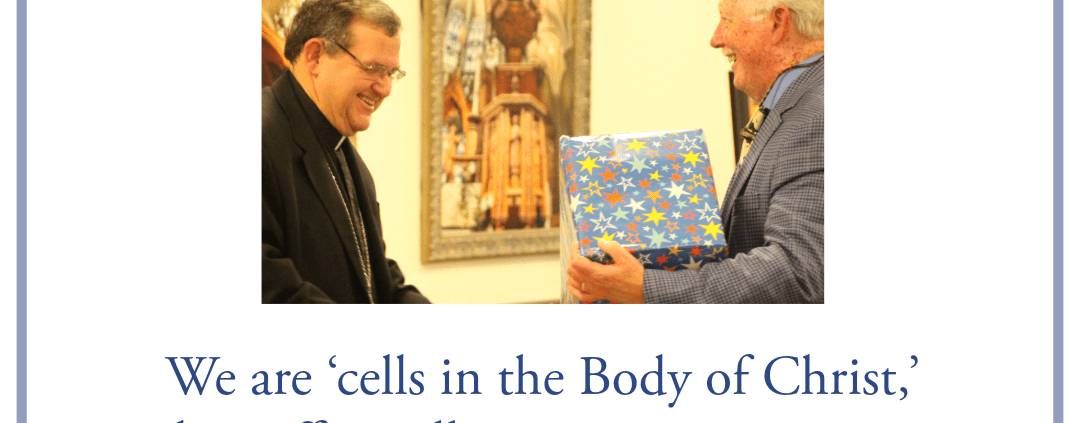
Awards were distributed to students by Bishop Emeritus Roger Foys, who additionally gave his remarks at the banquet.

He began by quoting Pope Leo XIV’s general audience the day before, “The sanctity of life, from conception to natural death, must be defended — especially now in a world marked by the madness of war.”

“We fought for many years, almost 50, to overturn Roe v. Wade,” Bishop Foys said, “… The easiest work is behind us, because what we need to do now is to promote a culture of life.”

Recalling the negative reception to the bills overturning on major news outlets and within communities, Bishop Foys said that “happened because, even though we were able to overturn that Roe v. Wade decision, we still had not achieved a culture of life … It’s behind me, at my age, but it’s ahead of us, especially in these young people,” he addressed the essay finalists.

“I think these essays tonight should give us hope — should be an anchor of hope for us that there are young people who can express in many, many ways, in a profound way, their love of life,” he said. “I think that’s remarkable, and for that we should be grateful, and we should thank God, and we should thank these young people.”

Help shape the future of the Diocese of Covington

Your input is important! Help shape the future of the Diocese of Covington by joining one of four pastoral planning and development Commissions.

The Diocese of Covington is launching an expansive, consultation‑driven process to develop a Diocesan foundation and set a pastoral course for “the next decade or more.” Bishop John Iffert is inviting parishioners from around the Diocese to be involved in the discernment and recommendation process.

The commitment involves four monthly sessions from April through July, lasting 90 minutes to two hours each.

Participants will attend an initial kick-off General Session, April 14, 15 or 16, 6:30–8:30 p.m., followed by three focused subcommittee meetings to benchmark best practices and draft actionable strategic goals. Meetings are held at the Curia, Bishop Howard Memorial Auditorium, Covington.

Registrations are now being accepted, visit www.covdioplanning.org.


The Catholic Foundation Commission will evaluate the feasibility of establishing a Diocesan foundation designed to inspire greater generosity and ensure sustained support for the Church’s mission. To inform this strategy, the Commission will analyze giving trends within the Diocese of Covington over the last 20 years, reviewing data across parishes, schools, and Diocesan ministries. This process includes benchmarking against peer organizations to adopt best practices in annual funds, major gifts, and planned giving.

Subcommittees of the Catholic Foundation Commission are:

Governance Committee
Foundation Services Committee
Communications and Technology Committee


The Catholic Schools Commission will work closely with the Superintendent of Schools and the Diocesan School Board to create a three-year strategic plan for the Office of Catholic Schools to ensure our diocesan school system is operating as a proactive, mission-driven model that ensures long-term viability, spiritual vitality and academic excellence. In an era of changing demographics and financial pressures, such a plan will serve as a “living roadmap” to align resources with our core values. The commission will use the National Standards and Benchmarks for Effective Catholic Elementary and Secondary Schools as the framework for the planning and sub-committee organization.

Subcommittees for the Catholic Schools Commission are:

Governance and Leadership Committee
Operational Vitality Committee
Academic Excellence Committee
Mission and Catholic Identity Committee

The Catholic Charities Commission will study the vital mission and history of Catholic Charities at both the local and national levels. With the Board and staff having celebrated the completion of its current three-year strategic plan and all associated achievements, this commission will develop a new strategic plan to guide Catholic Charities in the Diocese of Covington through 2030.

Subcommittees for the Catholic Charities Commission are:

Governance Committee
Programs and Services Committee
Parish and Community Partnerships Committee
Communications and Fundraising Committee

The Diocesan Governance Commission will meet from September–December 2026.

Specific dates and times will be determined and published in July.

Subcommittees for the Diocesan Governance Commission are:

Governance and Organization Committee
Finance and Financial Services Committee
Technology Committee
Communications Committee

The crucifixion reminds us of Christ’s humility, Bishop Iffert says in Palm Sunday homily

Maura Baker

Staff Writer

Holy Week began with the observance of Palm Sunday, March 29. Mass began at the Cathedral Basilica of the Assumption, Covington, on a breezy spring morning, with the congregation, carrying palms, gathering across the street from the Cathedral at St. Mary’s Park — where the palms were blessed and hymns sung before processing back across the street for the Mass proper.

During the observance of Palm Sunday, the Passion of Christ is read — describing Jesus’s journey starting with his arrival into Jerusalem on the back of a donkey, until he is crucified and laid in the tomb. The Scripture is read in parts, with different speakers taking on the dialogue of characters such as the apostles, Christ, and other key players, while the congregation reads the parts of the crowd/public.

Bishop John Iffert was the celebrant and homilist for the Mass, during which he commented on the social hierarchy of Ancient Roman society and how it relates to Jesus’s humility.

“Roman society in the first century AD was a highly competitive and stratified society,” Bishop Iffert said. “They were the most status symbol-conscious society of the ancient world. The elite especially thought of their lives as a contest, an honors race … honor meant personal esteem and public office.”

“Though Jesus was in the form of God, he emptied himself, becoming the form of a slave — the very bottom of the social status pecking order.” Bishop Iffert described that not only did Jesus “humble himself” by stooping from divine status to the lowest form of human servitude, “but Paul establishes that Jesus lived his human life in a particularly surprising and humbling way.”

“He was obedient to the Father,” he said. “Even to the point of death, he was a humble servant to the Father. Throughout his lifetime, this devoted and loving servitude made him a servant even to his fellow man, even to his fellow slave.”

The climax of Paul’s statement, according to Bishop Iffert, was that Jesus not only accepted death, but even death on a cross.

“Death on a cross was not only the ultimate extreme of pain,” Bishop Iffert said, “but especially of humiliation.

“The execution method of crucifixion was reserved only for non-citizen criminals, especially slaves,” Bishop Iffert added.

“If the city of Philippi was filled with inscriptions posted by citizens eager to boast of their accomplishments in the Roman race for honors, if we are sometimes preoccupied with status, wealth, office, nationality, celebrity, social media … if we get wrapped up in any of that,” said Bishop Iffert, “Paul counters this mindset with his acclamation of Jesus Christ’s self-emptying humility. Jesus, he meets our own self-promoting passions with his wholehearted embrace of the Father’s will … and he enters into the suffering passion that our selfish sins deserve. And because of this humility, meekness and obedience — God the Father exalts him.”

How the Diocese of Covington is planning and foundation establishment

Laura Keener

Editor

The Diocese of Covington has contracted with consulting firm L’Etoile Development Services to help guide its discussions on the formation of a diocesan foundation and its upcoming pastoral planning. Bishop John Iffert says the decision grew from listening and learning — first from other dioceses, and then from local stakeholders.

“We had a working group… exploring the establishment [of a] foundation,” Bishop Iffert explained. “We thought that we would start in just a very conventional way … talking to lawyers … drafting documents and setting up a board.”

But, Bishop Iffert said, advice from other dioceses changed the approach. The best guidance was “to begin from the other direction… start by talking to the people who had a stake in the success of the foundation — our priests, our principals, our school parents, our donors… and then from the grassroots up, design the foundation around the perceived needs.” He added, “You know me, I love to start these processes by listening to people.”

As the diocese looked for help to do that listening and design work, one name kept coming up. “Over and over again, people identified this L’Etoile … Marilyn and Mark are the people that we work with locally, and they have experience in several dioceses, helping dioceses to do that,” Bishop Iffert said.

Marilyn Blanchette is the founder of L’Etoile Development Services. After 30 years in non-profit management — 13 of those years with the Diocese or Orlando, Florida — she established her consulting firm in 2011 to assist dioceses, universities and religious orders to help plan for their future.

Joining Mrs. Blanchette in assisting the Diocese of Covington is Mark Dollhopf. Mr. Dollhopf has nearly 50 years of fundraising, marketing and donor engagement experience working with universities, faith-based institutions, and other non-profits.

Bishop Iffert notes that creating a foundation is a common step for healthy, growing church organizations. “It’s a very common thing anymore,” Bishop Iffert said, noting that many dioceses have foundations, some for 30 years or more.

The Diocese of Rockford, Illinois, was an early adopter, and one which Bishop Iffert is most familiar with, establishing its Catholic Foundation for the People of the Diocese of Rockford in 1987. Other local (arch)dioceses with established foundations include Cincinnati, Lexington and Louisville.

“If you think of a growing, successful, not-for-profit — whether it’s your diocese, schools or university — almost certainly they have a foundation.”

In the near term, the foundation’s “low-hanging fruit” will be helping parishes and schools with work that often gets overlooked. “Parishes are busy places, and … it’s nobody’s job,” Bishop Iffert said about promoting charitable giving. The foundation makes it their job “to help parishes and schools do that work,” especially building endowments and planned giving — needs that can seed long-term support for ministries.

Beyond the establishment of a foundation, wider pastoral planning is centered on consultation. Recently, Bishop Iffert met with every active priest for lunch conversations about the plan and next steps. “Over the last two weeks, we’ve had a lunch almost every day, inviting seven or eight priests in,” he said. Going forward, he plans “one or two meals a month … so that I see each priest at my table once or twice a year,” and to create “another opportunity … for priests to have a special voice” as planning advances.

Why so much listening? Because priests are key partners, and the changes will affect them and their people. “Priests are … my closest collaborators and co‑workers; they’re the only group that has the sacramental nature to form a college with the bishop, … they’ve given their whole lives, so these decisions will have an impact on them,” Bishop Iffert said.

Ultimately, Covington turned to L’Etoile because trusted peers recommended them, their approach starts with listening, and their track record matches the diocese’s goals. As Bishop Iffert put it, partnering with L’Etoile is already “a very productive relationship” — and it’s helping the diocese build a foundation, in every sense of the word, for the future.

Listening first: How the Diocese of Covington is shaping a foundation and a pastoral plan for the next decade

Laura Keener

Editor

The Diocese of Covington is launching an expansive, consultation‑driven process to develop a Diocesan foundation and set a pastoral course for “the next decade or more.” And like the process used to develop the 2022 diocesan pastoral plan, Bishop John Iffert is inviting parishioners from around the Diocese to be involved in the discernment and recommendation process.

Bishop Iffert says the effort stems from the 2022 pastoral plan, which called for a study on forming a foundation to “encourage giving.”

Rather than “put the cart before the horse” by filing papers and naming a board, the Diocese chose to listen first — to pastors, parish and school leaders, potential board members and donors — so the foundation’s structure and services truly match local needs. “We really needed to hear from pastors … from people who would benefit from these services … [and] potential board members and donors … What would be helpful to them?” Bishop Iffert said.

These initial conversations resulted in a process designed to keep the work focused and transparent by organizing the planning into four Commission-led dialogues:

— Foundation Commission — Designing the foundation’s governance, services, staffing and budget.

— Catholic Schools Commission — Addressing sustainability, structure, curriculum, finances and above all, mission and Catholic identity.

— Catholic Charities Commission — Evaluating governance, rural access to services, volunteer pathways and next‑generation ministries.

— Diocesan Governance Commission — Studying assessments, how diocesan structures and services support parishes and schools, and priorities like technology and communications.

Bishop Iffert is inviting parishioners from throughout the Diocese to consider being a part of a commission, based on personal interest, experience and expertise. The commitment involves four monthly sessions lasting 90 minutes to two hours each. Participants will attend an initial kick-off meeting followed by three focused subcommittee meetings to “benchmark best practices and draft actionable strategic goals,” according to the initiative’s website, covdioplanning.org.

Meetings will be held from April through July, except for the Diocesan Governance Commission whose meetings will occur in the fall and will be announced in July.

The commitment, he says, is to make the process “as open and as transparent as it can be” so that “we can come up with a set of solutions that we can walk out supporting together.”

Spearheaded by Deacon Jim Fortner, diocesan chief operating officer, the Diocese is working with L’Etoile Development Services to help lead and organize the process. Based in Orlando, Florida, L’Etoile Development Services was founded in 2011 by Marilyn Blanchette. Named after her late father, Raymond C. Letoile, the consulting agency specializes in strategic planning, major gift fundraising and leadership development. Joining Ms. Blanchette in leading the process is Mark Dollhopf.

Bishop Iffert describes his leadership approach as rooted in broad consultation that moves toward consensus and, when ready, a clear decision: “Decision making is always a group process, to gain the wisdom that’s there and to try to move towards a shared decision.  … [and] then there’s that moment of decision taking and that’s the role of the bishop; as those conversations progress, to recognize when we’ve come to a moment of consensus that also reflects my view and something we all can live with and support. Then it’s the unique vocation of the bishop, to take that decision and bring that conversation to a conclusion and promulgate whatever policy is going to come out of it.”

At its heart, planning is local Church discernment. “I believe God blesses every local community with the gifts they need to address their problems,” Bishop Iffert said. “In my mind, it’s an extension of God’s promise to fill the body of Christ with gifts; it’s kind of an extension of that promise to provide the kinds of pastors, the kind of shepherds that we need. I talk about a local genius. It’s not one person but it exists within the community. And that’s what we’re trying to do, we’re trying to be prayerful and discern together.”

As the conversations and discernment process begins, Bishop Iffert encourages everyone to “don’t assume” and to “stay open.” There is no agenda, no predetermined outcome. The process is really gathering information and expertise to answer questions that will help shape the future of the Diocese.

“What does the local genius tell us about the future of the Church here?” said Bishop Iffert. “How are we going to be best situated to witness to our neighbors, to evangelize one another, to grow deeper in faith in Christ, and to serve the local Church and the school community, not just in the way we always have, but the way that seems best? We’re going to study and we’re going to go where our discernment and our analysis leads us — with the hope of strengthening Catholic education [and] our life as a diocese.”

Cardinal Timothy Dolan to celebrate Mass with Bishop John Iffert in dedication of the Gardens of St. Patrick’s — a place of spiritual pilgrimage

Bella Bailey

Multi-media Correspondent

Twenty years ago, Gerald Lundergan, a long-time Maysville resident and then parishioner of St. Patrick Church, Maysville, bought a small plot of land, just off St. Patrick Cemetery, Maysville. With that land, it was his dream to build Stations of the Cross, a spiritual refuge and place of pilgrimage for the faithful. Now, on land just off his original plot, and leased by the Diocese of Covington, Mr. Lundergan’s dream is almost complete. Fifteen life-size, bronze, hand-carved Stations of the Cross will soon be unveiled at The Gardens of St. Patrick’s, Maysville — eight acres of hand-crafted beauty and extraordinary detail, paying homage to Christ’s great sacrifice.

The Gardens at St. Patrick’s and its 14 completed stations, with one remaining to be completed on Ascension Sunday, May 14, will be blessed and dedicated by Archbishop Emeritus of New York Cardinal Timothy Dolan and Bishop John Iffert. Cardinal Dolan and Bishop Iffert will celebrate Mass together on Holy Wednesday, April 1, to music composed by esteemed musician Francisco Carbonell, who studied at the Pontifical Institute of Sacred Music, Rome. The composition will be performed by Dr. Everette McCorvey and his American Spiritual Ensemble. The 19-person vocal ensemble will be accompanied musically by a brass choir consisting of trumpets, horns, trombones and tubas.

The celebration of Holy Mass, April 1, will take place at the outdoor altar and accompanying amphitheater seating, which are nestled into a small hillside, just before the first station.

“The Stations of the Cross, to me, is what it’s all about,” said Mr. Lundergan. “If you live the Stations of the Cross, you understand why you’re here on Earth.”

Upon arrival at the Gardens at St. Patrick’s, visitors will be greeted by a welcome center, ticket booth and a 7.5-story-tall cross. This cross will cast a shadow over the twelfth station, the crucifixion, at the time of Christ’s death, 2 p.m. Inside the welcome center, guests will be greeted by stories about the “crucifixion, stations, the history of the stations,” said Mr. Lundergan.

Before beginning their spiritual journey, visitors will walk through a recreation of the Garden of Gethsemane. Though not officially a location in the Stations of the Cross, the Garden of Gethsemane is an important part of the Passion of Christ. At the garden there is an olive press from Jerusalem, symbolic of the Garden of Gethsemane’s role as a functional olive garden at the time of Judas’ betrayal.

The replicate Garden of Gethsemane will lead visitors to the first of 15 stations, all of which are life-sized and hand-carved by Italian sculptor Reto Demitz, and his team of sculptors. The bronze statues include important figures in the Stations of the Cross including, of course, Jesus, Pontius Pilate and Mary, mother of Christ, but also Veronica, Simon of Cyrene and the women of Jerusalem.

“I wanted to make it just exactly the way it really was. So, there would be no discrepancies about what went on during this time in the life of Christ, who was there and who witnessed it. And so, when you walk these stations, hopefully you’ll feel like you’re there the day that it’s happening,” said Mr. Lundergan.

“It’s my hope that if you’ve got pain, you’ll come here and be relieved, if you’ve got a problem, you’ll come here and figure it out. I hope this is a solution place,” said Mr. Lundergan, “that people will come here and know that this is a quiet, sacred place … it’s a sacred place for you to figure out things that you want to do better in your life and how you conquer things in your life.”

Such a precise level of detail will be prevalent throughout the walking path as visitors travel from station to station. Mr. Lundergan partnered with a research team out of Lexington, Kentucky, to ensure the path which visitors walk, will closely replicate the Via Dolorosa, the path Christ walked as he proceeded towards death.

“I wanted it to be close, if not just like the real walk in Jerusalem,” said Mr. Lundergan.

Including two small bridges featured along the route, which will take visitors over a manmade stream twice, because “the path that we’re on that Christ took the day of his crucifixion, he crossed over the water twice,” said Mr. Lundergan. “So, we have recreated that. We took the natural stream that was here and we rebuilt it.”

The stream has been landscaped with limestone rock from a local quarry, an homage to Maysville history. The stream will be supplied by three 10,000-gallon tanks circulating water through the landscape.

Each station along the path will have an audio accompaniment, where visitors will be able to hear reflections from Cardinal Dolan and Mr. Lundergan as they walk the route. Visitors will have the opportunity to stop at each station and truly reflect as benches are provided at each station, with kneelers included at the twelfth station.

“We all have little roadblocks in our life. And if you can come here and solve that roadblock by just reflection and prayer and really realize what the Lord went through for us, maybe this is all worthwhile,” said Mr. Lundergan. “The whole idea just behind this whole thing is to give back in a way that will be very beneficial to people — middle-aged people, senior people, anybody that needs quiet time, that wants to reflect and wants to figure out their next move in life.”

He continued saying, “I’m just hoping that people will use this as a way to get closer to the Lord and prepare themselves for the real life that they’re going to live in Heaven.”

Federal tax credits granted by House Bill 1 serve as major victory towards school choice in Kentucky

Maura Baker

Staff Writer

Kentucky House Bill 1, which allows federal tax credits to nonprofit organizations providing scholarships and aid for private schools, is now law. Effective 2027, the bill was formerly vetoed by Governor Andy Beshear, but lawmakers recently overturned the decision — making this a major victory for advocates of school choice.

According to Jason Hall, executive director of the Catholic Conference of Kentucky, individuals who donate to these such organizations get a tax credit of up to $1,700 per year. Under the new law, “those scholarship granting organizations then have to provide scholarships on a needs-based approach,” said Mr. Hall. And that money can be given to families in need of assistance regardless if they are attending private or public school — as these tax credit supported donations can go to any educational need — including tuition, technology or tutoring. Donors can also request funds be allocated to specific schools, including Catholic schools.

Previously, similar tax credit programs in Kentucky were vetoed due to a provision in the Kentucky constitution prohibiting state tax money from supporting private schools. This does not apply to House Bill 1 as a federal program, allowing the program to be implemented state-wide.

One of the biggest struggles of seeing the bill passed — and part of the continuous struggle towards school choice state wise — was “a lot of misinformation,” according to Andrew Vandiver, a major proponent of school choice and formerly the associate director of the Catholic Conference of Kentucky. “It’s not about hurting public schools, or taking anything away from public schools,” he said. “This is just another opportunity to help kids.”

Optimistic about the program, Mr. Vandiver said that “the thing (he’s) really excited about is that this is going to bring millions of dollars into Kentucky to help kids.”

“You’re going to see nonprofits pop up around the state, including in the Diocese of Covington,” said Mr. Vandiver. “It’s going to really encourage charitable giving.”

“Kentucky is one of very few states that has no form of educational choice,” said Mr. Hall. “I’m hopeful that this will remove the stigma and show that we can really work together and support all kids in a better way.”

Students enrolled in OCIA exemplify Catholic schools as tools for evangelization

Maura Baker

Staff Writer

Evangelization is just one of many functions of Catholic schools. When attending, students are not only educated in theology but submerged in an environment surrounded by prayer and faculty, staff and peers living out their faith.

While Catholic schools are open to students of all faiths who desire a faith-based private education, some students find themselves called to the Catholic faith while attending these schools — choosing to attend OCIA with the eventual goal of Baptism and full communion with the Church.

This year, students and their families from across the diocese will be welcomed into the Church during the Easter Vigil. These candidates and catechumens come from both grade schools and high schools — including three students from Villa Madonna Academy, Villa Hills; one from St. Cecilia School, Independence; two from St. Joseph School, Crescent Springs; two from St. Joseph School, Cold Spring; three from Bishop Brossart High School, Alexandria, and others.

One such candidate is Ava Freppon, a junior attending Bishop Brossart High School, and enrolled in OCIA at St. Joseph Parish, Cold Spring.

“Back in the spring of 2024, I went to a non-denominational church with my friends from school because I found an interest in having religion in my life,” Ms. Freppon said of her experience. “I was then baptized in July of 2024 alongside many of my friends and it was such a fun and important day in my life.”

However, saying that her previous church didn’t give her the “strong passion” she had hoped for, she “attended (her) first Mass at St. Joes that November and (she) loved the Church’s meaningfulness and purpose behind each Mass.”

Later transferring schools to Bishop Brossart High School — a decision made to further encourage her interest in the faith — Ms. Freppon said that she “was excited to have a religion class to hear more about different topics of the faith. As the school year and OCIA sessions went on, I started to notice being able to compare things I learned at school to what I was learning at the OCIA meetings. I feel like I have been able to dive deeper into the Catholic faith and I am excited to continue my life alongside my friends and family under this wonderful following of our Lord.”

Catechumen cites sponsor, parish community, as strength during a long faith journey

Maura Baker

Staff Writer

Cailin-MacKenzie Adkins is one of over 40 candidates and catechumens of St. Timothy Parish, Union, welcomed as Elect during the Feb. 22 Rite of Election. She will be baptized alongside other catechumens during the upcoming Easter Vigil Mass.

This year is Ms. Adkins third year going through OCIA — overcoming challenges to reach the point of being able to receive the sacraments this Easter.

Growing up in Florence, Ky., Ms. Adkins’ interest in the faith began with her family. Despite having Catholic family, Ms. Adkins was never baptized herself but attended Church with her grandmother “whenever (she) could” at St. Henry Parish in Elsmere.

“Around my senior year of high school, I really just started becoming curious about the Catholic faith,” Ms. Adkins said. “I didn’t know why I didn’t get baptized. When I was little, I didn’t understand it, so I got really interested. I did a lot of research, and that’s what drove me.”

The first year in OCIA, Ms. Adkins was a student at Lincoln Memorial University in Tennessee. Due to the distance, Ms. Adkins remembered that she could not attend the OCIA meetings on Sundays. “I didn’t feel like I was putting in the effort, so I didn’t go through with it then,” she said.

The following year, Ms. Adkins attempted OCIA again — however, health issues put a speed bump in the process. Medical issues, including six surgeries in the course of the year, kept Ms. Adkins from completing the OCIA process — but in 2026, she tried once more.

“This year has actually been a really great year,” Ms. Adkins said. “I’ve been able to go to all my classes, and, why I think it’s been so successful is because of my sponsor. Debbi Cranley (the OCIA coordinator at St. Timothy Parish, Union) assigned me my sponsor and she’s amazing … She’s really gotten me into the spirit and helped me through this spiritual warfare.”

Citing her parish as another contributor to her spiritual growth, Ms. Adkins said that “I feel like St. Timothy’s is a very close-knit family community. Father Bolte and Father Hennigan stand outside Church every Sunday and shake every person’s hand that walks into the Church. It’s a really tight knit group, and I think that’s why my faith journey has gone so strong this year, because I’ve been fully committed to it, and everyone’s just very supportive.”

Now, after three years of trying and spiritual journeying, Ms. Adkins looks forward to finally completing the OCIA process — and especially the sacrament of Reconciliation.

“I think it’s so powerful,” she said, “and the priests at St. Timothy are really kind in helping you through these things, so I’m really looking forward to my first confession.”

Excited also for her baptism itself, Ms. Adkins said that she looked forward to “just being renewed, and one with God in that moment.”

The Cathedral Basilica of the Assumption prepares for a busy Holy Week with services, shroud exhibit

Bella Bailey

Multimedia Correspondent

The week preceding Easter Sunday consists of Palm Sunday, Holy Thursday, Good Friday and Holy Saturday. These days, and the ones in between, make up Holy Week, the center of the Church’s liturgical calendar.

“Holy Week is that commemoration that we walk with the Lord in his passion, and death and resurrection and that we become one with him in that through prayer and through the liturgies,” said Father Ryan Maher, rector of the Cathedral Basilica of the Assumption, Covington, the mother church of the Diocese of Covington.

Throughout Holy Week, like the rest of the churches in the Diocese, the Cathedral will be participating in the sacred celebrations. Starting with Palm Sunday, which marks the return of Jesus from his 40 days in the desert into the city of Jerusalem.

At the Cathedral, the celebration of Palm Sunday Mass begins at 10 a.m. across the street in St. Mary’s Park, Covington. There the Gospel of Luke, proclaiming the entrance of Jesus into Jerusalem, will be read. Bishop John Iffert will bless the palms the lay faithful will carry as all process into the Cathedral, a symbolic gesture of Jesus entering the city, through the main doors to begin the liturgy.

On Holy Tuesday, the Cathedral will host all the priests, deacons and religious of the Diocese as well as lay representatives from every parish and mission, at 7 p.m. for the Chrism Mass. This special Mass, during which Bishop Iffert consecrates the holy oils for the upcoming year, is a symbolic show of unity between the Bishop and his priests.

Father Maher said, “The Cathedral is packed with parishioners from throughout the Diocese. All of our parishes are at that special Mass. The unity of the Church is fully visible in the Bishop with his priests and his people all together and the consecrated religious and the deacons as well … It’s always an occasion of joy to celebrate the Chrism Mass with the Bishop; to enter into the liturgy with one mind and one heart with the people there present as well.”

Holy Thursday is the beginning of the Sacred Triduum, which is the three days leading up to Easter. Each day has a different celebration, though as Father Maher said, it is one liturgy celebrated over three days.

“Its really best to immerse ourselves in every celebration, encourage all priests, encourage their people to come to everything, all of the liturgies if they can,” said Father Maher.

The Holy Thursday celebration is the Mass of the Lord’s Supper, which begins at 6 p.m. At this Mass the Church recalls the events of the Last Supper — the institution of the Eucharist and the priesthood.

“The Lord has that Passover meal with the apostles as the end was near and the love that he shows them at the Last Supper and where he, the Lord Jesus, really replaces all of the sacrifices of old. He becomes the true Lamb, there is no more need for the Passover lambs to be sacrificed, he is the true lamb at the Last Supper, it is really Jesus giving his body and blood to his father … and giving his apostles his body and blood to eat and drink,” said Father Maher.

Those who attend the Holy Thursday celebration will also notice an act performed only once a year, the washing of the feet. In the Gospel of John, read at the Holy Thursday Mass, Jesus washes the feet of his apostles, an act of pure love.

“The Bishop, who in the person of the Lord in a special way, will put on an apron and wash the feet of the Cathedral parishioners. That’s always a very moving and really beautiful thing to witness and to participate in,” said Father Maher.

At the end of the Mass of the Lord’s Supper the Blessed Sacrament is carried throughout the Cathedral and placed at an altar of repose, which is an altar separate from the main altar and tabernacle. There the Blessed Sacrament will be exposed until 10 p.m.; lay faithful often spend that time in silent adoration and prayer while the altar is stripped of its candles and linens in preparation for the Passion of the Lord on Good Friday.

Good Friday is the only day on the liturgical calendar that no Mass is celebrated. Good Friday, the day of Jesus’ death, is the celebration of the Lord’s Passion at 3 p.m. With Stations of the Cross at 12 p.m., noon, and confessions from 12–2 p.m.

“That liturgy is really marked by the whole gaze of the Church, the whole gaze of our hearts solely fixed on the death of our Lord. That’s what that liturgy brings about for us that there is no Mass celebrated on Good Friday and so that day we are just fixed on our Lord’s suffering and death. We begin that liturgy in holy silence, in prostration before the altar and then we move into the Liturgy of the Word,” said Father Maher.

During the Lord’s Passion there is the solemn intercessions, where the Church prays for the Holy Father, the Church and the intention of every person.

Father Maher said, “It’s the Church praying for the world and everyone in the world and then we move from that to the veneration of the cross.”

The veneration of the cross is unique to the Celebration of the Lord’s Passion. “That is where the cross of the Lord is lifted up. Literally, lifted up as Moses lifted up the pole with serpent on it in the desert. So, the Cross of the Lord is lifted up and it is raised high for us to gaze upon and then the cross is venerated by the Bishop, the clergy and all the lay faithful. That, too, is just a beautiful moment as a priest celebrant to be in the sanctuary and watch the faithful come up and see the devotion, the love, the tears, the heart,” said Father Maher.

People can venerate the cross with a bow, genuflection, touch or kiss of the cross. Following the veneration, hosts that were consecrated during the Mass of the Lord’s Supper are brought to the altar for the lay faithful to receive the Eucharist.

The liturgical event of Holy Saturday will be the Easter Vigil at 8:30 p.m. The Easter Vigil Mass is unique because it begins in total darkness. But, as the flame from the Easter fire, blessed by Bishop Iffert, is passed from candle to candle inside the walls of the Cathedral, slowly the light of Christ spreads lighting the way for those inside.

The church remains shrouded in darkness until the Great Alleluia at which time the lights come on, signifying the resurrection of Christ.

This celebratory Mass includes the baptism and entrance into the church of the catechumens and the entrance into full communion with the church of the candidates through the sacraments of First Communion and confirmation. The lay faithful also renew their baptismal promises with the sprinkling right.

“The Easter proclamation,” said Father Maher, “recounts the Lord’s goodness in salvation history. His work, the working of grace, the working of the Holy Spirit, the working of the Lord’s love for his people. Then, we begin the Liturgy of the Word and that’s marked really by those great Old Testament readings.”

Easter season festivities at the Cathedral include the return of an Exhibit featuring a replica of the Shroud of Turin viewable in the Cathedral. This special exhibit will be open for all to view and venerate, 9 a.m.–3 p.m. from April 6–April 10, with extended hours until 8 p.m. on April 5.

While the times of the celebrations throughout Holy Week may vary from church to church one thing does not change, the outpouring of love from Christ to his people as the Church celebrates salvation through Christ.