
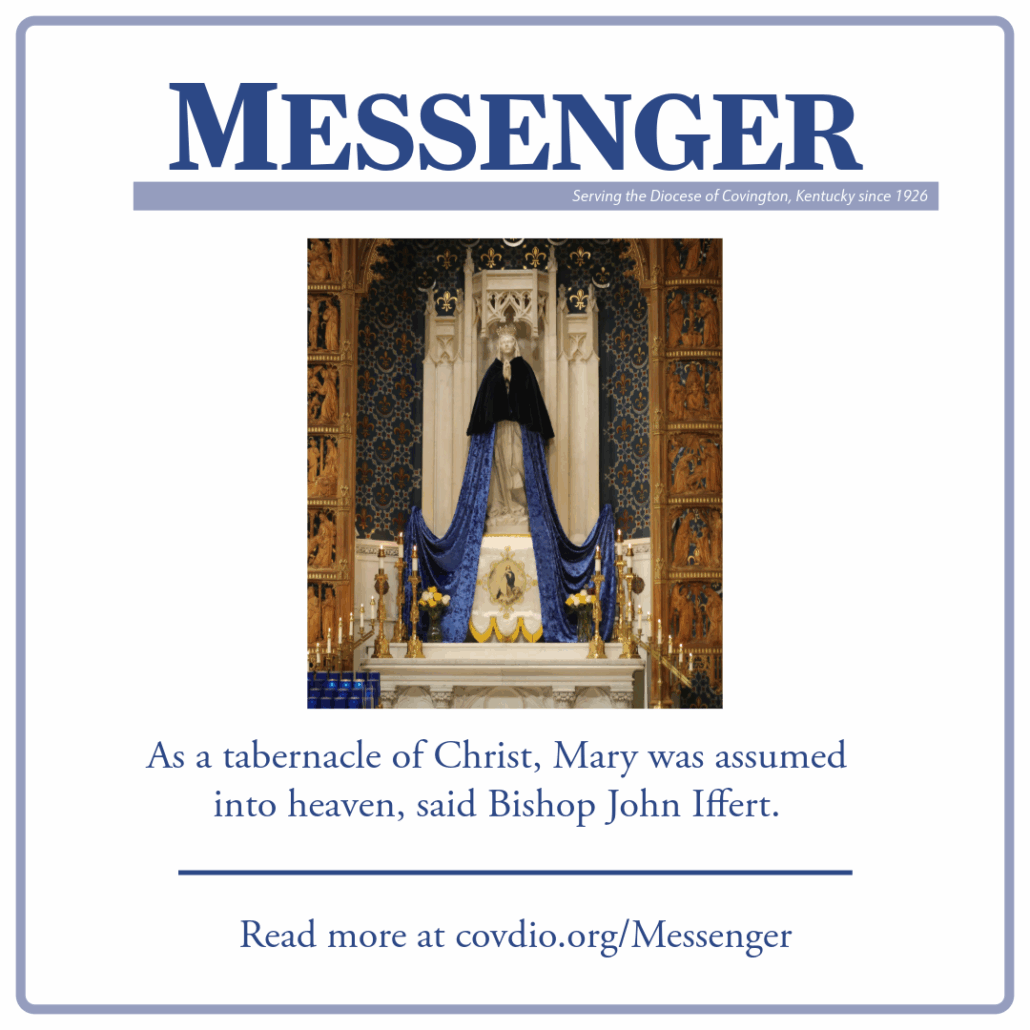
As a tabernacle of Christ, Mary was assumed into heaven, said Bishop John Iffert.
Bella Bailey
Multimedia Correspondent
Bishop John Iffert celebrated the vigil Mass for the Feast of the Assumption of Mary, August 14, at the Cathedral Basilica of the Assumption, Covington. This feast, traditionally recognized on August 15, celebrates Mary’s bodily assumption into heaven.
“Because she was the Mother of God,” said Bishop Iffert in his homily, “because bodily, she became the tabernacle of his earthly existence, her body was preserved from decay, her body was preserved from corruption, her body was preserved from the effect of sin.”
While the assumption of Mary into heaven is a point of distinction between Catholics and other religious denominations, Bishop Iffert defends the validity of the assumption with both anecdotal and doctrinal evidence.
Bishop Iffert, in his homily, recalled a story which happened to a friend who teaches at a university in the Palestinian side of Bethlehem. One day, Bishop Iffert said, this friend of his was taken on a tour by a Scripture scholar, and he was taken to three different locations. Each of which claimed to have the head of John the Baptist.
This friend, moved by disbelief, pointed out to the man displaying the relic at the third location that each of his previous stops also claimed to have the one head of John the Baptist. Bishop Iffert recalled from his friend that the man displaying the relic explained that they had the mature head of John the Baptist, and the village before them had the head of John the Baptist as a youth.
“I share this story not to add cynicism to the world but to point out just how desperate we are to connect to the holy ones who live before us. How desperate these communities are to exercise that claim for a connection to a holy saint … so much so that you end up with three heads of John the Baptist,” said Bishop Iffert.
“Nowhere in the world,” Bishop Iffert said, “do you find a relic of the Blessed Virgin Mary … nowhere in the world do you find a relic of her flesh, nowhere in the world do you find a relic of her bone. They don’t exist.”
The dogma proclaiming the assumption of Mary was defined 75 years ago in the year 1950 by Pope Pius XII, in the apostolic constitution “Munificentissimus Deus.”
“The Lord God preserved this vessel of the Lord Jesus from undergoing the corruption that normally occurs after death of a body. Mary was not allowed to be a corpse. She was always a body filled with life, that is the gift from the Holy Spirit. The Church teaches this, and it has been taught from the early centuries of the Church because it is true and it really happened,” said Bishop Iffert.
While the Church does not teach on whether or not Mary died or was “taken up in a whirlwind,” said Bishop Iffert, it does teach of her bodily assumption.
“Because she was the mother of God, because bodily, she became the tabernacle of his earthly existence, her body was preserved from decay, her body was preserved from corruption,” said Bishop Iffert.

