
Baptism of the Lord
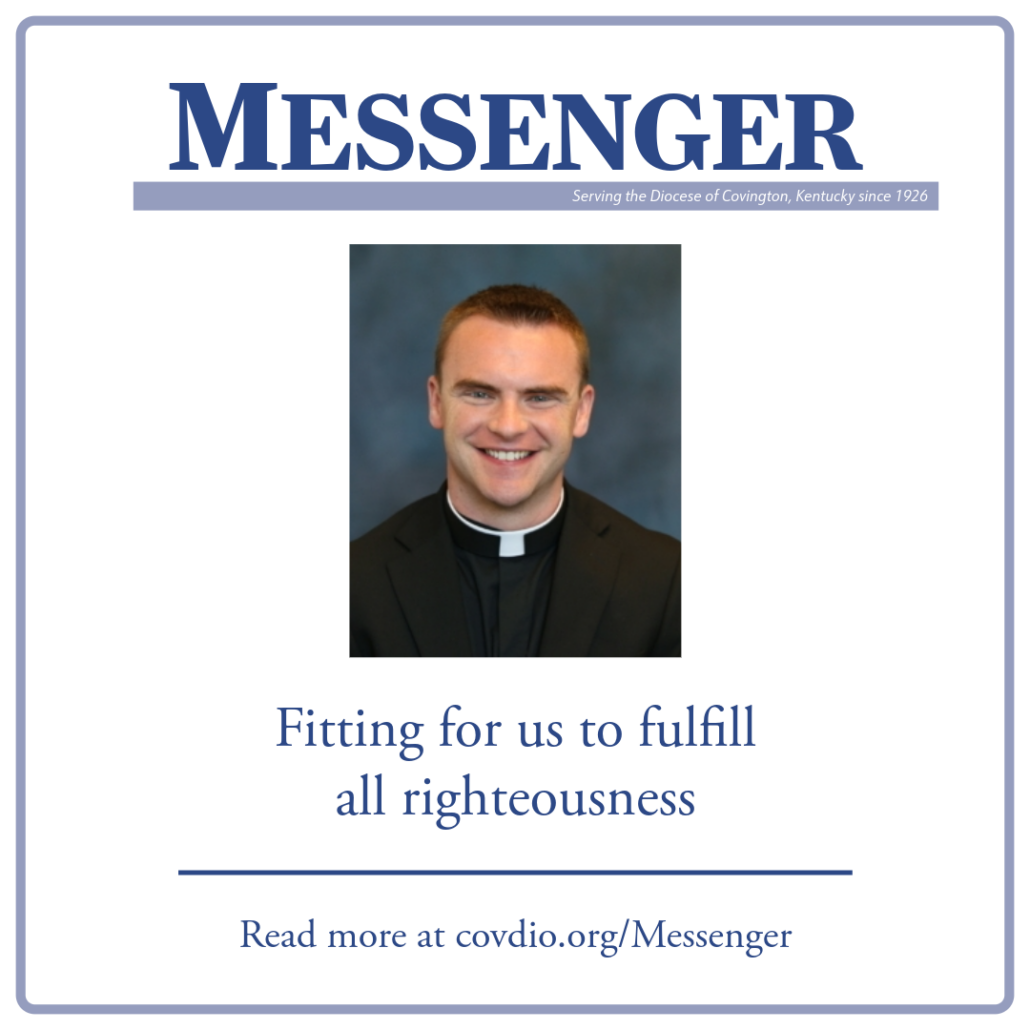
Father Michael Elmlinger
Guest
As we celebrate the end of the Christmas season, we turn our attention to the event that marks the beginning of Jesus’s public ministry: His baptism at the Jordan River by John the Baptist (Matthew 3:13-17). While this gospel is rather brief, it contains so many important realities that help to reveal to the world who Jesus is and what he has come into the world to do. By this baptism, God reveals to John the Baptist that Jesus is indeed his own Son, and that he has come into the world to “fulfill all righteousness.”
That said, this scene can be a little confusing. Why is Jesus being baptized to begin with? What does it mean for Jesus to be baptized to “fulfill all righteousness”? After all, Jesus, being the Son of God, has no sin, and John’s baptism was a baptism of repentance (cf. 3:11), meaning those who were coming to him were doing so to turn their backs on the sins that they had committed. Why would Jesus need to do this when He has not committed any sin? He certainly is tempted throughout His life, but not once does He ever fall into sin. When we keep this in mind, I think that we can all understand and maybe even share in John’s confusion when he says to Jesus, “I need to be baptized by you, but you are coming to me?” (3:14). So what righteousness is Jesus fulfilling by being baptized by John?
The righteousness that Jesus is fulfilling is that He is identifying himself with us, who are sinners. This is an aspect of God’s plan for salvation, for Jesus’s kingly mission. He is to identify Himself with us, become one of us and he is to take on our own sins as a sacrifice to the Father in the Holy Spirit in order to reconcile us to the Father, through the Son, in the Holy Spirit. What Jesus is showing here is His solidarity with sinful Israel, with each of us, who are sinners, by undergoing the same baptism as sinful Israel. This is a foreshadowing of what He is going to do on the Cross. “For our sake [the Father] made [Christ] to be sin who knew no sin, so that in him we might become the righteousness of God,” (2 Corinthians 5:21). “Sending his own Son in the likeness of sinful flesh and for sin, he condemned sin in the flesh” (Romans 8:3). His very mission as the Messianic King of Israel, anointed by the Holy Spirit and proclaimed by the Father Himself to be His “beloved Son, with whom [He is] well pleased” (3:17) is to identify himself with us in order to reconcile us to the Father.
By doing so, the Father has given us a wondrous gift: to become his adopted children through the Son and in the Holy Spirit. At our baptism, whenever it may have been, we are joined to the Paschal Mystery of Christ, where our old selves die in the waters of baptism, and we are reborn as the beloved sons and daughters of the Father. This is all accomplished for us by the fact that Christ was and is willing to identify Himself with us, by the fact that He, though never having committed sin, becomes the Paschal Lamb, Who was slain (cf. Revelation 5:12). This is the very reason that he was born into the world: to die, so that we might live. As Pope Benedict XVI says in Jesus of Nazareth, “Jesus loaded the burden of all mankind’s guilt upon his shoulders; he bore it down into the depths of the Jordan. He inaugurated his public activity by stepping into the place of sinners. His inaugural gesture is an anticipation of the Cross.” By this wondrous gift, the Father has given us all the opportunity to hear the same words that he proclaimed to Jesus: “You are my beloved son. You are my beloved daughter. With you, I am well pleased.”
Father Michael Elmlinger is a priest of the Diocese of Covington, Ky. Father Elmlinger is currently studying Canon Law at the University of St. Paul, Ottawa, Canada.

