
The Solemnity of Our Lord Jesus Christ, King of the Universe
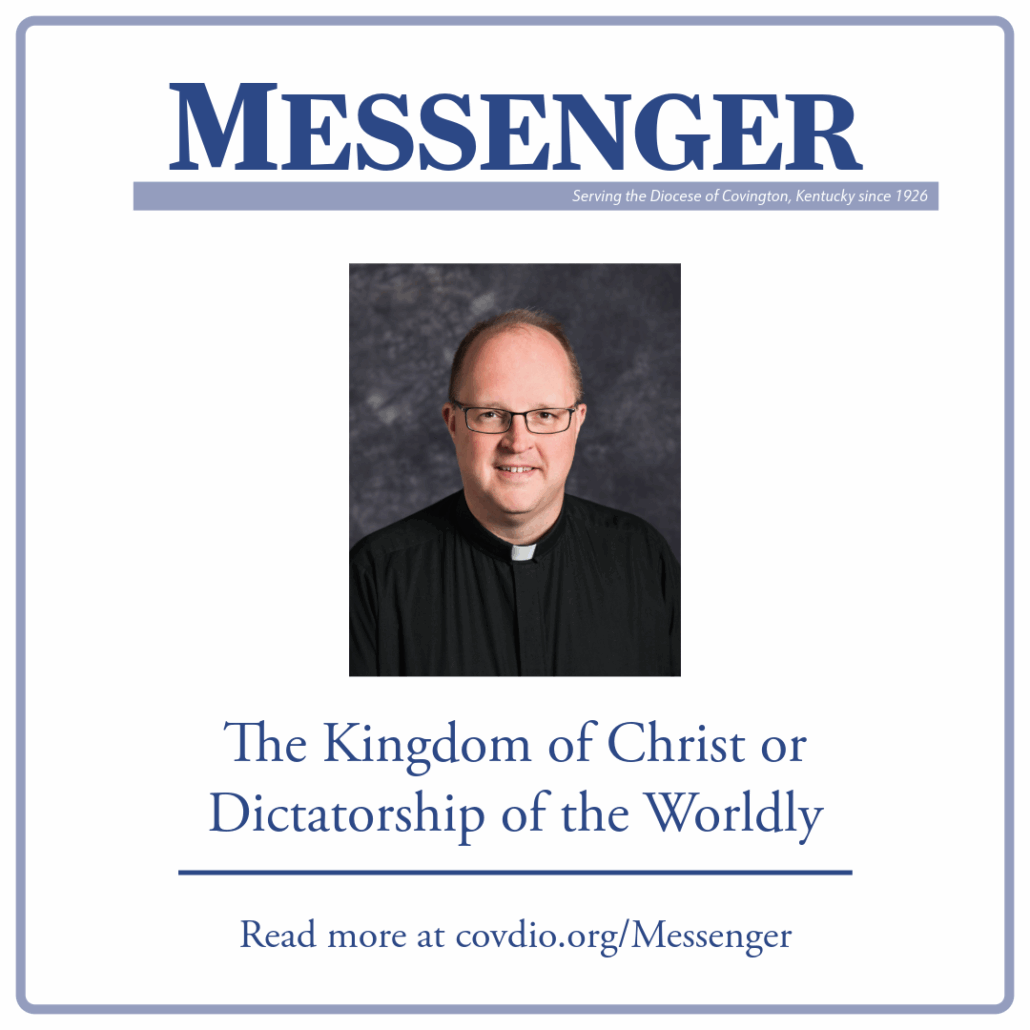
Father Phillip DeVous
Guest
“Almighty ever-living God, whose will is to restore all things in your beloved Son, the King of the universe … that the whole creation, set from slavery, may render your majesty service and ceaselessly proclaim your praise.”
These words of our opening collect for the Solemnity of Our Lord Jesus Christ, King of the Universe, unequivocally state that it is the will of God to restore all things in Christ, that creation is to be set free from slavery, and that the purpose of the entirety of creation is to render the majesty of God service and ceaselessly proclaim praise to God. This, of course, is true, however we must grasp that this statement of truth is also poses some deeply personal questions to us: Do we want to be restored in Jesus Christ? Do we want to be set free from slavery? Do we even want to see how it is we might be enslaved in various ways by the forces of the world, the flesh and devil?
It is quite easier than we think to become apathetic about the holiness of one’s life. Saying Christ is King may fall easily from our lips, but it is much harder to acknowledge that kingship with the ardor of our lives. It is easy to go the way of the world, but quite difficult to live in confrontation with the dictatorship of the worldly, which comes about as the consequence of rejecting Jesus Christ as King. The temptation is always to be more social than truthful, negotiating for our comforts within the confines of the worldly dictatorship, rather than accepting Jesus Christ as the Lord and King of our lives.
To live under the kingship of Christ is to be the target of the world’s animus. It is important to grapple with the depth of world’s hatred of those who belong to Christ. The theologian, Cardinal Jean Daniélou, describes it well:
“If I keep faith with Christ, I must incur the world’s reproach, it is impossible for me to be on good terms with the world . . . ‘The world’ [here] means the whole collection of those human tendencies that go against the Spirit of Christ, vanity, pride, hardness of heart, concupiscence; of which Christ himself said, ‘I am not praying for the world.’ [John 17:9] A Christian cannot agree with the spirit of this world, because there is a direct incompatibility between it and the spirit of Christ. So, it is natural for the Christian to be thoroughly disliked; his whole behavior is a living reproach. He has no love for the world’s ideals; this in itself is an intolerable position, because it amounts to a judgement and sentence passed upon the world. Therefore, the world hates him.”
That the world hates the Christian, because it first hates Jesus Christ, can be clearly seen in the Gospel: “the rulers sneered at Jesus … soldiers jeered at him … one of the criminals hanging there reviled Jesus.”
The rulers, the soldiers and the criminals in the crucifixion scene represent a Christological constellation of divine revelation: the scope of worldly powers opposed to the kingship of Christ. The rulers represent the forces of cynical political power, then and now, which understands power to be self-justifying by those who wield it. The soldiers represent the forces of egoism-those who get what they want by various forms of violence, believing that might makes right. Finally, the criminal gives voice to the force of sin and transgression which believes it can revile Jesus Christ without consequence.
We see here the comprehensive rejection of the Kingship of Jesus Christ, which Jesus exercises not through political power or violence or lawlessness-the ways of the world-but in humility, sacrifice and self-giving. The dictatorship of the worldly, with its cynicism, violence and free-form transgression is contrasted to the Kingdom of Christ, which is a “kingdom of truth and life, a kingdom of holiness and grace, a kingdom of justice, love and peace.”
The proclamation of Christ’s kingship and kingdom places before us the stark choice to be slave to the dictatorship of the worldly or to be sanctified citizen of the Kingdom of God. Though assailed and tempted by the various forces of the world, luring us down the paths of cynical power, egoistic violence and transgression, we make an act of profound trust in the Eucharistic Lord, knowing in my Holy Communion with Him, the Father has “delivered us from the power of darkness and transferred us to the kingdom of his beloved Son, in whom we have redemption, the forgiveness of sins.”
Fr. Phillip W. DeVous is the pastor of St. Charles Borromeo Parish in Flemingsburg and St. Rose of Lima Parish, May’s Lick.

