
Sixth Sunday in Ordinary Time
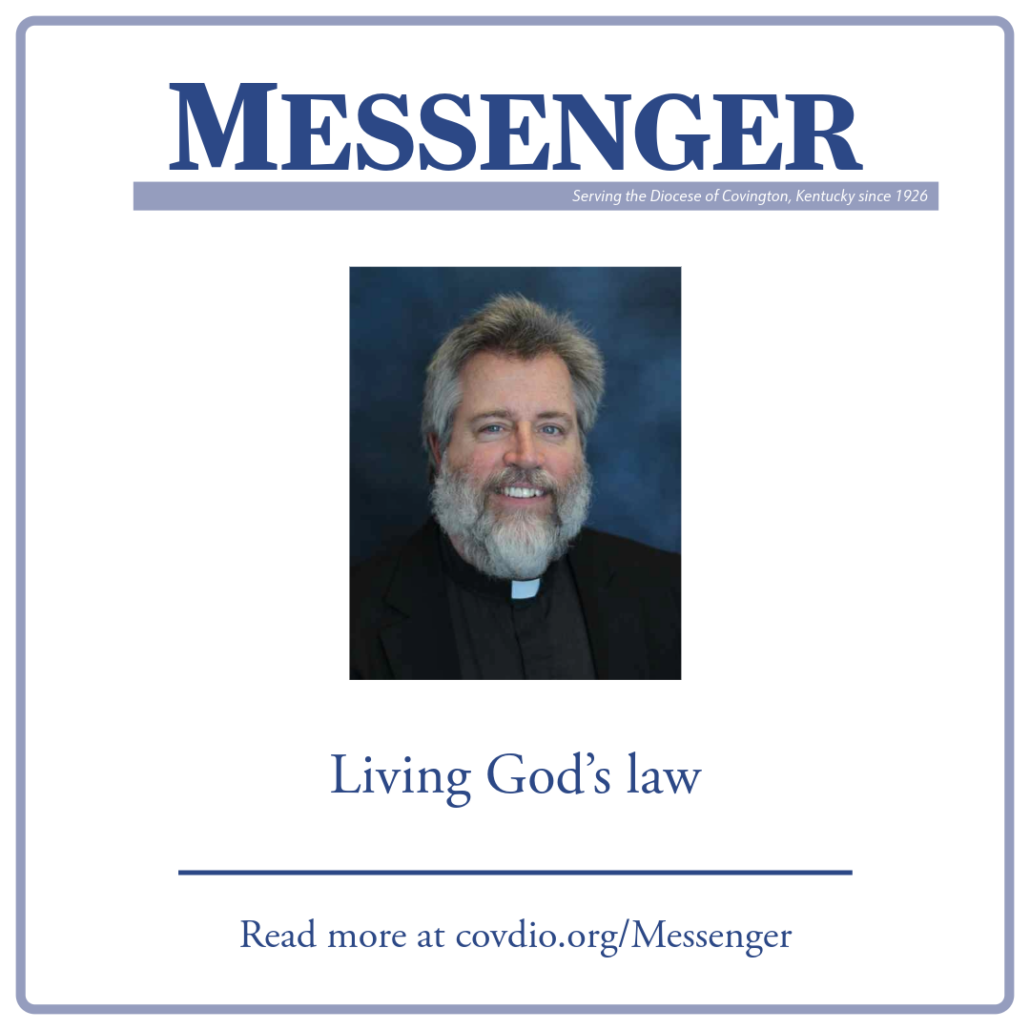
Father Stephen Bankemper
Guest
In the Gospel for the Sixth Sunday in Ordinary Time, we continue through what we call Jesus’ Sermon on the Mount. In the section of the sermon we hear this Sunday, Jesus addresses various commandments — about murder, adultery, divorce and oath-taking — but the key to understanding his teaching about these and other commandments is three sentences from what we could call his introduction to his teaching.
Jesus begins this part of His sermon saying, “Do not think that I have come to abolish the law or the prophets. I have come not to abolish but to fulfill.” It is clear from this statement that Jesus is not positioning himself against the law of Moses, which only makes sense, as God cannot be divided against himself. Remember that the evangelists record Jesus as saying, “I and the Father are one,” (Jn 10:30) and “… no city or house divided against itself will stand.” (Matt 12:25)
It might seem obvious what Jesus means by juxtaposing ‘abolish’ and ‘fulfill,’ but it is worth risking the obvious to discuss it. Abolishing “You shall not kill” would mean, of course, that Jesus is making murder legal, that we could do less than the Mosaic law. Fulfilling the law implies that there is more to the commandment than the words on the page (or the stone), that our goal should be to do more than the letter of the law, and not more quantitatively, so to speak, but qualitatively; not more as in more things to do, but more as to go more deeply into the commandment. So to insult and vilify and blast someone with my anger, but say, “I did not kill her,” is to miss the point of the law.
A third sentence in Jesus’ introduction makes this even more clear. Jesus tells his disciples, “I tell you, unless your righteousness surpasses that of the scribes and Pharisees, you will not enter the kingdom of heaven.” We might ask ourselves how this can be: the scribes, and especially the Pharisees, were highly respected as the ones who observed the law to the highest degree. In fact, they were so careful to observe the law that scripture scholars describe their approach as “building a fence around the law,” referring to their practice of adding oral regulations that were stricter than the law to prevent accidental transgressions of the law.
What Jesus could mean is that the Pharisees were so focused on obeying the mandates of the law — bodily obedience, we might say — that they did not allow the law to change their hearts. “Woe to you, scribes and Pharisees, hypocrites! For you tithe mint and dill and cumin, and have neglected the weightier matters of the law, justice and mercy and faith; these you ought to have done, without neglecting the others.” (Matt 23:23) “Woe to you, scribes and Pharisees, hypocrites! For you cleanse the outside of the cup and of the plate, but inside they are full of extortion and rapacity. You blind Pharisee! First cleanse the inside of the cup and of the plate, that the outside also may be clean.” (Matt 23:25)
Jesus could also be referring to the fact that the law itself cannot save. There are many passages in St. Paul’s letters that comment on this, but here is how he expressed it to the church in Rome: “But now the righteousness of God has been manifested apart from law, although the law and the prophets bear witness to it, the righteousness of God through faith in Jesus Christ for all who believe.” (Rom 3:21-22)
We might express all this by saying that mere obedience to dictates of the law is not the purpose of our Christian faith. Becoming “good” is not the purpose. Placating God by being perfect is not the purpose. The purpose of our Christian faith is to be transformed, to become like Christ. There was a book published in the 1970s with a chapter entitled, “How Far Can We Go?” referring to how much sexual activity can an unmarried couple engage in before they sin. The question itself is Pharisaic. The true Christian attitude is the opposite: not how little can I do and still say I belong to God, but how much of myself will I allow to be transformed, how much like Christ can I become?
Notice the passive tense of the last part of that last sentence: how much of myself will I allow to be transformed. Obeying the letter of the law will not transform us, because we are still in control. Obeying the law in its fullness — fulfilling the law — transforms us because we allow God to be in control, because we have handed ourselves over to him. It is interesting that obeying the law is easier than fulfilling the law; that is because we can obey the law by our own strength, our own willpower, but to live the law in its fulness, we need God’s grace.
Notice one final and lovely thing. Jesus does not say that he has come to get us to fulfill the law; he uses the word ‘I’: “I have come to fulfill the law.” Jesus asks nothing of us that he does not do. He leads, in obedience and humility, in fulfilling the law, and then invites us to follow. Let us accept his invitation. Let us follow him, not disregarding God’s law but living it to its fulness, allowing it to transform us into the likeness of our Savior, bringing us finally to love.
And let us pray for each other and help each other in that endeavor.
Father Stephen Bankemper is pastor, St. Catherine of Siena Parish, Ft. Thomas, Ky.