Solemnity of the Most Holy Trinity
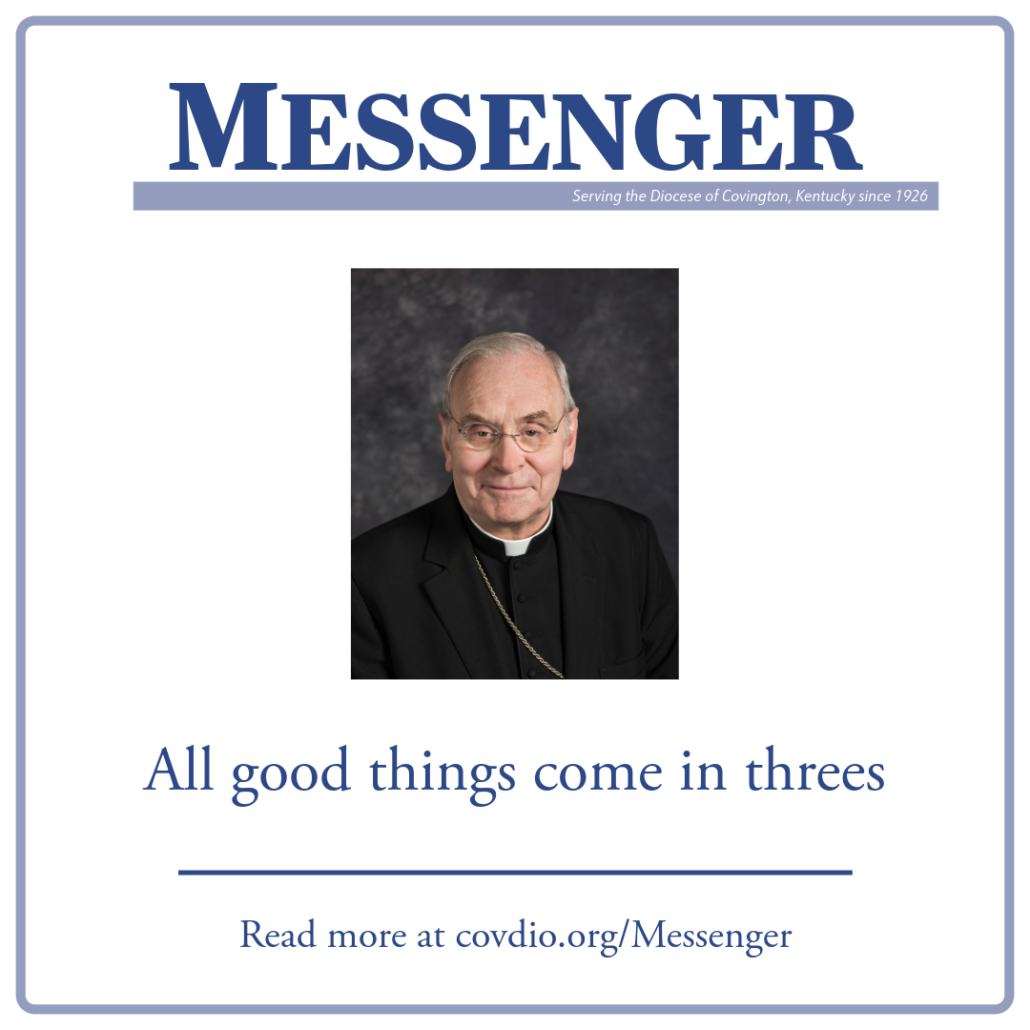
Bishop Emeritus Roger Foys
Guest
When I was studying the Italian language, the textbook (this was before Rosetta Stone) introduced a new proverb at the top of the page of each chapter. One that came to mind as I prepared for the Solemnity of Trinity Sunday is Ogni trino e Perfetto. Literally the meaning is “Everything that comes in threes is perfect.” We know the proverb as: “All good things come in threes.”
The doctrine of the Most Trinity is a mystery — One God in three Divine Persons. Yet, there are several references to it in the Scriptures. As Jesus was taking leave of his apostles as he ascended into heaven, he leaves them with a clear instruction: “Go, therefore, and make disciples of all nations, baptizing them in the name of the Father, and of the Son, and of the Holy Spirit, teaching them to observe all that I have commanded you.” (Matt 28:1920)
This was, so to speak, Jesus’ farewell, his last wishes.
Note that he doesn’t say to baptize only in his name, or only in the Father’s name but rather in the name of Father and of the Son and of the Holy Spirit. This was, of course, before the Father and Son had sent the Holy Spirit upon the disciples as he had promised: “I will ask the Father, and He will give you another Advocate to be with you always, the Spirit of truth which the world cannot accept because it neither sees nor knows it. But you know it, because it remains with you and will be in you. I will not leave you orphans.” (John 14:16-19)
And so, the Father, who is the creator and the Son, who is the redeemer, send the Holy Spirit who is the counselor and comforter and who remains with the Church until the end of time.
Another word to describe the Holy Spirit is paraclete, from the Greek parakletos. It means one who is sent to help. And this paraclete is with us until the end of time to be comfort and counsel, especially in times of difficulty or doubt. But Father and Son and Holy Spirit are one, bound together in love and unity. And from them we learn to live in that same love and unity.
In the early Church people were attracted to the followers of Jesus because they saw how they loved one another. Christians looked after each other, cared for each other, especially those who needed their help such as the widows, the orphans, the poor, the aged. There was no want in those early Christian communities, no one went hungry.
Their love was genuine, it was honest, it was not exclusive. They took seriously the words of Jesus to his disciples: “A new commandment I give you: Love one another. As I have loved you, so you must love one another. By this everyone will know that you are my disciples, if you love one another.” (John 13:34-35)
The early Christians were also known by their unity and community. “They devoted themselves to the teaching of the apostles and to the communal life, to the breaking of the bread and to the prayers. Awe came upon everyone … and every day the Lord added to their number those who were being saved.” (Acts 2: 42, 43, 46)
So, perhaps it is true that good things come in threes. The Father and the Son and the Holy Spirit continue to be an example to us of how we should live, about how we should profess our faith, about how we should be united as one and love each other as Jesus, who gave his life for us so that we might have new life, eternal life!
Most Rev. Roger J. Foys, D.D. is Bishop Emeritus of the Diocese of Covington, Ky.

