
Twenty-first Sunday of Ordinary Time
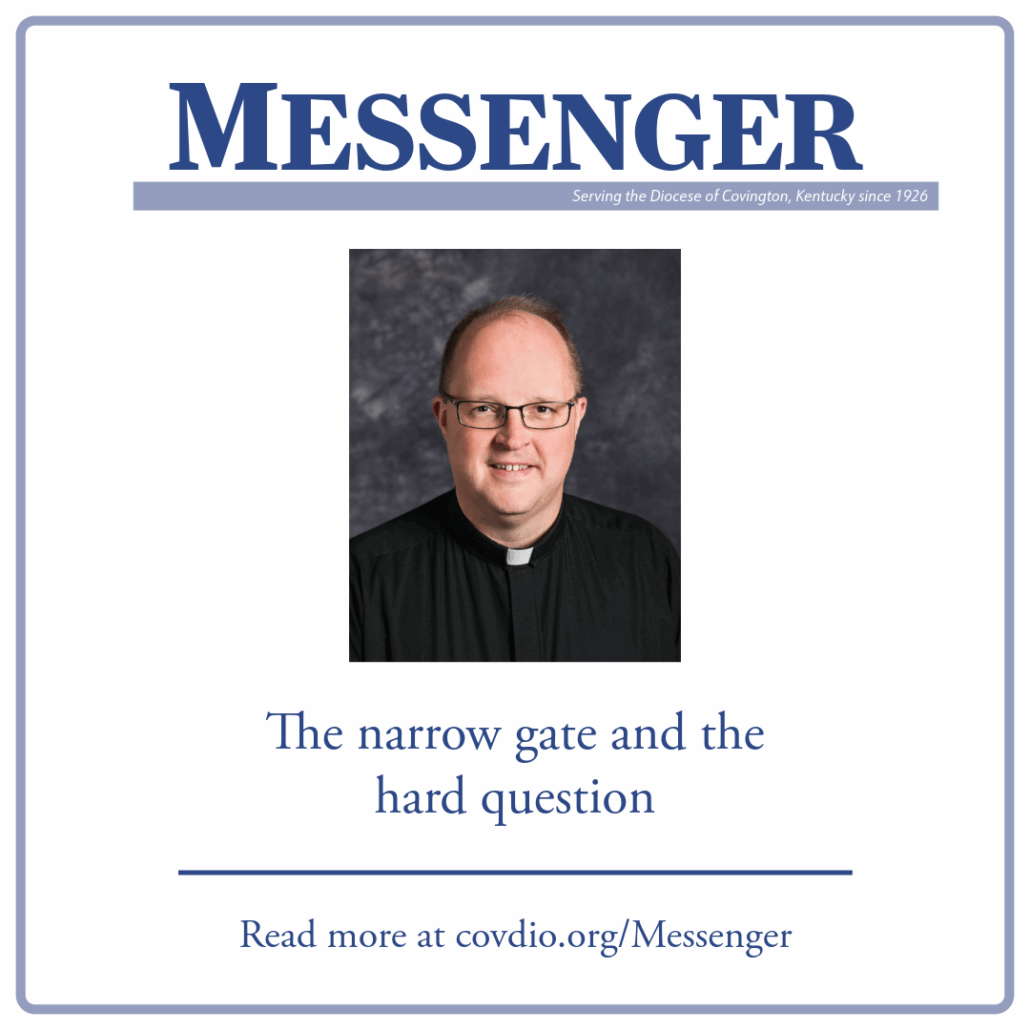
Father Phillip DeVous
Contributor
“Lord, will only a few people be saved?” This, surely, is one of the most important existential questions raised in the Gospel. It is the question that everyone who follows Christ, or who would follow Christ asks, albeit in a more personal way: will I be saved? Are those I love to be saved? These are the hard, searching questions we are to ask and to consider if we truly desire to follow Jesus Christ.
There is a too frequent tendency in contemporary Church life to demur and deflect on the hard questions, especially if we sense the answer might be radically at odds with the consensus of the unbelieving world. As the philosopher, Walter Kaufmann, provocatively states it, “the present age is the age of Judas … To be sure, it is not literally with a kiss that Christ is betrayed in the present age: today one betrays with an interpretation.”
Surely the question of how many people will be saved, and the related question of whether I will be saved, is a question that tempts us to conjure congenial interpretations that would wave away the question’s seriousness. The good news is the word of God is made for our heart, and our heart is made for the Word of God. Consequently, under the tutelage of the Holy Spirit we can rise to occasion of both contemplating a deep question and living with its answer- requirements for the following Jesus.
First and foremost, we must understand that God the Father “has blessed us in Christ with every spiritual blessing in the heavenly places”(Eph 1:2). These spiritual blessing are the Holy Sacraments and the Church, which is the grace of the Incarnation of Christ extended throughout history until the Second Coming and final judgment. So, we must not fear that sufficient grace and truth for salvation is lacking for salvation.
Our Blessed Lord suggests to us that what might be lacking is our will to acknowledge, accept and engage the graces that are revealed and on offer when he teaches, “strive to enter through the narrow gate, for many, I tell you, will attempt to enter but will not be strong enough.” Of course, salvation depends first and foremost on God’s grace. Once the grace has been given then surely our cooperation, conversion and obedience to the grace and truth that has been given is required. We know, even as we struggle, we must not be after as we were before such grace is given. So much “interpretation” in the air today tempts us to remain the same.
The Lord Jesus is laying out for us the difficulties of the spiritual life necessary to correspond to the grace of salvation. Further, he seems to be indicating that many will not want to take it up precisely because of the hardship it entails. I cannot help but think Jesus is referencing the “Two Ways” teaching of Deuteronomy: “See, I have set before you this day life and good, death and evil.” (Deut 30: 15). Jesus envisions the ease with which we pass through the main gates of worldly ways, living according to what’s egotistic, popular, pleasurable, socially accepted and necessary for material advancement in world.
The few, who have seen and heard the Lord, who have encountered his grace and truth, who wish to live according to “life and good” must exert greater effort to pass through the narrow gate of holiness and Godly virtue. This narrow gate, which gives one access to God is none other than Jesus himself. We pass to and through him to the Trinitarian life and eternal existence of Divine Love through receiving the Holy Sacraments and the Word of God with faith and obedience.
This is why we pray in the opening collect of the Holy Mass that our minds might be united in a “single purpose”, so that we might love what God commands and, most significantly, desire what God promises. We will not pursue the path through the narrow gate, which is the imitation of Jesus Christ, if we do not desire the grace and truth that has been revealed and gifted to us. If we do not desire it, will be tempted to interpret and reduce the Catholic faith to therapeutic bromides; to deploy compassion as a solvent of the truth, not its servant; and we will end up with a mush of nice, but not the utter fullness and holiness of God, which is our dignity, destiny and fulfillment as human persons.
Father Phillip W. DeVous is the pastor of St. Charles, Flemingsburg and St. Rose of Lima, May’s Lick.

