
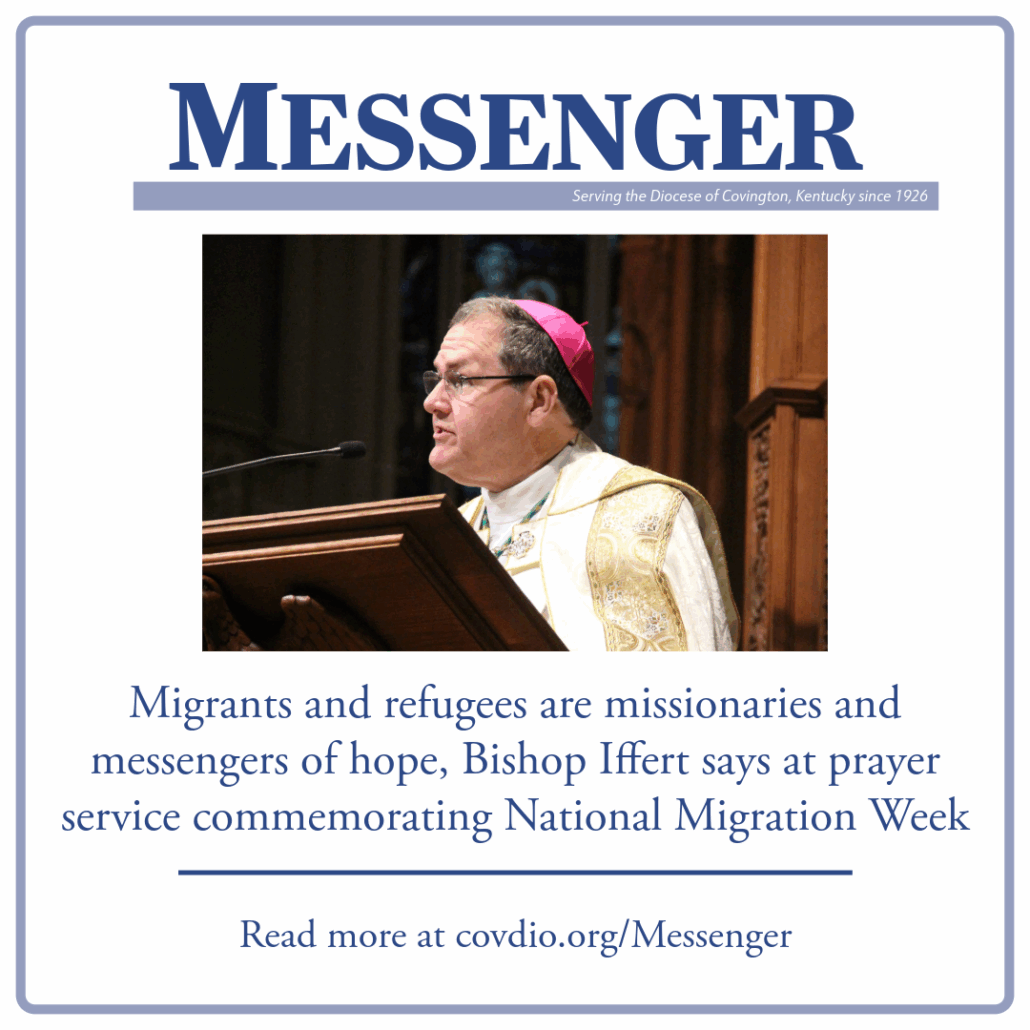
Migrants and refugees are missionaries and messengers of hope, Bishop Iffert says at prayer service commemorating National Migration Week
Maura Baker
Staff Writer
People gathered in the pews of the Cathedral Basilica of the Assumption, Covington, for a prayer service, Sept. 26. This service commemorated National Migration Week — calling back to the late Pope Francis’s jubilee theme, “Migrants, missionaries of hope.”
The service opened with words from Rosario Osnaya, an immigrant herself, who shared part of her story with those gathered.
“I want to thank the United States for giving me the opportunity to live with dignity and hope,” she said, in a tearful but touching testimony. Mrs. Osnaya sent her prayers and gratitude to all immigrants, as well, asking God to “protect them,” and for the same doors opened to her will be open to them, as well.
Bishop John Iffert, who led the service, further commented in his homily on the dignity of the migrant, especially under their title as “missionaries of hope.”
“The theme reminds us that migrants are not takers,” said Bishop Iffert, “They are and always have made a contribution to society and are a powerful force for the growth of the Church.”
He spoke on the Diocese of Covington’s legacy as built on migrants and missionaries, as well, with previous bishops themselves having immigrated or came to America from countries such as Germany and Belgium.
“We know that all people who are baptized in the name of the Father, and the Son and the Holy Spirit are our brothers and sisters in Christ,” Bishop Iffert continued. “We understand that those who are of Christ are never truly at home in this world, but living as a pilgrim people in anticipation of fullness of life.”
He emphasized further, that “migrants and refugees are more than brothers and sisters who deserve our compassion and mercy … migrants bear an infinite dignity, and are entitled to keep that dignity … They are the foundation upon which church buildings,” referencing Bishop Camillus Maes, a former Bishop of Covington and Belgian immigrant who began construction of the Cathedral Basilica of the Assumption, “and Church, the people of God, spring from and are supported by.”
Quoting Pope Leo XIV, who called migrants “messengers of hope,” Bishop Iffert said, “Many migrants, refugees and displaced persons are privileged witnesses of hope … Indeed, they demonstrate this daily through their resilience and trust in God as they face adversity, while seeking a future in which they glimpse that integral human development and happiness are possible.” He goes on, Bishop Iffert said, that “in a world, darkened by war and injustice, even when all seems lost, migrants and refugees stand as messengers of hope.”
Circling back, Bishop Iffert once again brought light to the legacy of the Diocese of Covington, and the Church as a whole.
“It was the missionary mission of a migrant who first envisioned this place for you. It was a migrant architect who translated those dreams into stone and glass … these people who come to us, whether because of a missionary zeal or from fear of violence or from desire for economic opportunity — they are not merely a duty. They are not a burden. They are certainly not, as some people have said, an infestation, a plague or a problem. They are brothers and sisters in Christ; they are messenger of hope,” Bishop Iffert said.

