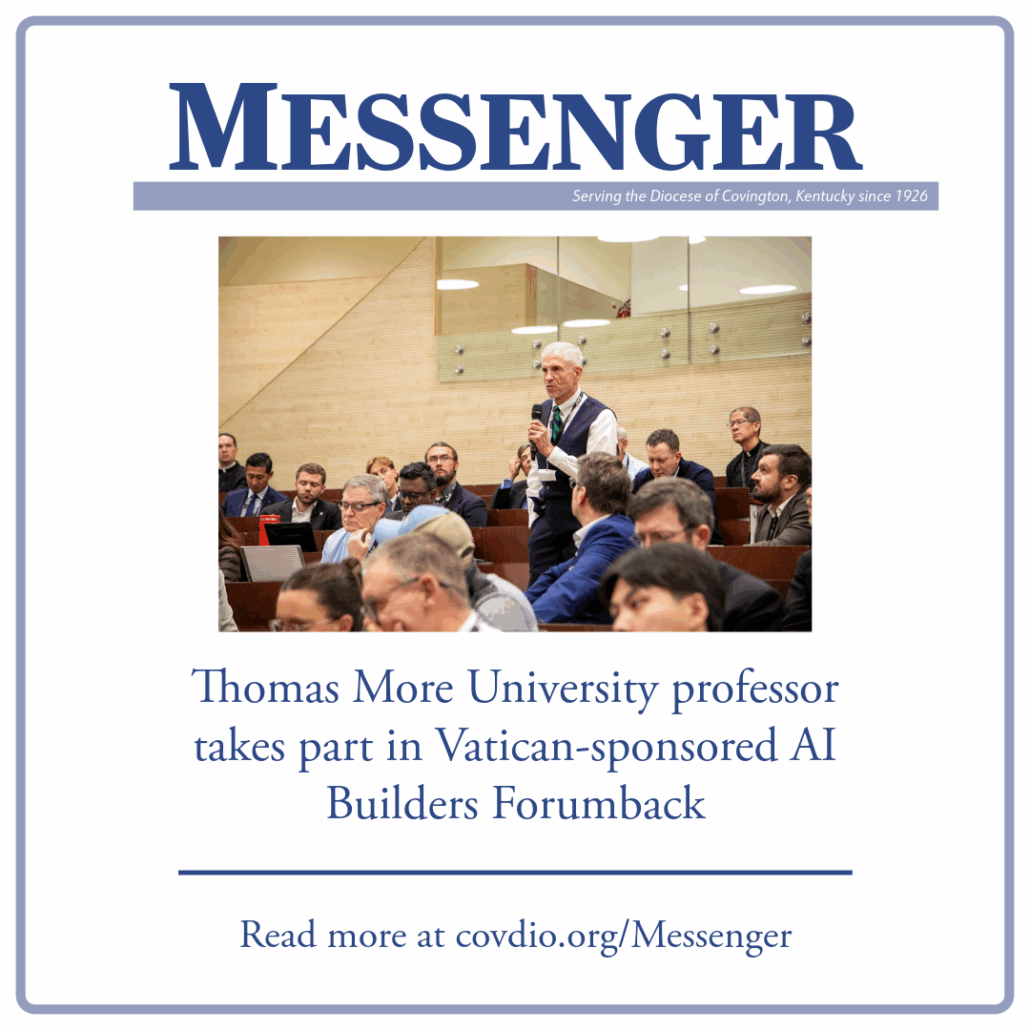
Thomas More University professor takes part in Vatican-sponsored AI Builders Forum
Laura Keener
Editor
A Catholic cruise with Catholic Answers has found Dr. John Rudnick, a year later, at a completely unexpected destination — the Vatican-sponsored AI Builders Forum.
“Catholic Answers reached out to me knowing that I was working in higher education and asked me what we were doing in artificial intelligence,” said Dr. Rudnick. “They thought it sounded interesting,” and offered Dr. Rudnick an invitation to the Forum.
When Catholic Answers extended the invitation and he accepted, Dr. Rudnick said he had no idea where the Forum was being held. The awe of being at the Vatican and among 200 like-minded Catholic leaders — educators, healthcare workers, innovators, priests, bishops and others — has left Dr. Rudnick on an “academic and spiritual high.”
“It was a wonderful time. The people that I met were just as kind and as welcoming and giving and sharing as one could have. It was very much a Catholic community and we were all rolling in the same direction,” Dr. Rudnick said. “You could say that our goal is to get each other to heaven, and our goal is to try to make sense of artificial intelligence in a positive way.”
Dr. Rudnick is a professor at the College of Business, Thomas More University, Crestview Hills. In addition to Thomas More University, other institutions of higher education with representatives at the Forum included Ave Maria College, Boston College, Catholic University of America and Notre Dame University.
His attendance at the AI Builders Forum is beneficial not only for TMU but also the Diocese of Covington. Already, Dr. Rudnick is working with Deacon Jim Fortner, chief operating officer, and Kendra McGuire, superintendent of Schools, to develop ways to share the information and to develop AI best practices with educators and leaders throughout the diocese.
The Church now stands at a pivotal moment comparable to the introduction of the printing press — an inflection point calling not for hesitation but for imaginative, evangelizing leadership, said Dr. Rudnick. AI presents new possibilities to expand access to learning, deepen pastoral outreach and strengthen global mission impact. Rather than retreat, the Church is invited to guide the development of Christian digital humanism, ensuring that emerging technologies serve truth, beauty, justice and communion, he said.
During the AI Builders Forum, the 200 members broke into six workshop groups. These six groups are now forming global cohorts to continue discussing, evaluating and recommending policies on AI. Dr. Rudnick is part of the education cohort.
“We will try to help shape policies and guidelines in relation to guardrails, privacy, cybersecurity and how artificial intelligence can be applied in education to make things more efficient and effective for faculty members and for staff, and to also be flexible and adaptive to the needs of diverse student learning types,” said Dr. Rudnick.
According to Dr. Rudnick, in the United States, Hollywood’s fascination and representation of AI, often as an antagonist in its movies, is a formidable hurdle to overcome in the general public’s understanding of AI.
“The Internet can be used for good things or bad things, and artificial intelligence can be used for good things or bad things,” Dr. Rudnick said.
The overarching theme at the Forum and one that will help guide the ongoing work of the cohorts is to leverage AI always with the dignity of the human person and the common good at the forefront. That, like with all human innovations, AI is a tool to be used by and for persons, not to replace persons.
“AI is changing hourly, and it’s something to be reckoned with,” said Dr. Rudnick. “But if we approach it with the foundation of truth, beauty and goodness, with regard to the need for the Catholic bias to be at the root, and for this to be aligned with our souls, then we’ll be okay.”

