The Catholic Schools Commission; how prayer, discernment and community drive strategy
Bella Bailey
Multimedia Correspondent
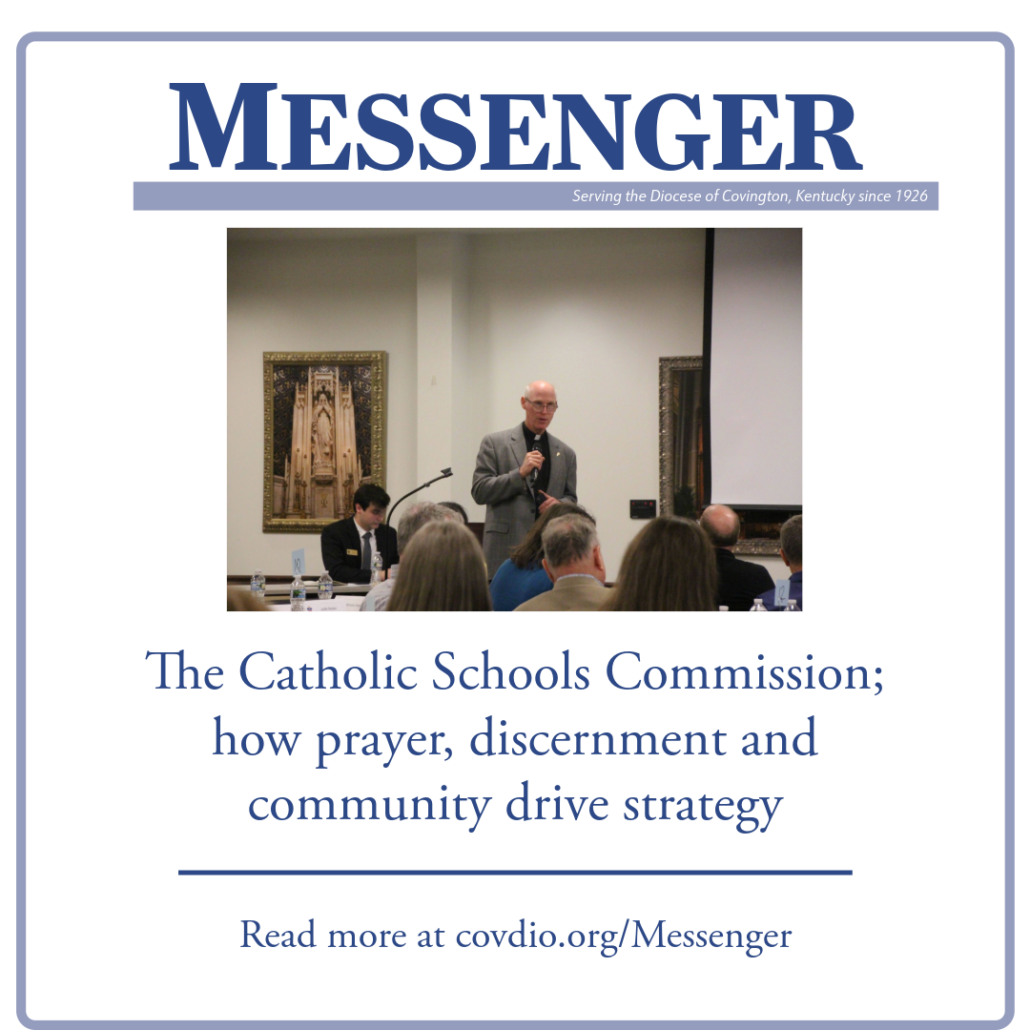
The first in a series of four meetings took place, April 14, for the Catholic Schools Commission as part of the new Diocese of Covington strategic planning process. This commission is one of three that will meet throughout the 2026 summer months to discuss a strategic plan which will carry the Diocese through 2030. The fourth commission, Diocesan Governance, will meet in the fall months and will build on the fruits of the commissions that came before.
Each commission is broken into four sub-committees. The Catholic Schools Commission sub-committees will focus on: mission and Catholic identity; academic excellence; governance and leadership; and operational vitality.
In his opening remarks, shared via video, Bishop John Iffert said to those in attendance, “The Diocese of Covington is rightly proud of its schools. In a Diocese of fewer than 90,000 Catholics, we have more than 10,000 people, 10,000 students in our Catholic Schools.”
It will be the work of the Catholic Schools Commission and its sub-committees to discuss, “a clear strategy around how do we strengthen the faith of the students and the teachers? How do we strengthen the Catholic identity,” said Deacon Jim Fortner, chief operating officer, Diocese of Covington.
The commission will, “really examine the faith, how it’s delivered, how we hire teacher’s, what’s our qualifications to be teaching,” he said.
Nearly 140 people attended the April 14 commission meeting including principals, teachers, priests, women religious and dedicated laity of the Diocese.
“It was like the Who’s Who, it was an all-star cast of experts in the schools,” said Deacon Fortner. “I’m pretty confident we have the right people. But they have got to believe in it themselves … this is not just an exercise.”
Kendra McGuire, superintendent of Catholic schools, said, “there’s a lot of people signed up on the commissions with a lot of varying backgrounds and knowledge and experiences, and I think with their input and review of this, I am hopeful that we will come out with … a strategic plan that we can move forward with to improve our schools.”
The Catholic Schools Commission is, so far, the largest of the four commissions, helping to realize Bishop Iffert’s vision for this strategic planning process.
“I want this process to benefit from as wide a collaboration as possible,” said Bishop Iffert in his video message. “I would like to see the participation of the entire Church – clergy, consecrated religious, lay people — working together to make decisions that are in our common interest and the common interest of our community.”
About the collaborative effort, Deacon Fortner said, “it’s a synod approach of listening, engaging people. The approach, I feel is very, very rich in theology and in practice in our Church.”
Deacon Fortner said that it is Bishop Iffert’s intention to be as transparent as possible, so that conversations and recommendations can be both mission and data driven. To that end, commission members received enrollment data from the last 30 years for every elementary and high school in the Diocese and will soon receive similar financial data. Additionally, the results of a recent survey of 1,200 alumni, parents, donors and priests have been shared.
Soon, leaders for the four sub-committees of the Catholic School Commission will be selected and prepared to lead the discussion of the fundamental aspects of Catholic education in the Diocese of Covington.
Mrs. McGuire emphasized that keeping the Holy Spirit at the forefront of the process is essential. “All of our work is guided by the Holy Spirit,” she said. “Our mission of Catholic education, at the center, is to be Christ-centered schools that are teaching about Jesus and the faith, and so everything we have do has to be through that lens.”
“I think the thing is, pray and trust that the Holy Spirit is going to guide us,” said Deacon Fortner. “It’s about spiritual transformation, it’s changing lives.” This, Deacon Fortner said, is why the Diocese is focusing on strategy, it is about changing the lives of those who walk through the doors of Diocesan schools.
“What is sacred in this process is the revelation that Jesus Christ is Lord, and the sacrifices of prayer, talent and treasure that our ancestors had offered in sewing the seed of faith in our region,” said Bishop Iffert. “As far as I’m concerned, there are no other sacred cows, there is no other set agenda. We need to discern together the way forward.”