
A stone mason’s legacy: Building a Mary grotto
Laura Keener
Editor
May is a month in which we celebrate mothers. Each year, the second Sunday of May — Mother’s Day — is a time devoted to moms. In the Catholic Church, the entire month of May is dedicated to Mary — our spiritual mother. Scripture tells us that it was Jesus who appointed Mary the spiritual mother of the entire Church, when, while dying on the cross, said to her, “Woman, behold, your son.” Then turning to his disciple, John, said, “Behold, your mother.” (John 19:26–27)
We honor Mary under many titles. If you are ever awake listening to Sacred Heart Radio at 5:55 a.m., you will hear a recording of Bishop John Iffert and Diocese of Covington seminarians praying the Litany of Loreto. The Litany petitions Mary under 53 of her titles, which, to name a few, are: Holy Mother of God, Mother of the Church, Mother of Mercy, Seat of wisdom, Ark of the covenant, Morning star, Refuge of sinners, Solace of Migrants, Queen of the most holy Rosary, Queen of families and Queen of peace.
Other titles for Mary are tied to apparitions like Our Lady of Fatima, Our Lady of Guadalupe and Our Lady of Lourdes. It is often under these titles that images of Mary find their way into statuary and grottos. These grottos offer the faithful a place of respite, to pray and reflect, to contemplate Mary as she leads all to salvation, her son, Jesus.
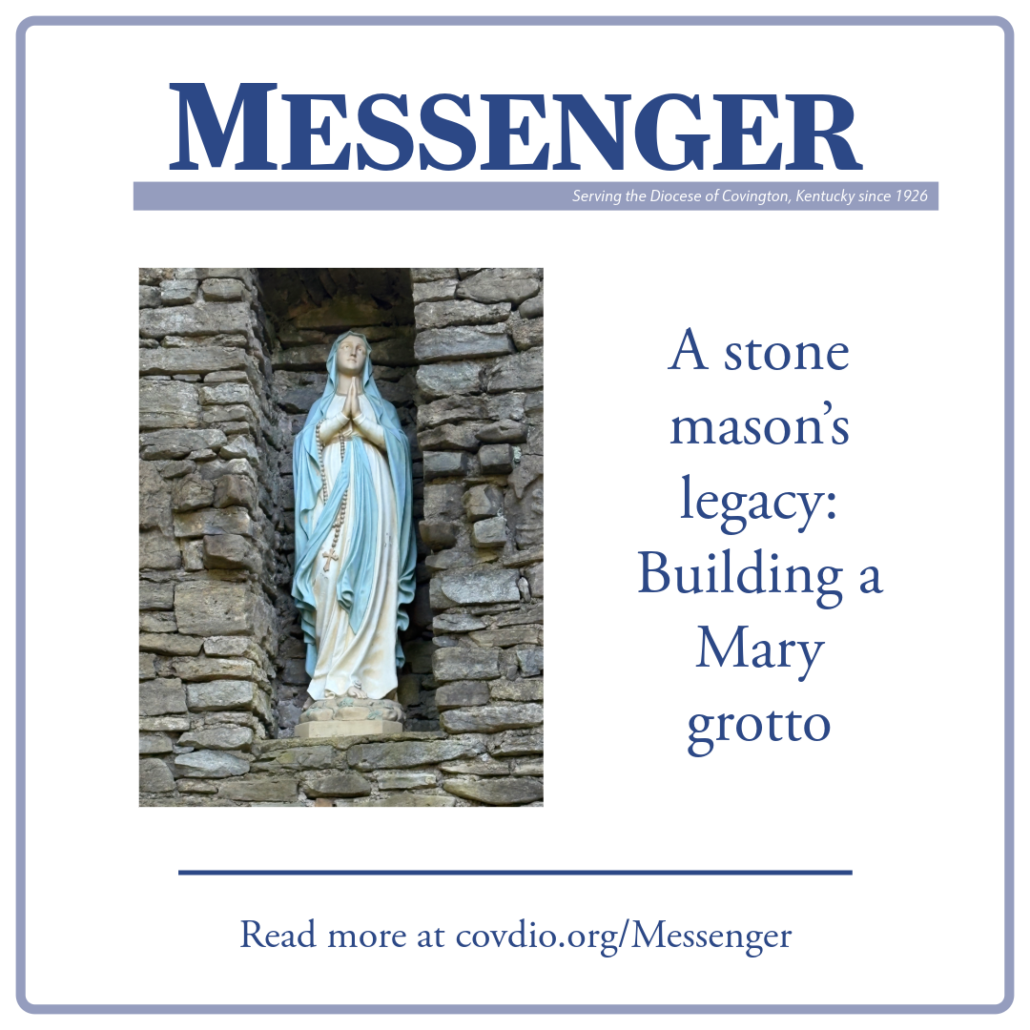
St. Anthony Parish, Taylor Mill, is home to one such grotto — a significantly sized stone edifice with a statue of Our Lady of Lourdes perched in its top niche. Recently, Father Ivan Kalamuzi, pastor, met Bob Leen, the grandson of the stone mason who built the grotto, while he was visiting there.
Behind St. Anthony Church, the stone grotto has stood for generations — its rockwork still tight and steady, even after decades of weather. Mr. Leen said that family stories trace the Mary Grotto back to the early 1930s and to his grandfather and Northern Kentucky craftsman: George Henry Ricken, a working stone mason whose hands shaped walls and landmarks across the region.
As the story was passed down through the Ricken family, a priest — remembered as Father Bernard Nurre — asked Mr. Ricken to build a shrine. Father Nurre was pastor at St. Anthony Parish for 46 years, retiring in 1967.
At the time, Mr. Ricken’s family attended Holy Cross; he himself was not Catholic. But the work, and his conversations with the priest along the way, became a turning point that eventually led him to convert to Catholicism.
Mr. Leen said that his grandfather approached the grotto the way he approached every job: by letting the material guide the design. He reportedly walked up and down neighboring Banklick Creek collecting rocks, choosing pieces he knew would set well and last. The result was a grotto built with heavy stone and plenty of mortar — solid enough that visitors still remark on its strength and craftsmanship.
One detail the family remembered most vividly was a cross. According to his grandson, Mr. Ricken didn’t want a cross pieced together with mortar joints. Because he understood the grain of stone and how it would split, he searched until he found a rock that could be cut into a cross from a single, solid piece.
That original stone cross is no longer there — whether it fell, weathered away, or was removed over the years is unclear. Still, the grotto itself remains, its stonework holding firm.
Mr. Ricken was known locally for building things to endure. He worked throughout Northern Kentucky, including stone walls in Devou Park and other projects in the Latonia area. Mr. Leen recalled that he cut stones precisely rather than stacking rough rock — an old-world method that, in the best examples, leaves walls that “never, ever moved,” he said.
Today, parishioners still visit the Mary Grotto for quiet prayer and, at times, community devotions like the rosary. The statue itself needs occasional restoration, but the rock structure remains remarkably intact — an enduring testament to the mason who built it and to the faith journey that, according to family memory, began with stone gathered from a creek bed.

