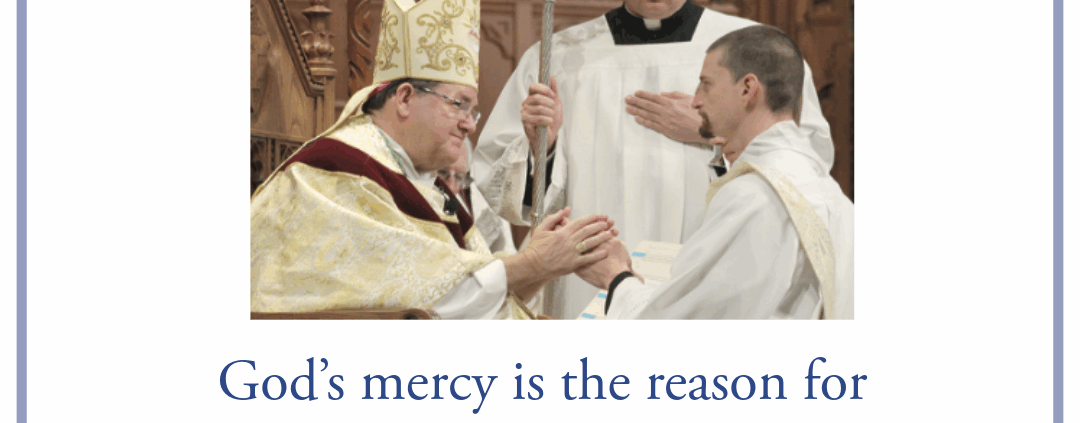
God’s mercy is the reason for priestly vocation, Bishop Iffert says at ordination Mass

Maura Baker

Staff Writer

Celebrated among a congregation of the people of the diocese – including family, friends and many fellow clergy – Father Joshua Heskamp was ordained to the Order of Priest, June 7, at the Cathedral Basilica of the Assumption, Covington.

Bishop John Iffert was the celebrant of the Mass, and welcomed the now ordained Father Heskamp to the presbyterate alongside priests fro across the diocese – and some beyond, including St. Vincent Seminary faculty Benedictine Father Jude Brady and Benedictine Father Isaac Haywiser.

Father Heskamp’s family also partook in the Mass, with notably his uncle, fellow priest, Father Jeffery Von Lehmen, pastor of St. Patrick Parish, Taylor Mill, serving as vesting clergy for his investiture.

Bishop Iffert began his homily acknowledging to the contribution of Father Heskamp’s family to his formation. Even though he addresses him as his “own dear son,” Bishop Iffert said, and that “this is an acknowledgment that I’m able to introduce [Deacon Heskamp] to the life of grace-filled service to God’s people in the priesthood,” he said, “in no way is this little reference of endearment meant to supplant the role of Deacon Heskamp’s own father and his own family…who gave him life and nurtured him in the faith.”

“It’s a profound gift,” said Bishop Iffert, “that Deacon Heskamp presents today in offering himself to be set apart for the ministry. I thank you for supporting his in his vocational discernment.”

As part of his homily, Bishop Iffert also reflected on a question that a student asked him at a dinner at Thomas More University, Crestview Hills. The student asked him why he thought that God chose him as a bishop, to which Bishop Iffert replied that, after a moment, the reason is that, “God is always being merciful, and always leading us to salvation.”

“I can only presume that God has allowed me to be here,” he said, “because there is something in this experience that will help me towards salvation, something that I need to be able to grow in holiness and be more like Christ.”

“As soon as I said it, I recognized that truth of it,” said Bishop Iffert, then addressing the soon to be ordained Deacon Heskamp, “Joshua, we are not called to be priests because we are such swell guys…We are called to be priests because the empty, needful, broken space inside us conforms to the way Christ and his Holy Spirit long to fill us and make up for our sins and our failure. We are called not because of our personal strengths, but because we boast in our weakness and in the cross of Christ that is our salvation.”

“Today,” Bishop Iffert said, “you are called to be a father to the faithful. As you will pray over the fathers of the children you will baptize, so we all pray for you today.”
Mary Grable to retire from St. Edward School for the second time

Bella Bailey

Multimedia Correspondent

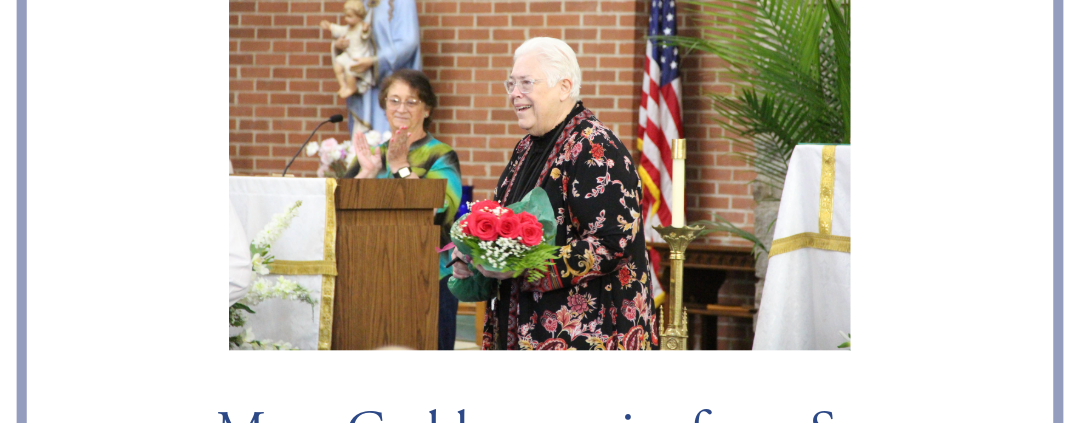
Beloved teacher, mentor and principal Mary Grable is to retire for the second time as principal of St. Edward School, Cynthiana. Her dedication and devotion to St. Edward School was celebrated by the community at the end of year Rose and Candle Ceremony.

This annual ceremony is a farewell to the fifth graders as they prepare to leave St. Edward for the local middle school, however this year the community was also saying goodbye to Mrs. Grable. During the Rose and Candle Ceremony the fourth graders give the fifth graders roses to take with them on their new adventure and the fifth graders give the fourth graders a candle, reminding them to lead the school with the light of Christ.

Mrs. Grable and principal-elect, Mark Hatmaker, teacher at St. Edward School, participated also in this ceremony with Mrs. Grable bestowing the ceremonial candle to Mr. Hatmaker and Mr. Hatmaker presenting Mrs. Grable with a dozen roses.

“Twelve roses is probably not enough for all the dedication you’ve given to the school, but we thank you Mrs. Grable,” said one faculty member as the rose and candle exchange was occurring.

“I want to express my sincere gratitude to Mary Grable for coming out of retirement to serve as the interim principal of St. Edward School. She worked tireless during this time leading the school. Mary is a true servant leader who gave so much of her time to help St. Edward,” said Kendra McGuire, superintendent of schools for the Diocese of Covington, in response to the Messenger request for a comment.

Mrs. Grable has been a tireless servant leader, in both her first and second term as principal, putting first the needs of the students and their faith formation. Upon her first arrival at St. Edward School the pastor at the time said that while academics are important, it was her job to turn them into saints. This was a motto she said that stuck with her throughout her tenure.

“My first year here we had a mirror that we put up,” said Mrs. Grable. She would tell the students, “You should see Christ in everybody, so go look in the mirror. Is Christ looking back at you, or is it somebody else?”

Father Niby Kannai, pastor at St. Edward Parish, Cynthiana, said about Mrs. Grable, “Her deep Catholic identity, lived so faithfully and joyfully, has been a shining example for our children and families. Her tireless dedication and tender love for every child has not only educated minds but also formed hearts in Christ.”

Mrs. Grable’s career started at Southside Elementary School, Cynthiana, where she served for 27 years as a special education teacher, before retiring from public education and transitioning to St. Edward School.

As a principal, Mrs. Grable says her favorite part is watching the kids grow up. “Watching people grow,” she said, “after all these years somebody comes back … it makes you feel like you’ve done something.”

Mrs. Grable expressed her sound support for the incoming principal, Mr. Hatmaker, “He’s interested in learning, but he’s also interested in what their future is going to hold and how close to God they’ll be. That’s what I think we need,” said Mrs. Grable.

Upon his being named principal, Mrs. Grable shared with Mr. Hatmaker a poem,

“Isn’t it strange that princes and kings,

And clowns that caper In sawdust rings, And common people,

Like you and me,

Are builders for eternity?

Each is given a bag of tools,

A shapeless mass,

A book of rules;

And each must make –

Ere life is flown –

A stumbling block

Or a steppingstone.”

Mrs. Grable said she hopes she has built a steppingstone for Mr. Hatmaker, and that he will build one for the next principal. Leaving a lasting legacy for the future students of St. Edward School.

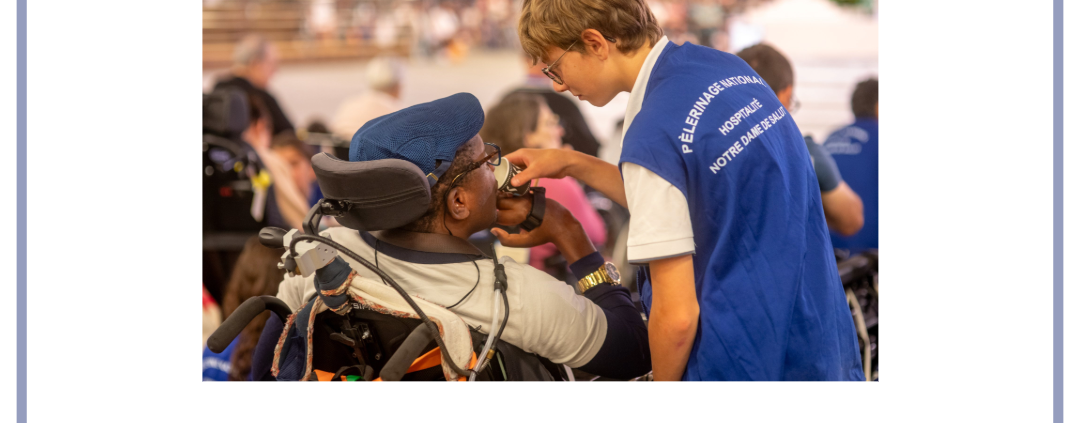
This summer, show mercy by giving drink to the thirsty

Maura Baker

Staff Writer

As part of the Diocesan-wide Campaign of Mercy, the Messenger has been highlighting a different work of mercy each month. For the month of June, the focus is on the corporal work, giving drink to the thirsty.

“And if anyone gives even a cup of cold water to one of these little ones who is my disciple, truly I tell you, that person will certainly not lose their reward.” (Matt 10:42)

Water serves as perhaps the world’s most important resource — life depends on it, and it is because of water that the planet earth is able to sustain life at all. More than 70 percent of the surface of planet Earth consists of water — but, even then, only 1 percent of that is accessible and ready for safe human consumption.

In fact, UNICEF reports that four billion people, almost two thirds of the world’s population, experience water scarcity (that is, lack of access to safe drinking water) for at least one month each year, and over two billion people live in countries where water supply is inadequate.

Water is crucial to human survival, according to University of California’s Davis Health. It supports vital functions including ferrying nutrients to cells, getting rid of wastes, protecting joints and organs and — notably important as the warm summer months approach — maintaining body temperature.

This June, the Messenger will be sharing stories of mercy where people of the Diocese of Covington meet the challenge to combat water scarcity in our community.

Seventeen parishes underway to receive DPAA rebates, more to go

Maura Baker

Staff Writer

The 2025 Diocesan Parish Annual Appeal (DPAA) is well underway, with a recent mailing encouraging parishioners from across the Diocese to dedicate their contributions if they have not already.

As of the end of April, the DPAA has raised more than $2.6 million which will be used to help fund the ministries of the diocese. This is just short of the $2.7 million goal of the whole campaign — but, more than that, there are goals for the individual parishes that are yet to be met for the campaign.

In July, money collected over the goal amount for any specific parish is returned to the parish as a rebate. This money is used towards parish construction projects and ministries. However, with only 17 parishes having exceeded their goal so far, there is still a long way to go in terms of raising money for diocesan parishes.

St. Henry Parish, Elsmere, has successfully exceeded its DPAA goal this year — and has been setting aside rebates since 2022 for the pavement and restriping of the parish’s parking lot this year, according to Kris Staverman, a parishioner. “The lot was last resurfaced with new asphalt in 1989,” said Ms. Staverman, who notes that additional funds will be put towards a new sound system for the church.

Other parishes who have exceeded their goals include St. Therese Parish, Southgate, whose pastor, Father Michael Grady, hopes to put the money towards tuition assistance for St. Therese’s school. “We see a need there and we try to fill that need so that our families can afford a Catholic education,” said Father Grady.

Holy Spirit Parish has also exceeded its goal, and will be putting their 2025 DPAA rebate into a “transformative project,” according to parishioner Alex Bramel. These projects include a new limestone retaining wall, new landscaping and an irrigation system.

However, with these parishes on track to receive funds towards their projects — many other parishes are still working together to meet those goals.

Giving for the 2025 DPAA is still open — and pledges and contributions are needed to assist not just the parishes of the Diocese of Covington, but the ministries and people, as well. More information, including giving, can be found online at https://covdio.org/ stewardship-missions/.

Graduates possess an ‘unalienable dignity, ’ says Bishop Iffert at Thomas More baccalaureate Mass

Maura Baker

Staff Writer

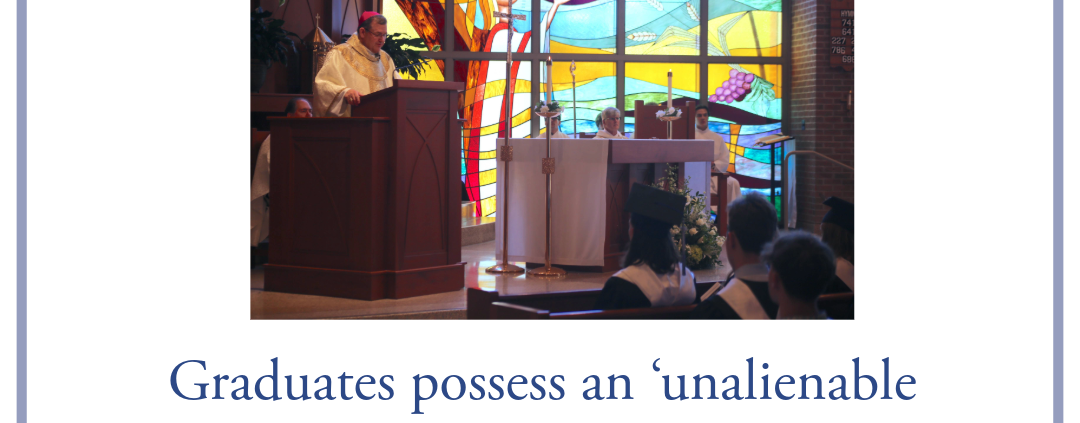
Thomas More University’s graduates were among the first to graduate as the Class of 2025 this year — celebrating their accomplishments with a baccalaureate Mass, May 16. Held in the campus’s Mary, Seat of Wisdom, chapel — Bishop John Iffert visited to celebrate the Mass with the Class of 2025.

“Do not let your hearts be troubled,” Bishop Iffert began his homily quoting John 14, and reflecting on a story of a young girl he met when he was pastor at Immaculate Conception Parish in Columbia, Illinois. The little girl, a fifth grader, who had been caught cheating, was distraught. “Literally bawling,” said Bishop Iffert.

The little girl believed because of this mistake, she would not get into the best high school, or college, and feared that she would not “fulfill her potential worth.”

“As I sat there and watched this young girl, just riddled with anxiety,” Bishop Iffert said, “I wanted to punish someone. But, it wasn’t her. Her parents, the school, myself, maybe, for ratcheting up the pressure on this girl. That anxiety, it’s a killer.”

“We are the most rejected generation,” Bishop Iffert quoted a young man in an article for the New York Times. College applications, internships and even jobs, all have a lower acceptance rate now than ever, according to the article.

“Rejection reinforces the dark world mentality,” said Bishop Iffert, “that is so prevalent in our culture. The idea that the world is menacing and that people and institutions are untrustworthy. It’s a dark view of the world that believes that our neighbors are out to get us, or even in constant competition.”

“Here at Thomas More University,” he continued, “I hope that you have learned a few things that will help you stand against that dark view of the world. I hope that you have learned that you possess an unalienable dignity that comes to you as a free gift from God, and that can never be taken away from you because of anyone’s judgment or rejection.”

“This dignity is yours by right,” Bishop Iffert said, “You are created with it. You do not have to earn it. It is yours.”

For more graduation coverage including a listing of the Class of 2025 from Thomas More University and all nine Catholic high schools in the Diocese of Covington, see page 9.

Praying for the Living!

Kentucky House Bill 90 passes after a veto; affirms what is and isn’t an abortion in Kentucky law

Bella Bailey

Multimedia Correspondent

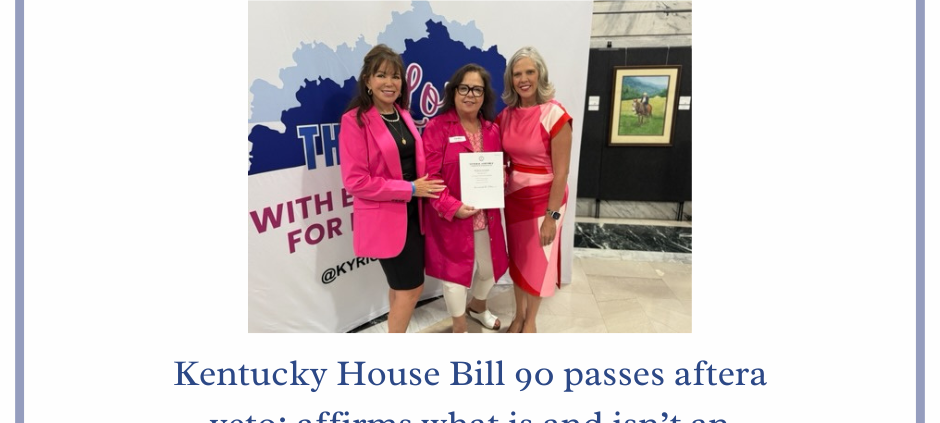
Kentucky House Bill 90, AN ACT relating to maternal health and declaring an emergency, was passed on March 27 with a veto override vote in both the House and Senate. The bill, lobbied on by Addia Wuchner, executive director, Kentucky Right to Life, included three main components.

“House Bill 90,” said Mrs. Wuchner, “is a comprehensive maternal health bill covering many aspects that concern maternal health in the Commonwealth of Kentucky.”

The three main components are the establishment of a licensing framework for free standing birthing centers in Kentucky, the providing of legal and clinical clarity for maternal health interventions that are not elective abortions and the expansion of access to perinatal palliative care.

A freestanding birthing center is described in the bill language as, “a safe and regulated alternative for maternity care, offering a medically directed care, midwifery-led model that emphasized holistic, patient-centered care.”

The establishment of freestanding birthing centers was the core of House Bill 90 before the two latter elements were introduced to the Bill framework.

The legal and clinical clarity for maternal healthcare helps physicians to distinguish comprehensive and appropriate medical care from elective abortion. It provides clarification on medical conditions that are not abortions and therefore are explicitly protected medical treatments under Kentucky law. Conditions such as miscarriage management, ectopic pregnancy treatment, molar pregnancy treatment, sepsis treatment, hemorrhage control and the management of fetal demise and stillbirth.

This portion of the Bill was cited by Kentucky Governor Andy Beshear as his reason for vetoing the Bill. The primary concern of all those against House Bill 90 was the restrictive nature of an exhaustive list of treatable conditions under Kentucky law.

“No one, including legislators, can possibly create an exhaustive list of emergency situations that may occur in a hospital or medical facility. Gaps in the law are literally a matter of life and death,” said Governor Beshear in his veto.

Mrs. Wuchner refutes this claim, saying that it is necessary to define what is not an intentional abortion so that medical intervention is able to be exercised without fear of legal retribution.

“While we already define what is an abortion, let’s define what isn’t an abortion. We defined an outline that miscarriage, ectopic pregnancy, septic miscarriage, are not abortions … The common language defining that these are not considered an elective abortion so that it was clear that women in Kentucky … have the care that they need,” said Mrs. Wuchner.

“Working with the medical community was to assure that there’s no question when it comes to the care that women in Kentucky are going to receive and deserve. We didn’t think that there was a question before, but since it kept being brought up that there were concerns, we wanted to eliminate those concerns,” said Mrs. Wuchner.

Representative Kim Moser, chairwomen of Health and Family Services committee, said, “This is about offering real options and real support when families face incredibly difficult medical news. House Bill 90 brings clarity when a maternal complication requires medically therapeutic treatment or critical life-saving interventions.”

Faye Roch, director of the Diocese of Covington ProLife Office, worked closely with Mrs. Wuchner, in listening sessions and advocating for pieces in the Bill.

“We’re working together to keep a close eye on everything that’s going on in Frankfort,” said Mrs. Wuchner.

When asked what she wanted Messenger readers to know about the Bill, Mrs. Wuchner said, “I hope that when they hear about this, I want them to be proud of Kentucky and proud of what the General Assembly gas done.”

Forty years has brought parish priest both foresight and wisdom

Maura Baker

Staff Writer

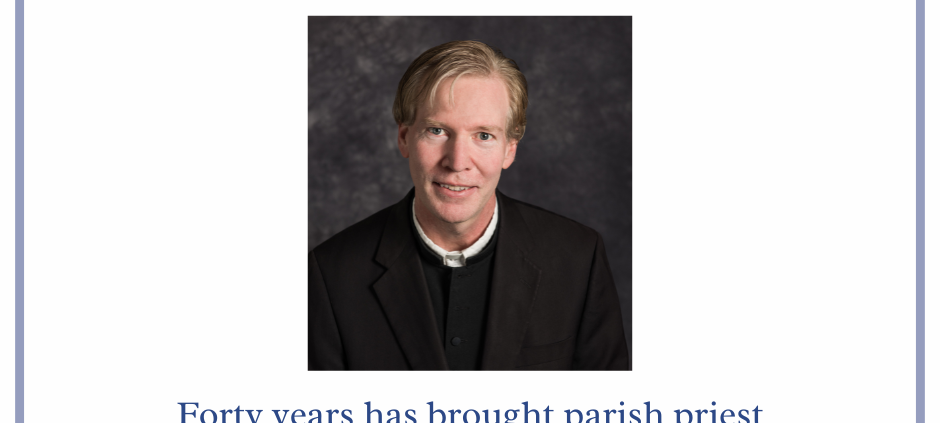
“I remember one day during Advent many years ago, I was sitting in the church office by myself. It had been a few years since I returned from a Marian pilgrimage but happened to be reminiscing about it,” Father Jeffrey Von Lehmen, pastor, St. Patrick Parish, Taylor Mill, fondly recalled. “There was a stack of mail which I was not anxious to open, usually just more bills — I felt a sense of spiritual emptiness and exhaustion which sometimes come with the pre-Christmas season. On top of the stack of mail was a brown package. I saw a return address from Florida and recognized that it was someone with whom I had been on the Marian pilgrimage. I opened it, and there was a nice note and a DVD movie — ‘It’s a Wonderful Life.’” Father Von Lehmen, who is this year celebrating his 40- year jubilee in the priesthood, noted that he felt “a little vulnerable and humble” at the gift.

“Here is someone who could see who I really was and how I felt at the time,” he said, “Like George Bailey, I didn’t set out to be extraordinary. I just kept showing up — one day at a time, one person at a time. And somehow, mysteriously, God uses these small, ordinary choices to touch lives. Pope Benedict said it best speaking about priests: ‘God makes use of us poor men in order to be, through us, present to all men and women.’ That’s the miracle of the priesthood. It’s not about doing great things — it’s about making Christ present in the quiet corners of people’s lives … This particular memory has helped me remember what I need to be as priest. People don’t need you to be impressive. They need you to be real — to be an example. That’s when they see Jesus.”

Father Von Lehmen mentioned that his “favorite” part of his calling is when “through the gift of priesthood, the people I am called to serve can feel and know God’s favor upon their hearts and minds — those freeing and loving graces now accessible in Christ.”

He recalled a memory in the old Good Shepherd convent, with a retired Irish nun, Sister Rita, whom Father Von Lehmen said spiritually adopted him, along with the Mother Superior, Sister Kevin. “Surrounding me at a distance in the back of the chapel where I had Mass and heard confessions from time to time were orphans, prostitutes, the lost, angry, hurt — darkened hearts and misguided minds from intense brokenness,” he said. “I saw there on the table a book or article called: ‘You Ain’t Nothing But A Nobody.’ In this true story, a young boy comes home with good grades for the first time and his mom tears up his report card, saying, ‘You ain’t nothing but a nobody.’ I thought to myself the people surrounding me right now have probably lived this story. I wondered how many people in the world must feel this way in various degrees whether wealthy or poor, educated or uneducated.”

Twenty years later, Father Von Lehmen recalled being “privileged to encounter these very same persons again” at the retirement of Sister Kevin. “They gathered to thank her for her vocation and how they came to know God’s favor and grace upon each of them.”

“That evening, I learned what the favorite part of my vocation is: to participate in Christ’s Priesthood to form others, to bring out their true selves in the image of God in this space called grace,” he said. “In short, to evangelize and form others as God’s favorites is a favorite part of my vocation. And formation here does not mean to be better than others, but to help persons to be better for themselves and others in the Kingdom of God.”

Looking back on these experiences in the past 40 years, Father Von Lehmen said that he has learned “some foresight and much more wisdom.”

“Much of my wisdom has come from being with the youth all these years in the classroom and as a chaplain,” he cited, “together each year we learn how easily and with not much thought people misperceive themselves, their image of God, their image of the Church and their image of different cultures. … How many people, including very intelligent and well-educated people, have misinterpreted reality let alone the Scriptures? And how much has false accusation or gossip contributed to false perceptions? … so, my wisdom I have learned over 40 years is this: we must develop a prayer life to see ourselves and each other through God’s eyes with the help Mother Church.”

“Interestingly,” Father Von Lehmen said, “Forty is a number meaning thresholds. I think I have grown inwardly enough to better cross these thresholds through integration from self-knowledge to self-restraint to self-gift for others. St. Pope John Paul II said in his book, ‘Threshold of Hope’, that the real threshold can be summed up in two words of Jesus: ‘Follow Me.’”

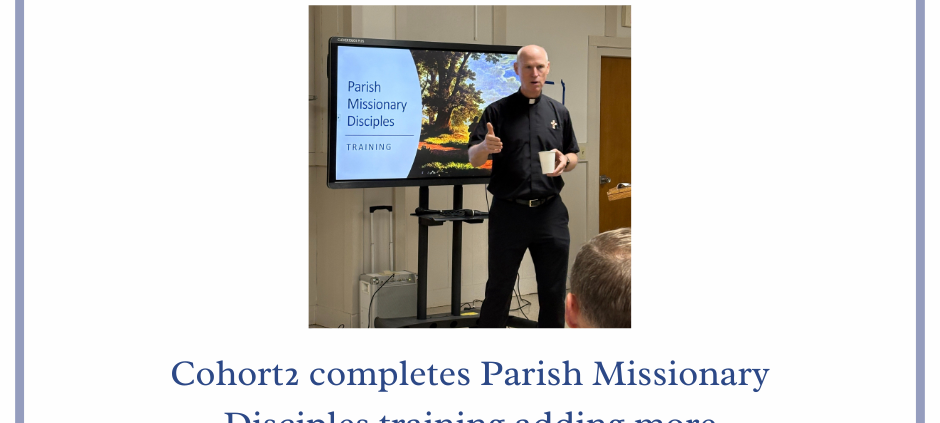
Cohort 2 completes Parish Missionary Disciples training adding more witnesses to ignite parish life

Laura Keener

Editor

Cohort 2 completed four weekends of Parish Missionary Disciples training, May 17, at St. Joseph Parish, Cold Spring. Carla Molina, leadership consultant, Catholic Leadership Institute, led the training, with Deacon James Fortner, diocesan chief operating officer and Jamie Schroeder, chancellor, leading the sending at the final meeting.

In his comments, Deacon Fortner emphasized the importance of PMD as a model of how diocesan offices and parishes should work together, as envisioned by Bishop John Iffert.

“To him, this is the model of a lot of our ministries, where we provide some training, some accompaniment, some skill building and then we turn the lay faithful loose, to go work back at their parish,” said Deacon Fortner. “Parish life is ground zero, that’s where relationships are struck, that’s where we lead people to the sacraments.”

PMD is a training program designed to equip parishioners with the skills needed for effective evangelization. This includes knowing and be able to articulate a personal faith witness and to engage with others through prayer. PMD is part of the With One Heart initiative and a Leadership Development strategy of the Diocesan Pastoral Plan. PMD training is led by consultants from the Catholic Leadership Institute (CLI) and has been offered to members in the Diocese of Covington at no charge, thanks to generous donations from benefactors committed to promoting evangelization efforts in the diocese.

“We’re blessed to have CLI that brings this capability,” Deacon Fortner said.

Cohort 1, a group of 60 witnesses, completed PMD training in April 2024. Cohort 2 adds another 31 witnesses to Bishop Iffert’s goal of 500 witnesses, impacting 90 percent of parishes in the Diocese. Two initiatives begun by two couples from Cohort 1 will help the diocese to meet its goal.

The first is the establishment of the GYMM, an acronym for Growing Your Missionary Disciples Muscles. Bill and Kim Dehlinger, parishioners, Blessed Sacrament Parish and Jerry and Bridget Otto, Mother of God Parish, host a monthly meeting for PMD witnesses. At the GYMM, witnesses practice what they learned — praying together and sharing their faith story.

“The idea for the GYMM is that this is a place where you can go back and review and be refreshed and be renewed and get support and network with everybody else that’s been through Parish Missionary Disciples,” said Mrs. Schroeder. “I really encourage you to do that, just to keep this going and to keep that fire burning.”

The second is to continue honing a shorter, more easily presentable discipleship program to implement at parishes. Mr. and Mrs. Otto have already taken leadership of this program. With the blessing of the CLI, the Otto’s took the information from PMD training and distilled it into three two-hour sessions. Last month, the Otto’s held the first presentation at Mother of God Church. “It was a big success,” said Deacon Fortner noting that about 25 people from parishes across the diocese attended. “Honestly, that’s kind of what we’re thinking is the path forward, to reformulate this and to do an intermediate kind of a program.”

Having quantitative measures is certainly a worthy goal, but Deacon Fortner said, more important “is transformation.”

“You guys need to take this competency and run with it,” Deacon Fortner said, “We’re never going to have all the training, trust me. You’re never going to feel like you got it all, because we don’t. It’s all about the Holy Spirit. You know how to love. Invite others to dinner, invite them into a relationship and let the Holy Spirit come lead.”

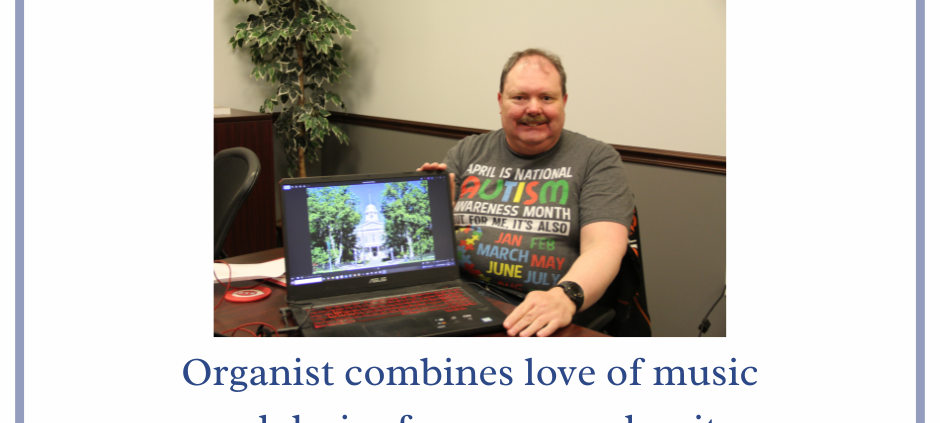
Organist combines love of music and desire for peace and unity into a daily prayer meditation

Laura Keener

Editor

As the Messenger continues highlighting the Campaign of Mercy and its foundation — the corporal and spiritual works of mercy, this month we focus on the spiritual work of praying for the living. Praying for others strengthens the unity of the Body of Christ and brings us closer to Christ. It is intercessory prayer, praying to God on behalf of another. The Catechism teaches, “Since Abraham, intercession — asking on behalf of another has been characteristic of a heart attuned to God’s mercy.” (CCC 2635) Praying for others is an act of love, strengthening the bonds within the Church and drawing individuals closer to God.

The Messenger caught up, April 4, with Tony Beyer and his mom, Mary Jo, to learn more about what began as a Lenten meditation 16 years ago and has developed into a yearlong global prayer for peace.

Music has always been a passion of Mr. Beyer’s. He’s been playing the piano “as soon as he could reach his grandparents piano,” Mrs. Beyer said. His home piano is a “theater piano” made by his grandfather in 1971, he proudly shares.

Mr. Beyer is one of the organists at St. Anthony Parish, Taylor Mill. He also plays the organ three Saturdays each month at Holy Name Church, Mt. Auburn, for the Helpers of God’s Precious Infants morning Mass. Naturally, his prayer meditation is replete with music, incorporating songs whose lyrics “voice my prayer intentions.”

These songs include, “Little Baby Yet Unborn,” by Dana; “Honesty” by Billy Joel; “Mama” by BJ Thomas; “In the Living Years” by Mike and the Mechanics and “America, the Dream Goes On” by James Ingram. His prayer meditation begins with the Our Father, and includes the rosary, the Fatima prayer and the prayer to St. Raphael.

Mr. Beyer said that he began his prayer meditation during the 2009 election, when he began to see strong division during the election process and developed concern for the policies candidates were promoting.

“Since then, (I’ve) been worried about our nation,” said Mr. Beyer. “In 2009, I took it as my cue to research when each state was admitted into the Union” and to pray for each state by the order they were admitted.

Mr. Beyer begins his Lenten mediation 11 days before Lent actually begins so that he can include all of the states. Each day, he loads an image of the state’s capital on his computer to help focus his prayer. On the first day, he prays for the United Nations. “I hope that by praying at the UN building on my computer, it would be for the world over,” he said. The Lenten meditation ends on Holy Saturday, with prayers for Washington, D.C.

“I hope to bring the United States back to freedom and holiness and unity,” said Mr. Beyer. Mrs. Beyer limits his prayer meditation to 45 minutes each day, “because he’s not a monk,” she said laughingly.

Throughout the year, Mr. Beyer continues his prayer meditation for peace by including iconic cultural and familial places. A picture of Rockefeller Center and the Hollywood sign, focus his prayer for the American culture and the media. Mr. Beyer also pulls up photographs of prisons, “to pray for prison inmates to amend their lives and to bring an end to crime.” He includes pictures of colleges that family members have attended, “to pray for the professors and staff there,” he said.

He pulls up locations where his family members live, “to pray for peace in my family and to pray for other families, for peace in their families as well,” he said. His brother-in-law is from Poland, so he often includes a photo of Krakow, “so that they would be true to the legacy of His Holiness Pope John Paul II.”

Mr. Beyer said that he is driven by the famous adage that those who don’t learn their history are doomed to repeat it.

“What the world really wants is Jesus, but the world is too proud to admit to it,” he said.