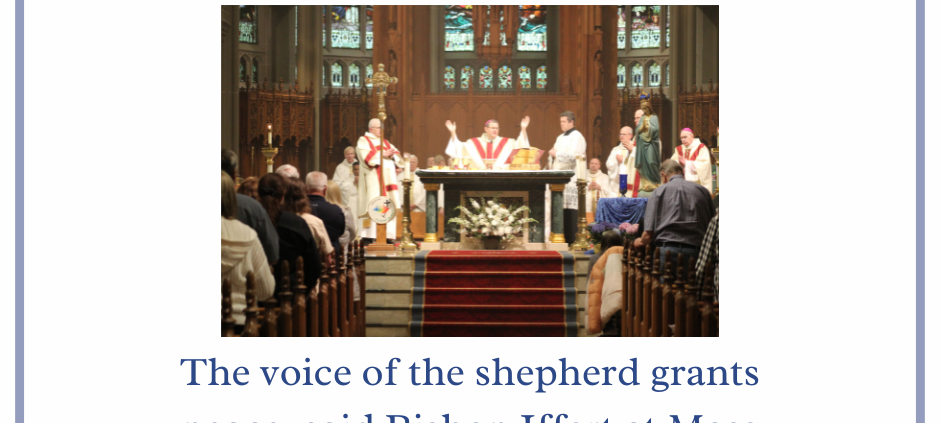
The voice of the shepherd grants peace, said Bishop Iffert at Mass celebrating newly elected pontiff

Maura Baker

Staff Writer

Clergy and laity came together from across the diocese to celebrate a Mass of Thanksgiving for the election of Pope Leo XIV, a Chicago native recently elected Pope by the cardinal conclave succeeding the late Pope Francis. The Mass was celebrated by Bishop John Iffert, May 12, at the Cathedral Basilica of the Assumption, Covington.

Also the homilist for the Mass, Bishop Iffert recalled a quote from St. Augustine he had heard twice in recent times — from the installation of Archbishop Michael McGovern of Omaha, and from Pope Leo XIV when he was first introduced as pope.

“For you, I am a bishop, but, with you, I am a Christian,” Bishop Iffert repeated the quote. But, he said, the quote is taken out of context, explaining that “the former is a duty, the latter is a grace. The former is danger, the latter is salvation.”

Bishop Iffert recalled Cardinal Joseph Tobin’s words during the conclave. He recalled Pope Leo XIV’s fear as the voting ended and his apparent peace after the tally that declared him the next pope.

“Where does that peace come from,” Bishop Iffert asked the congregation during his homily, “for one who is facing stepping onto the world stage in a way that so few will ever have to face? To bear the burden of the weight of shepherding the entire Church of Christ on earth. How does one bear under such a strain?”

“There’s only one way,” Bishop Iffert explained, “These men, Francis, and now Leo — they are practiced at listening for the voice of the shepherd. They are practiced at hearing his call and letting it be their comfort … He is joined to the body of Christ, and he finds there among us, with Christ, the strength to allow himself to be sacrificed in all the various ways he will be sacrificed.”

“We come together today to acknowledge the sacrifice our brother is making,” Bishop Iffert said, “and to give thanks to God for choosing him and for supporting him with his grace, for guiding him in the way of Christ.”

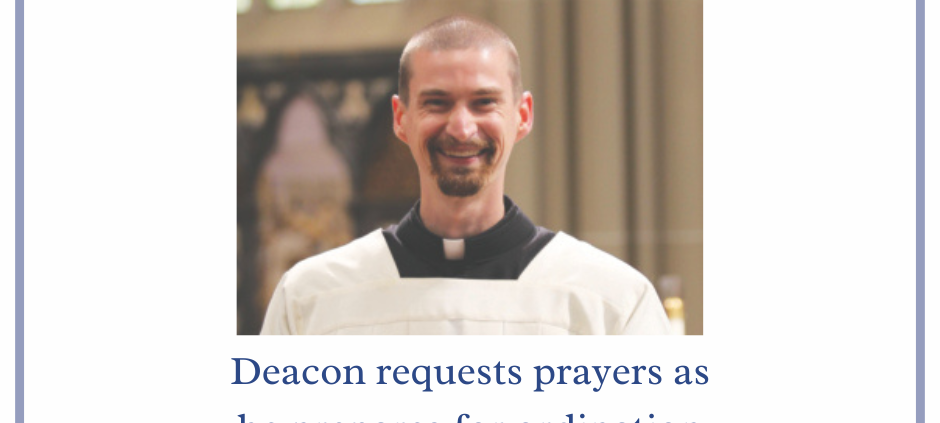
Deacon requests prayers as he prepares for ordination to the priesthood

Maura Baker

Staff Writer

“It feels like a big change is coming,” Deacon Joshua Heskamp told the Messenger, in an interview with the Messenger preparing for his upcoming ordination to the priesthood. Having finished his studies as a seminarian, and nearing the end of his year in the transitional diaconate, Deacon Heskamp will be ordained in a public ceremony, June 7, 10 a.m., at the Cathedral Basilica of the Assumption in Covington.

Additionally, many members of Deacon Heskamp’s family will be participating in the Mass’s liturgy, with his brothers as lectors and his uncle, Father Jeffrey Von Lehmen, pastor, St. Patrick Parish, Taylor Mill, will concelebrant and vest Deacon Heskamp in priestly robes during the ordination.

“The next big step is ordination,” Deacon Heskamp said, “It feels a bit surreal, in a way, moving out of school and into full-time ministry — preparing myself for that.”

“Getting settled in the new life, a new routine of priesthood that’s unfamiliar to me … there’s a lot of unknown there that gives me anxiety, but I trust in the Lord that things will work out for the best in the end,” Deacon Heskamp said, though, in spite of his anxieties, he looks forward to service in the priesthood — and, in particular, through the sacraments.

“Celebrating the Mass, hearing confessions, doing Anointing of the Sick … being able to be an instrument of grace in people’s lives and leading others to Christ” are among the things that he most looks forward to.

As the date approaches, Deacon Heskamp requests the support of prayers from the people of the diocese. “The number one thing I can ask people for is to pray that I may minister with the heart of Christ,” he said, “that the heart of Christ may shine forth out of my priesthood and my ministry, and that I can fully give myself to them — to the people of God.”

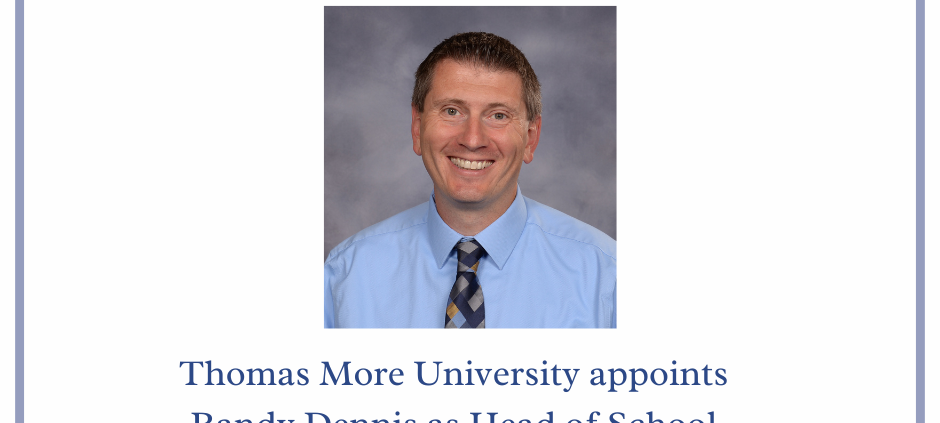
Thomas More University appoints Randy Dennis as Head of School for Covington Latin School

Laura Keener

Editor

Thomas More University announced this week the completion of the Covington Latin School leadership team. Randy Dennis is appointed Head of School for Covington Latin School and will assume the role on July 1, 2025.

Mr. Dennis joins Covington Latin School at an exciting time, with the 2025-26 academic year to be the first under a new affiliation with Thomas More University. As Head of School, Dennis will work collaboratively to leverage the advantages of this new partnership and lead strategic planning initiatives that maintain and advance Covington Latin School’s mission to provide a rigorous Catholic, classical education for the region’s most gifted learners.

“I am thrilled to welcome Randy Dennis as Head of School for Covington Latin School,” says Thomas More University President Joseph L. Chillo, LP.D. “As an experienced and visionary educational leader, Dennis is uniquely suited to lead Covington Latin into a new era.

Mr. Dennis most recently served as principal of St. Lawrence Catholic School in Lawrenceburg, Indiana. He successfully led the merge of St. Lawrence with St. Mary School (Aurora, Indiana), while overseeing a period of record growth in enrollment and demonstrating a strong ability to unite faculty, staff, students and families under a shared mission and vision. He holds a Bachelor of Science in secondary education from Indiana University and a Master of Arts in curriculum and instruction from University of St. Mary.

Earlier this month three people were appointed to the CLS leadership team: Samantha Darpel Rice, Dean of Studies; James Stebbins, Dean of Students and Madison Light, director of Campus Ministry. They join Amy Darpel, director for Advancement and Zack Ryle, director for Enrollment Management and Marketing, both of whom are currently serving in their respective roles.

“We love the energy and the excitement that people are bringing,” said Dr. Joseph Chillo, president, TMU, not only from the leadership team but also from parents, students, teachers, alumni and supporters.

“The leadership team that’s there in the building has just been really youthful excitement and, more importantly, the focus on mission is critically important at a time when we’re trying to redefine Catholic education with this model that we’re working on.”

Over the last year, leaders at Thomas More University and the Diocese of Covington have been transitioning Covington Latin School to TMU as a University affiliated school. On June 1, TMU will begin oversight of the affiliation and begin to run the CLS based on the model. While there will be no changes to curriculum for the upcoming 2025–2026 school year, Dr. Chillo said that plans are already in the works “in terms of what academic pathways are going to like” for the 2026–2025 academic year. Covington Latin School’s name, motto, accelerated program and classical Catholic education will not change.

“That’s the foundation. We are firm believers that there’s lots of similarities between a classical education and the Catholic intellectual tradition, which serves as a grounding for our university,” said Dr. Chillo. “Being able to integrate both the acceleration format along with the Catholic education component are tremendous assets and benefits that will lead into these new academic pathways that will allow students at Covington Latin to earn college credits at Thomas More and then us those college credits regardless of where they want to go to college after their time at Covington Latin.”

About the TMU/CLS affiliation, Dr. Chillo said, “I think this partnership, this affiliation, is really allowing us to utilize the best talents of both places to advance that educational experience for the students and the families who will be here.”

Bishop John Iffert welcomes the new head of school and expressed gratitude for the TMU/CLS transition team.

“I welcome Mr. Dennis to the Diocese of Covington as he accepts the position as Head of School for Covington Latin,” said Bishop Iffert. “In our meeting I found Mr. Dennis to be an energetic and mission-oriented leader. He is an accomplished educator who has effectively led Catholic schools through a period of transition. I thank Dr. Chillo, Kendra McGuire, our diocesan superintendent of Schools, and the TMU and CLS transition team for their expertise in leading this unique and innovative model in Catholic education for Northern Kentucky. My prayers and blessings to all as we continue to provide our children the highest quality academic education, grounded in Catholic teaching and modeled after Jesus Christ.”

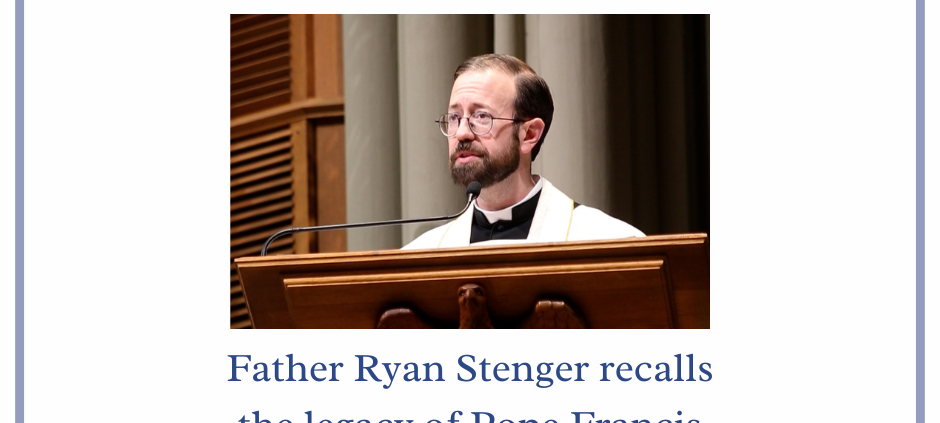
Father Ryan Stenger recalls the legacy of Pope Francis during evening vespers

Bella Bailey

Multimedia Correspondent

The death of Pope Francis triggered an outpouring of grief from Catholics worldwide with a reported 400,000 people flocking to Rome for his funeral. Dioceses around the world have been mourning the loss of the Holy Father with stational Masses, Vespers and funeral Masses in his honor. The Diocese of Covington has joined in this mourning, celebrating all three in the week following the passing of the Holy Father.

During the celebration of sung evening Vespers in commemoration of Pope Francis, April 25, Father Ryan Stenger, judicial vicar for the Diocese of Covington and pastor, St. Jospeh Parish, Camp Springs, walked through the hallmarks of Pope Francis’ 12-year papacy.

Father Stenger recalled Pope Francis’ first homily as Pope, “He said, ‘We can walk as much as we want, we can build many things. But, if we do not confess Jesus Christ, nothing will avail.’”

Father Stenger continued saying, “Now he developed that thought a little more a few months later, one of his first general audiences, he said, ‘The Church is not a shop, she’s not a humanitarian agency, she’s not an NGO. The Church is sent to bring Christ and His Gospel to all. She does not bring herself; the Church brings Jesus.’”

Having been in Rome during the conclave of Pope Francis, Father Stenger remembers the feeling in St. Peter’s Square when the cardinal appeared on the balcony ready to announce the next Pope.

“I remember hearing all the different languages being spoken around me in that moment and thinking about whoever stepped out on that balcony would touch the lives of countless people around the world in ways we can never begin to imagine,” said Father Stenger.

The humble nature that often embodied the papacy of Pope Francis, did not escape mention from Father Stenger’s homily, “The Holy Father called us often to go to the very margines of society, to be close to the people most removed from the life of the Church and from a relationship with God,” said Father Stenger.

Humility, a humble heart, is necessary to reach those on the fringes of society in the way Pope Francis so often did. Father Stenger called those at evening Vespers to honor the life of the late Holy Father by humbling their hearts and seeking to renew the love of Christ in others.

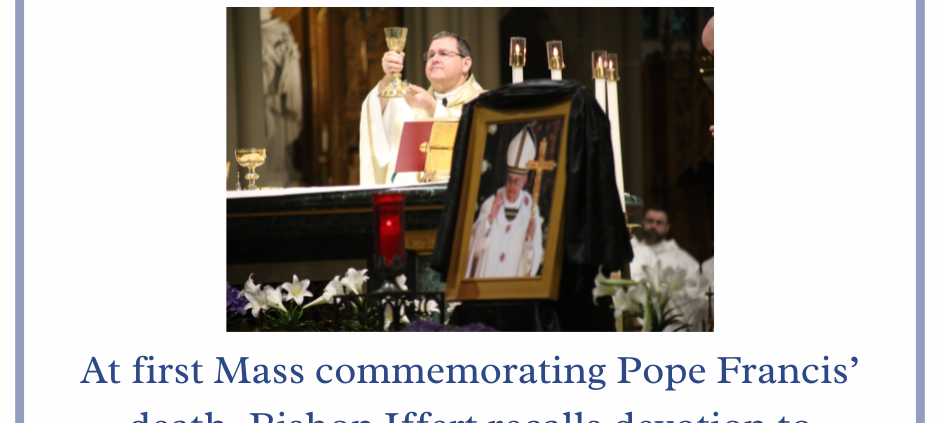
At first Mass commemorating Pope Francis’ death, Bishop Iffert recalls devotion to interior freedom and synodality

Laura Keener

Editor

Over 200 people gathered at the Cathedral Basilica of the Assumption, Covington, April 22, the day after the announcement of Pope Francis’ death, as Bishop John Iffert celebrated a stational Mass commemorating the death of the Holy Father. The Mass was the first of several liturgical celebrations in the Diocese joining local prayers to those of all the world for the peaceful repose of Pope Francis, who has led the Universal Church since March 2013.

“We join our prayers to all the Church in assisting Pope Francis as he journeys to the final shore. May he have, for all eternity, the freedom that he tried to share with us by his witness on the largest of stages,” said Bishop Iffert as he closed his homily.

Earlier in his homily Bishop Iffert said that since Pope Francis’ passing, “we’ve heard lots of memories that have no doubt moved us, stirred up in us sadness and moved us with joy.”

From as early as the first days of his election to the papacy, when Pope Francis returned to his hotel to personally check-out and pay his bill, to his final days, when, for years now, he has been calling the last remaining Catholic parish in war-torn Gaza every day asking the hundreds of displaced people gathered there if they have food, water and the ability to charge their cell phones so that they can communicate with loved ones. “Like a father. Right? Thinking about all the necessities of what’s needed there,” said Bishop Iffert.

Many have noted that Pope Francis was the first Jesuit priest in the history of the Church. As a Jesuit, Pope Francis valued the process of discernment of God’s will for individuals and the Church.

“He shared that in a special through that Jesuit practice of spiritual conversation, which was so manifest in his call for synodality in the life of the Church,” said Bishop Iffert. “He wanted to lead us to be a people who could talk to one another and listen to one another without judgement; who could come to conversations without preformed opinions but who could come together and hear the experience of others and pray and ask God to open us to the movement of the Holy Spirit, so that we could discern the will of God and the way forward for us together as the ecclesial Body of Christ on earth.”

Bishop Iffert said that his favorite aspect of Pope Francis was his interior freedom.

“When he believes that the Lord, God is calling him to something, he does it — speedily! He is faithful to the Word of God as he recognizes it in his life and he doesn’t care what people say about him or how they attack him … if he thought something was right, he did it,” said Bishop Iffert. “He was a man, and is a man, who understands that freedom comes from being a child of God and that God intends for us to live as free children.”

Additionally, in the Diocese of Covington, on the day of Pope Francis’ death, churches throughout the diocese rang bells for 10 minutes beginning at 3 p.m. Church doors are draped in black or purple bunting or decorated with black or purple bows or wreaths as a sign of mourning until a new pope is announced. At that time, the buntings will change to the papal colors of white and gold.

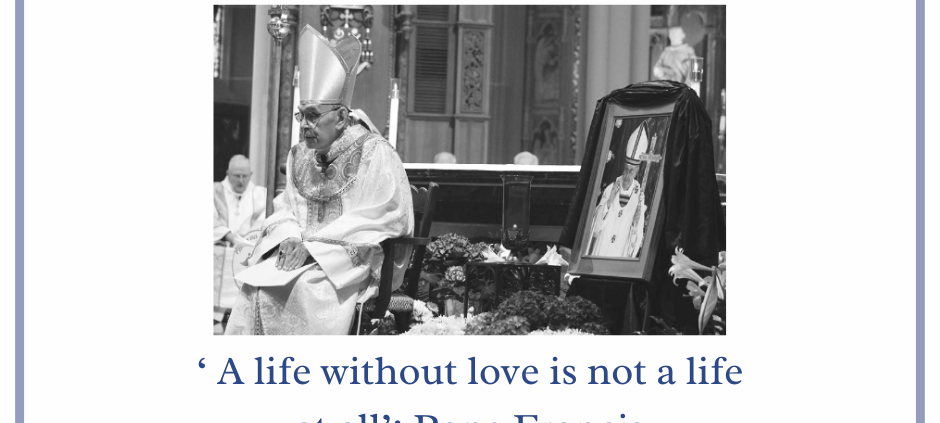
‘ A life without love is not a life at all’: Pope Francis remembered at Requiem Mass

Maura Baker

Staff Writer

Following the death of Pope Francis, the Diocese of Covington concluded a trio of services commemorating the deceased pontiff with a Requiem Mass, April 26, held at the Cathedral Basilica of the Assumption, Covington.

A Requiem, known also as a Mass for the dead, is a special service in the Catholic Church offered for the repose of the souls of the deceased and is typically held in the context of a funeral.

The Requiem Mass was celebrated by Bishop John Iffert alongside many of the priests of the diocese, Bishop Emeritus Roger Foys was the homilist.

“Do not grieve like those who have no hope,” Bishop Foys quoted St. Paul, continuing to say that that greeting is often misunderstood. “People say that Paul is telling us we shouldn’t grieve,” he said, “He’s not. We grieve because we love. If we never love we never grieve, but a life without love is not a life at all.”

Instead, Bishop Foys stressed the words that St. Paul said: not to grieve like those who have no hope, and he reminded the congregation gathered that Easter Sunday, celebrated a week prior “is our hope.”

“So, we grieve, yes,” he said, “We grieve the loss of someone we love. We grieve the loss of someone who is dear to us … the difference is we have hope.”

Before his death, Pope Francis declared 2025 as a Jubilee year, with the theme “Pilgrims of Hope,” which Bishop Foys said was “especially important.”

“It sometimes seems to be a hopeless world,” he said, “… you might feel hopeless. In those times, you cling to the hope of Lord Jesus.”

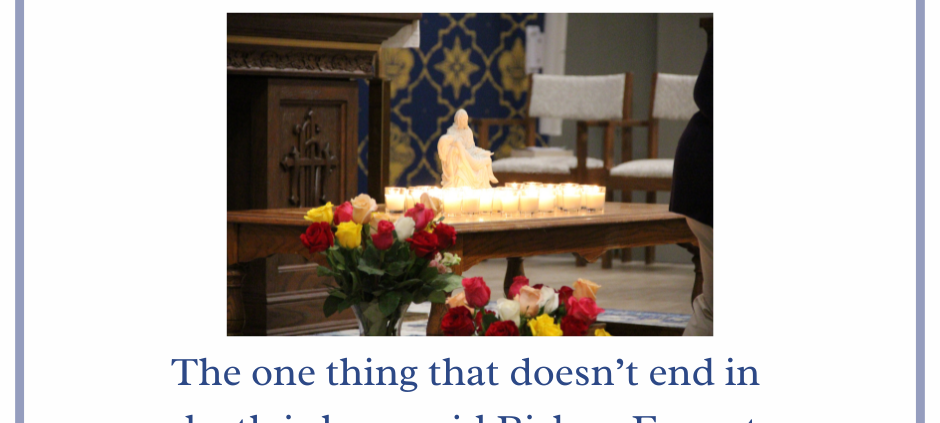
The one thing that doesn’t end in death is love, said Bishop Foys at annual Mass for Loss of a Child

Maura Baker

Staff Writer

Over 100 people attended this year’s Memorial Mass for the Loss of Child, April 7, at Immaculate Heart of Mary Parish, Burlington. The annual Mass, hosted by the diocesan Pro-Life Office, invites parents, grandparents and others grieving the death of a child to gather to memorialize their child and to surrender to God’s loving embrace. Bishop Emeritus Roger Foys was the celebrant and homilist at the solemn event.

“A child is a child to their parents for as long as they live,” said Bishop Foys. “… one of our hopes, that all of us, please God, being faithful to the Lord, to his word and to his Church, will one day enter the Kingdom of Heaven. We firmly believe that we will join those who have gone before us. So, mothers and fathers can hope to embrace those children who have gone on before them, just as they embraced them in this life. The one thing, St. Paul said, that does not end in death is love. Love remains, that bond of love between parent and child. That is where our comfort comes and hopefully lessens our grieving.”

Annual ACUE donor luncheon thanks donors for their contribution to urban Catholic education

Bella Bailey

Multimedia Correspondent

The mission of the Alliance for Urban Catholic Education (ACUE) is to ensure that all children within the inner-city areas of the Diocese of Covington have access to a Catholic education. This mission is accomplished through administrative and financial means; and it would not be possible without the many donors who donate their time, talents and treasure to the ACUE mission.

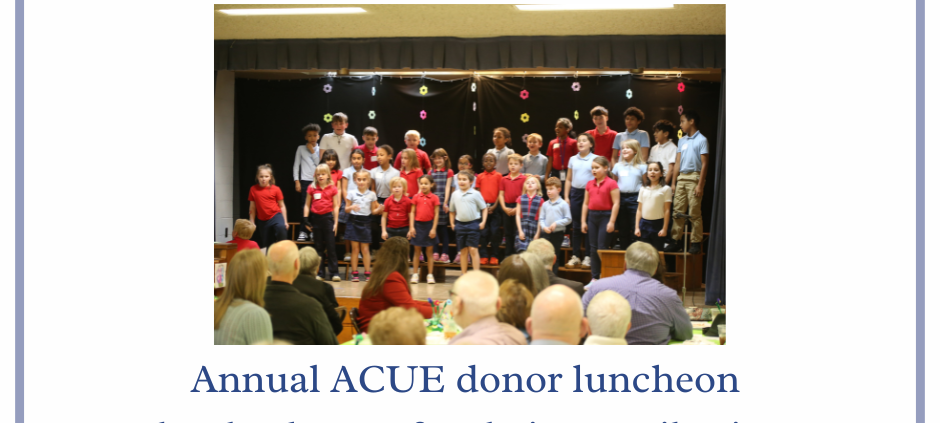
It is for their generosity that they are thanked at the annual ACUE Donor Appreciation Luncheon, held this year at Holy Trinity School, Bellevue. The luncheon, sponsored by the ACUE Advisory Board, rotates locations between the five ACUE schools in the Diocese of Covington: Prince of Peace School, Covington; St. Anthony School, Taylor Mill; St. Augustine School, Covington; Holy Cross Elementary School, Covington; and Holy Trinity School. Among these five schools, nearly 500 students are receiving a high quality, Catholic education.

“For decades, Catholic schools have stood out as leaders in education,” said Kendra McGuire, superintendent of schools for the Diocese of Covington. “In addition to our record of academic excellence, we provide an education in the faith, teaching the next generation how to follow Christ and care for their neighbors. Time and time again Catholic schools have seen their graduates succeed in their chosen careers but also become leaders at giving back to their communities.”

Upon arrival to Holy Trinity School donors were met with the smiling faces of students, waiting to meet the people that help make their education possible.

“What it means to be a Holy Trinity student is that we get to get a good education, and not only that, but also a very good Catholic education. We get to learn in a positive and fun environment, and luckily for us, we have great academics and staff,” said one Holy Trinity student.

Mrs. McGuire said to the donors, “For our families, the support that you give eases the fears and worries that parents have when raising children. Education is a necessity, the path to a bright future that every parent wants for their child. In the urban areas, finances often limit their educational options, but your support gives them an opportunity to choose a school where their child is provided an outstanding education, a place where their child is welcome, a place where their child feels safe, and a place where their child is loved.”

As a thank you for their generosity, students from Holy Trinity School performed a medley of songs, accompanied with a chorus line, for the donors. The songs included “There’s No Business Like Show Business,” by Irving Berlin; “Swinging on a Star,” by Bing Crosby; and popular folk song, “Oh Shenandoah.”

“You’re not only transforming the lives of the children today, you’re transforming the community and the future of Northern Kentucky and the Diocese of Covington. So, I hope and pray that God continues to bless you for your kindness and your generosity, and we appreciation your ongoing support for our ACUE schools and their students,” said Mrs. McGuire.

The true testimony for the gratitude felt by ACUE students came on behalf of one Holy Trinity student when she said, “We are extremely glad to have ACUE for several reasons. Without you guys, we wouldn’t have some of the learning resources we have, we wouldn’t have our new playground equipment because we wouldn’t be able to afford it. We wouldn’t even really have enough money to pay bills like heat, electricity, plumbing, so on and so forth, because we just don’t make enough money. And so, that is why we’re glad to have ACUE, because you guys are just so nice to donate to us. We can afford all this stuff. We really appreciate it, so, thank you ACUE donors.”

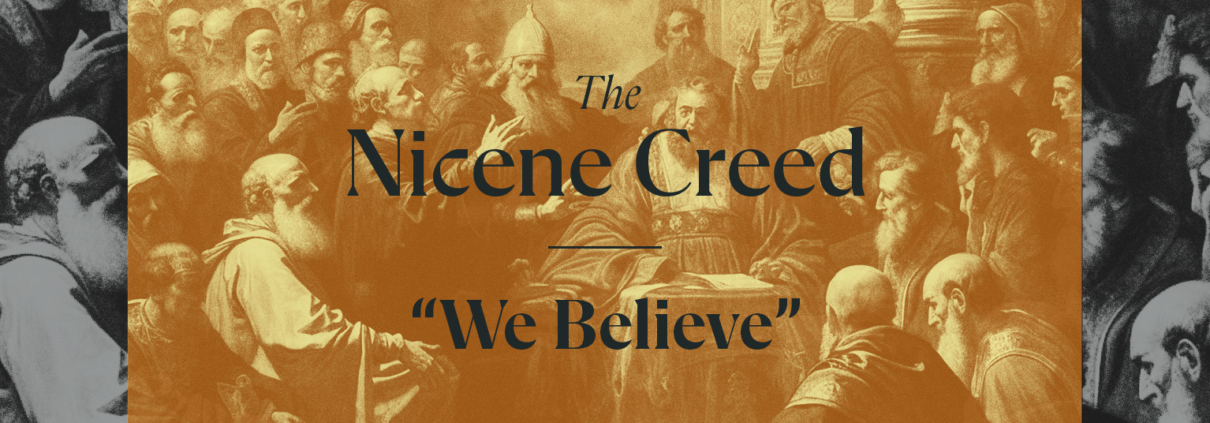
Nicene Creed

The eloquent ambiguity of ‘I Believe’

By Bishop Robert Barron.

There is an eloquent ambiguity in the way in which the opening word of the Nicene Creed has come down to us. Our best evidence suggests that in the formula that goes back to the Nicene Fathers themselves, the word is pisteuomen (we believe), but as the Creed has been passed on, translated, and used in liturgical settings, pisteuomen often became pisteuo (I believe). The ancient Latin translation indeed begins with Credo (I believe). For the first several decades of my life, the Church commenced the Creed at Mass with “we believe,” but about ten years ago, it switched back to a rendering of the standard Latin version: “I believe.” I say that the ambiguity is eloquent, for there is value in both forms.

On the one hand, “we believe” effectively emphasizes the communal and corporate dimension of the Church’s faith: we are in this Christian project together and never individualistically. Moreover, it indicates how, in a sense, we believe not only with others but in some cases for others. Perhaps my conviction regarding an article of the Creed is wavering, but yours is strong, and mine is firm with respect to another article, and yours is weak. The “we believe” allows us to find mutual support in our faith.

However, the “we believe” also allows us to escape, at least to some degree, personal responsibility. Do I truly believe this? What is at stake in agreeing to this ancient statement is not a triviality or even a matter of purely epistemic interest. Rather, the issues raised by the Creed have to do with where a person stands most fundamentally. And therefore, in another sense, it is altogether appropriate that the one who recites the Creed commence by saying unequivocally, “I believe.”

The verb itself is of crucial importance: “believe.” Especially mindful of the army of the unaffiliated, those who have either never been exposed to a serious presentation of the faith or have actively left religious practice behind, I want to stress, as strongly as I possibly can, that authentic faith or belief has not a thing to do with naïve credulity or accepting claims on the basis of no evidence. Faith, in a word, is never below reason, never infra-rational. The Church has absolutely no interest in encouraging superstition or intellectual irresponsibility. Rather, real faith is supra-rational, above what reason can grasp. If we must speak of a certain darkness in regard to the matters of faith, it is the darkness that comes from too much light, rather than from defect of light.

If I might propose a somewhat homely analogy, the play between reason and faith in regard to God is something like the play between reason and faith in regard to coming to know another human being. To be sure, investigation, examination, research, and observation all play a role in this process, but finally, if one wishes to know the heart of another person, he has to wait until that other reveals himself, and then he has to decide whether he believes what he has been told. An aggressive reason that seeks always to grasp on its own terms will never come to know deeper dimensions of reality, including and especially the personal. Such depths can be plumbed only through something like a faith that accepts and receives.

It is worth noting that in Thomas Aquinas’ religious epistemology, faith is a rare case of the will commanding the intellect. Typically, in Aquinas’ account, it is just the opposite: will is a function of the intellect, responding to what the intellect presents to it. But when it comes to faith, the will, in a way, comes first, for it commands the intellect to assent, and it does so out of love. Because the will loves God, it directs the mind to accept what God has revealed about himself, even though the mind cannot clearly see or understand it. Again, lest this sound anomalous, much the same dynamic obtains in an interpersonal relationship. Is she telling me the truth about what is in her heart? I cannot possibly know directly, but my will, which loves her and has come to trust her, commands my intellect to assent.

“Faith” is tantamount to a willingness to attend to a voice that transcends one’s own, a trusting surrender that there is a reasonability on the far side of reason. It is, therefore, an openness to adventure.

Bishop Robert Barron is bishop of the Diocese of Winona-Rochester, Minnesota. Article originally published at WordOnFire.org.
Curia staff experience service to others in a different way at annual Day of Service

Maura Baker

Staff Writer

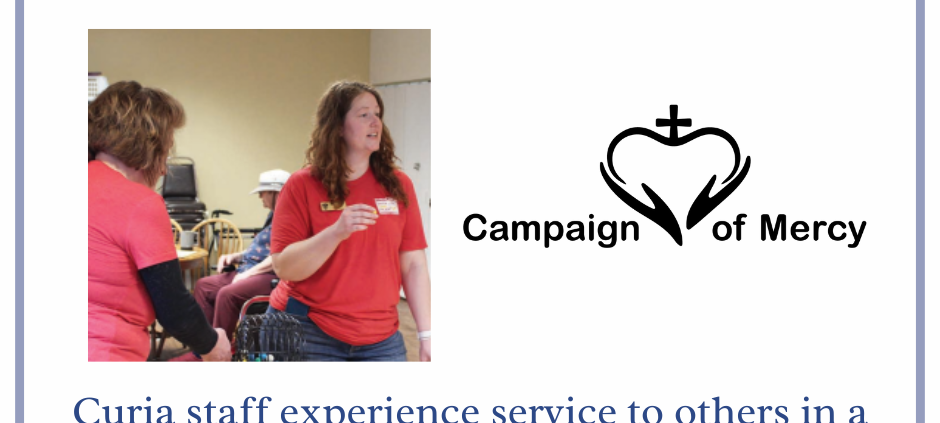
The Diocese of Covington’s Curia staff held its second annual Day of Service, April 3. An extension of Bishop John Iffert’s “Campaign of Mercy,” the annual Day of Service begins and ends with reflection and prayer — offering staff a break from routine and an opportunity to serve the diocese in a different way, both physically and spiritually.

Curia employees divided their work in groups between different ministries — some played with and cared for children, or served lunch at ACUE schools, while others played bingo with seniors or helped clear out the now closed Holy Family School, Covington.

Kelly Linkugel was a member of the planning committee for the Day of Service, and said that she “thought it was very evident from my colleagues how much they all cared about this day and how much we could collaborate and make sure we were serving different segments — not just older folks, or kids — we made sure we got a full circle of people to take care of.”

“I think the Day of Service was a meaningful day for everyone who was involved in it,” said Sister Margaret Stallmeyer, another member of the event’s committee, “We all were stretched and experienced different than what we have every day. It was a time for us to see the diocese, see the work that’s going on in this Church and this community and to recognize the role that we have in strengthening the Church and the community.”

“The annual Day of Service is a really good opportunity for the Curia staff to move beyond the office,” said Sister Margaret, “and to experience time with the people whom we are serving here in the Curia in a different way. It all becomes real for us, and I think that’s a blessing.”