Thirtieth Sunday of Ordinary Time
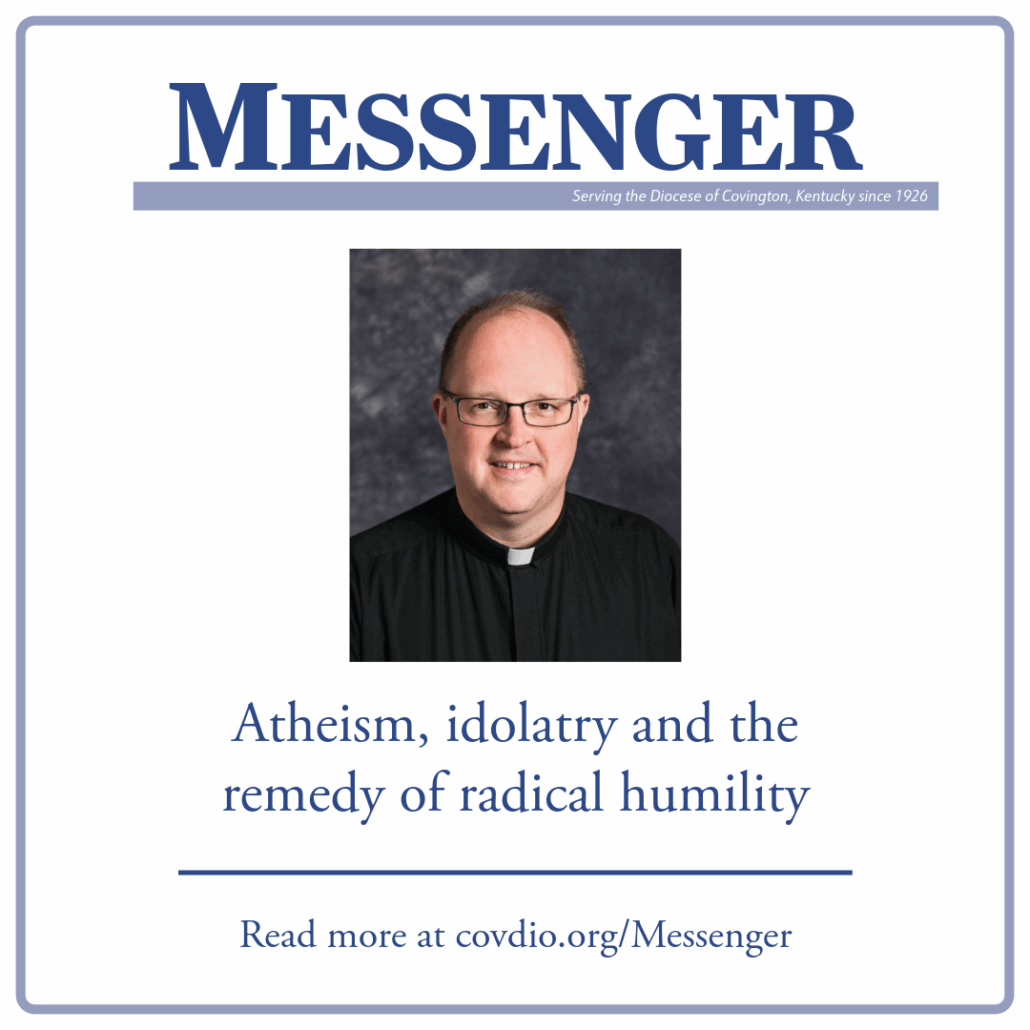
Father Phillip W. DeVous
Guest
One rarely hears much anymore about the “New Atheists”, or from other professional atheists in the public square. Given the relative silence of this previously influential contingent, it would be lovely to think they were successfully rebutted by the arguments for faith in Jesus Christ and defeated by the evidence supplied by lives of faith. While such arguments are not absent and such lives are present among us, I sense that atheism has largely triumphed, at least, socially, as the lingua franca of cultural life. In other words, their ideas were successful, and public opinion simply absorbed their notions as the default norm.
This gives us an opportunity to properly examine the true nature of atheism. Contrary to the common understanding, atheism is not simply a rejection of belief in God or the idea of God. Upon closer examination, one can see that atheism is a form of idolatry, of self-sufficiency, and a radical belief in oneself and in one’s own power to make oneself “good.” We see this phenomenon illustrated in the figure of the Pharisee when he prays, ostensibly to God, but really to himself: “O God, I thank you that I am not like the rest of humanity — greedy, dishonest, adulterous — or even like this tax collector.”
This is what one strain of atheistic idolatry looks like—praying to a god we have made in our own image and likeness. As the late Pope Benedict XVI noted in his deeply insightful book, Jesus of Nazareth:
“At the heart of all temptations . . . is the act of pushing God aside because we perceive him as secondary, if not actually superfluous and annoying in comparison with all the apparently far more urgent matters that fill our lives. Constructing a world by our own lights, without reference to God, building on our own foundation; refusing to acknowledge the reality of anything beyond the political and material, while setting God aside as an illusion — that is the temptation that threatens us in many varied forms.”
Jesus is beckoning us to recognize the reality that even believers can be tempted to the corruption of atheistic-idolatry, even as they call on the name of the Lord in prayer and worship. We treat God as secondary, ourselves as first. We construct a god that suits our purposes and we end up worshiping the false gods of politics and material pursuits, which is to say, worshiping ourselves under various guises. In our age where materialism is regnant in every sphere of life, and deeply influences our understanding of the human person, this temptation is ever-present.
What then is the remedy to this powerful and often subtle temptation? Radical humility and an awareness of our poverty of spirit. As the Holy Gospel teaches, “for whoever exalts himself will be humbled, and the one who humbles himself will be exalted.” Humility does not come easily to us, as self-will and a refusal to acknowledge our relationship of dependence on God and others is a consequence of original sin, intensified by our personal sins. That is why we pray in the opening collect of the Holy Mass, “make us love what You command.” Left to our own devices, living according to our lights, we tend to “love” only what we want. If our wants are untutored by Gospel truth and untouched by grace, we end up in a state of unbelief and idolatry.
When we allow the Holy Spirit to reveal to us our poverty of spirit, our dearth of understanding about what truly matters, and what makes us whole as humans, we may well experience a profound sense of being brokenhearted. This is a natural consequence of recognizing where in our lives we have worshipped that which is unworthy, believed that which is false, and been made less than we are meant to be. This recognition, though painful, is the path to the highest good! As the psalmist proclaims, “the Lord is close to the brokenhearted; and those who are crushed in spirit he saves.”
This is the posture of radical humility that conquers the atheism which is really the idolatry of self and our state of possession by desires untutored by truth and untouched by grace. In faith, trusting that the Lord will rescue us from every evil, we turn to the Lord who is alive to us in the Holy Sacraments, praying, “perfect in us what lies within them, that what we now celebrate in signs we one day possess in truth.”
Father Phillip W. DeVous is the pastor of St. Charles Borromeo, Flemingsburg, and St. Rose of Lima, May’s Lick.