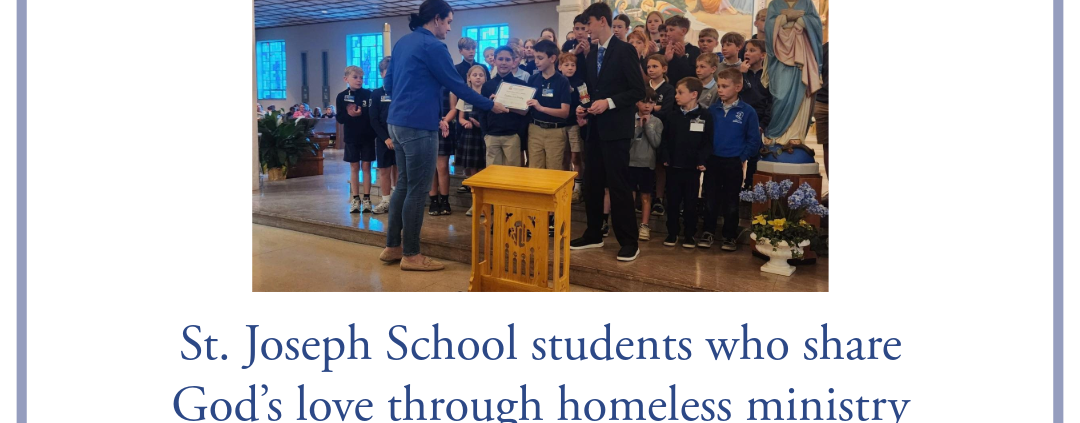
St. Joseph School students who share God’s love through homeless ministry are recognized by Emergency Shelter of Northern Kentucky

Bella Bailey

Multimedia Correspondent

Students at St. Joseph School, Crescent Springs, were recognized by Kim Webb, chief executive officer, Emergency Shelter of Northern Kentucky, Covington, with the Ralph Drees Impact Award. This annual award is presented to volunteers of the shelter and recognizes those who make an impact on the shelter and its guests. This year the students of the St. Joseph School Cavaliers Care Ministry awarded, in surprise, following an all-school Mass.

The Cavaliers Care Ministry is a parent-run volunteer organization that encourages St. Joseph School families to volunteer in their communities. The ministry has partnerships with four organizations, but Christie Pavia, founder, said that it is the Emergency Shelter of Northern Kentucky that impacts the students the most.

“Every time a student goes down there and humbly submits themselves to the most vulnerable in our community it’s extremely rewarding, and I think it just feeds the soul of the kids and encourages them to be the hands and feet of Jesus,” said Mrs. Pavia.

Families can register for the volunteer opportunities at the shelter through the Cavaliers Care Ministry, and serve food donated by local organizations. As guests of the shelter come through the line to receive a meal, the students and families greet them with a smile, a conversation and a human connection.

When it came time to decide who would be the recipient of the 2026 Ralph Drees Impact Ward, Mrs. Webb said that it was the students of St. Joseph who “immediately” came to mind. Their work with the guests of the shelter, “brightens up their mood and the shelter. They get excited when they see the students in here, and they just bring an energy and a joy, often in ways only young people can do.”

“To witness our guests engage with these students as they’re going through the meal line, and they’re talking to them, and the students in return talk to our guests like they are worthy of a conversation, it removes the homelessness side of it,” said Mrs. Webb, “they normalize that experience for our guests, in terms of feeling valued in our community, feeling heard in our community.”

Timothy Maines, principal, St. Joseph School, Crescent Springs, said, “we have so many students wanting to help and do things that there’s just not enough space for it, and there’s not enough space at the shelter … the students and the parents, just the whole community, want to give back and show that Christ-like attitude of helping others.”

“I feel nothing but pride for these students,” said Mr. Maines. “I am just so incredibly proud of all the accomplishments they have, and everything they do.”

Mrs. Pavia shares a message with all the students who volunteer through the Cavaliers Care Ministry, telling them, “God gives you gifts, not to store them up in your school or your church or your house, but to be the vessel” that pours them out.

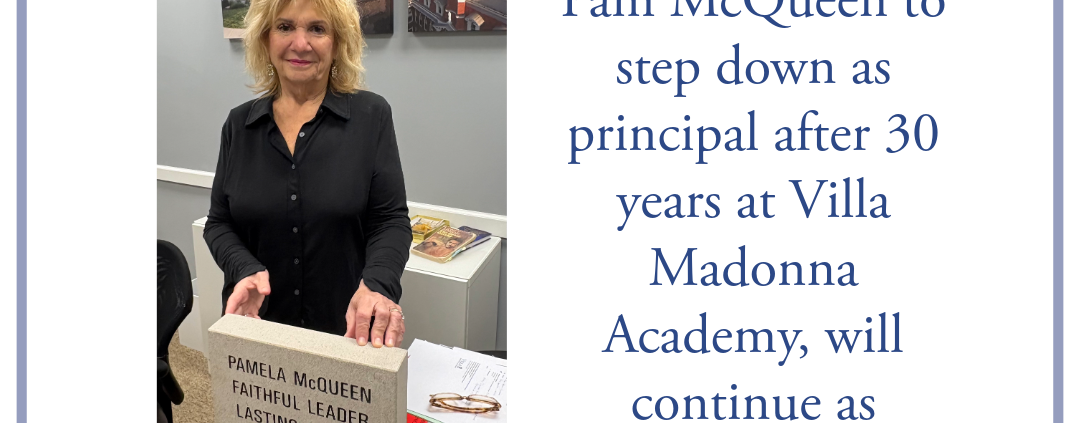
Pam McQueen to step down as principal after 30 years at Villa Madonna Academy, will continue as president

Laura Keener

Editor

Long before Pam McQueen ever walked the halls of Villa Madonna Academy as its first lay principal, a paperback copy of The Great Gatsby helped chart her course. Assigned by her high school English teacher, the novel gripped her so completely that, she said, “I don’t know — I read the first couple of chapters, I couldn’t put it down,” and “there was something about the characters in this that just changed my life.”

Mrs. McQueen said she saw herself most in Nick Carraway — the observant narrator who tries to make sense of the people around him and, ultimately, chooses integrity over illusion. As a young reader, she was drawn to Nick’s role as listener and truth-teller, she said, and to “the way he watches everything and then decides what really matters.”

That perspective, Mrs. McQueen explained, stayed with her in education: paying close attention to students’ stories, weighing competing voices and leading with a steady moral compass.

This spring, Mrs. McQueen will deliver commencement remarks one more time — like always, with Gatsby “in there” — and then retire from the principal’s office after 30 years leading the Benedictine school. She will remain at Villa Madonna Academy in the role of president focusing on strategic planning, alumni engagement and the next phase of fundraising.

Mrs. McQueen became principal three decades ago after teaching English at St. Henry District High School and Newport Central Catholic. “Brand new principal — first lay principal here,” she recalled.

She remembers arriving to an unfamiliar culture and quickly learning that the job was more than first-day excitement. “The first days were challenging,” she said, but she found mentors and, importantly, a warm welcome from the Benedictine Sisters who founded the academy. “They were incredibly supportive … and from the get-go, made me feel like part of their family,” Mrs. McQueen said. “I always felt welcomed, always.”

Over the years, Mrs. McQueen worked to make Villa Madonna’s Benedictine identity unmistakable. “I set out [that] the minute you walk into this building, you need to know you’re in a Benedictine school,” she said, describing graphics, a prominent Benedictine cross and giving each freshman a copy of the Rule of St. Benedict. “Every day we talked about hospitality and respect and reverence and stewardship. It’s in our announcements and it’s in everything we do.”

Those values, she said, helped sustain a close-knit faculty community through decades of change. “We don’t go to work in the morning — we go to school,” Mrs. McQueen said. She points to milestones such as opening the new gym in 2000, earning multiple National Blue Ribbon recognitions and other honors and navigating a major capital campaign that began in 2019 and paused during the pandemic. Despite rising costs, “we raised the money to renovate that building,” she said and the campus’ new STEM wing is nearing completion.

Mrs. McQueen also championed a distinctive grade-level model, integrating junior high students into the high school setting. The approach, she said, reframes early adolescents as “young adults,” giving them expectations and role models while surrounding them with a Benedictine house system designed to teach community. “It works. The model really works well,” she said.

During her tenure, she and faculty members began connecting with 24 other Benedictine high schools in the United States, forming a colloquium. “We have this tight knit group of Benedictine heads of school and we all work together,” said Mrs. McQueen, noting that she, faculty members and students have visited and welcomed students from California, New Jersey, Alabama and more.

Next year, Villa Madonna Academy will return to a leadership structure that separates day-to-day academic oversight from long-range operations and advancement. Mrs. McQueen has held a dual role, but the school is splitting responsibilities so she can focus on the president/executive director portfolio.

In the model, the president leads advancement, finance and community relationships, while the principal concentrates on curriculum, student life and instructional leadership. “It’s become more and more — I think more and more is expected of principals through the years,” Mrs. McQueen said, citing student mental health needs, teacher support and new programming. “So, you really need somebody that can focus 100 percent” on the principalship.

The search for a new principal is nearing completion, with the school down to its final candidates, she said.

As she transitions, Mrs. McQueen says she will work intentionally to give the incoming principal room to lead. “For me, it’s going to be important to step back and let the new principal create his or her culture,” she said, while still staying present with students and families. “I want to do that too … but to not be intrusive … just to be a support, however they might need me to be.”

About her time as principal, Mrs. McQueen said, “Being here has been the gift of a lifetime. It’s bittersweet … I will miss it,” she said, as she looks toward a new chapter — still at Villa Madonna Academy — in a singular role as president.

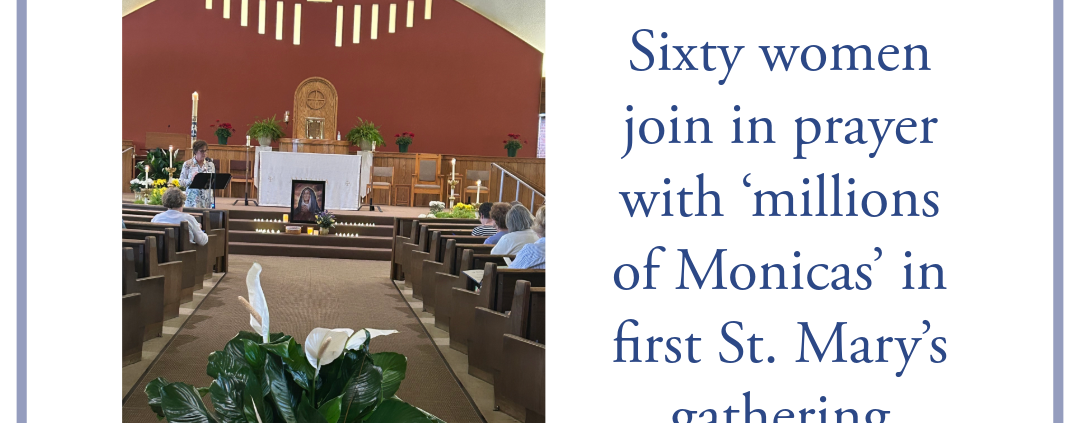
Sixty women join in prayer with ‘millions of Monicas’ in first St. Mary’s gathering

Maura Baker

Staff Writer

In 2021, three Michigan mothers founded “Millions of Monicas” — a movement of Catholic women coming together to pray, through the intercession of St. Monica, for the return of their children — and young people as a whole — to practicing their faith. Now, with over 100 individual communities worldwide, St. Mary Church, Alexandria, is joining with these other women in prayer as the second Millions of Monicas (MOM) group in the Diocese of Covington, following in the footsteps of Immaculate Heart of Mary Parish, Burlington.

Meeting for the first time, May 4, around 60 women came together to pray hopefully for their children’s return to the faith. Carol Ernst, who coordinates the group at St. Mary’s, was inspired to bring MOM to St. Mary Church after attending the diocesan hosted “Return” workshop last fall with hopes to “learn more about motivating (her) girls to come back to the Church,” said Ms. Ernst.

Intrigued by Immaculate Heart of Mary’s incorporation of the program, as she learned during the workshop, Ms. Ernst recalled that it was “wonderful to be in the company of other women praying for the same thing … It was a form of support by just coming together.”

Now, after having their first gathering, Ms. Ernst and the other women behind St. Mary’s MOM group plan to host time in prayer monthly — on the first Monday at 6:30 p.m.

Judy Schilling, who helped to plan the meeting, reflected on the meeting’s success. “We all have someone that we’re praying for,” said Ms. Schilling. “I just thought it was beautiful to share that and to see so many other women that have the same concerns and want to bring our children and family members back into the faith that we raised them in.”

“It’s a quiet, prayerful ministry,” said Ms. Ernst, who encouraged women across the diocese to join either St. Mary’s or Immaculate Heart of Mary in this ministry of prayer.

“We’re hoping that more women will get involved and attend,” she said.


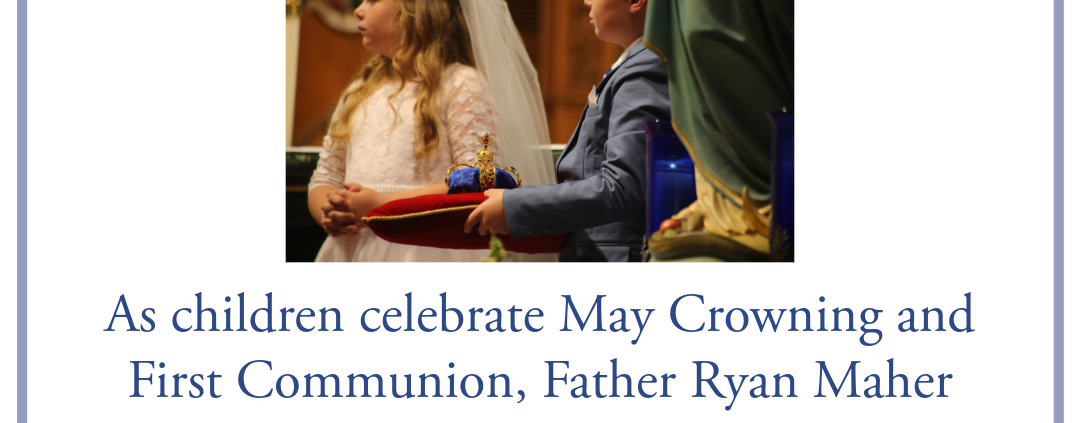
As children celebrate May Crowning and First Communion, Father Ryan Maher invites young communicants to ‘make a dwelling place’ for Jesus in their hearts

Maura Baker

Staff Writer

May in the Catholic Church is dedicated to the Blessed Virgin, Mary. Traditionally, and in many parishes today, one way that she is celebrated during the month is through a “May Crowning” — a ceremony where a statue of Mary is crowned, typically by the parish’s children, representative of her role as Queen of Heaven.

May Crowning at the Cathedral Basilica of the Assumption, Covington, coincided with the Sacrament of First Communion for three parish children, May 3. These children were the ones to crown Mary during that morning Mass, celebrating with their parish, families and with Father Ryan Maher, the Cathedral’s rector as well as the Mass’s celebrant and homilist.

During his homily, Father Maher descended from the sanctuary to sit with and speak directly with the first communicants. He began his homily speaking to the children about St. Peter.

“It was Peter that Jesus chose to be the head of the 12 and the head of the Church,” Father Maher said, “and we know about Peter’s life in the Scriptures — Peter sometimes got excited about something and wasn’t able to follow through.”

“Sometimes,” he said, “he wanted to love Jesus with his heart — and then, when Jesus needed him, he wasn’t around. He betrayed Jesus.”

Father Maher pointed out to first communicants the depictions of St. Peter in the cathedral’s windows, where he is seen dressed in gold vestments — “because he was chosen by the Lord to be the head of his Church and the head of all of us in the life of faith.”

Referencing the second reading of the Mass, as St. Peter speaks to the Church’s early disciples, Father Maher told the children, “He says, go to him. Go to him, a living stone. Jesus, he’s talking about, is a living stone. Jesus is chosen and precious in the sight of God, be built into a spiritual house.”

“The same Jesus who forgave Peter forgives us when we are far away from the Lord,” said Father Maher. “… Peter is telling the early Church to go to him and to become like him because we are chosen. We are precious in the sight of God … and we are to be built into a dwelling place.”

While the Cathedral itself can be considered a spiritual dwelling place, Father Maher said that “Jesus, in the Gospel today, speaks of another type of dwelling place … it’s the place of Heaven.”

“Did you know?” he asked communicants, “Did you know that God, the Father, has already made a place for you in Heaven? For me in Heaven? For all of you in Heaven? That’s how much he loves us.”

“On this day, the day of your First Holy Communion, make a dwelling place in your heart for Jesus,” Father Maher continued, “… Every time you come to Mass, open your heart because you are chosen and you are precious in the sight of God. If we can all remember that we will truly become a dwelling place that’s fit for the Lord Jesus — a place to know in Holy Communion how much we are loved, how much mercy the Father has for us. When we allow ourselves to be built into living stones and our heart becomes a tabernacle for Jesus in the Eucharist, you know what changes? Our whole life.”

A stone mason’s legacy: Building a Mary grotto

Laura Keener

Editor

May is a month in which we celebrate mothers. Each year, the second Sunday of May — Mother’s Day — is a time devoted to moms. In the Catholic Church, the entire month of May is dedicated to Mary — our spiritual mother. Scripture tells us that it was Jesus who appointed Mary the spiritual mother of the entire Church, when, while dying on the cross, said to her, “Woman, behold, your son.” Then turning to his disciple, John, said, “Behold, your mother.” (John 19:26–27)

We honor Mary under many titles. If you are ever awake listening to Sacred Heart Radio at 5:55 a.m., you will hear a recording of Bishop John Iffert and Diocese of Covington seminarians praying the Litany of Loreto. The Litany petitions Mary under 53 of her titles, which, to name a few, are: Holy Mother of God, Mother of the Church, Mother of Mercy, Seat of wisdom, Ark of the covenant, Morning star, Refuge of sinners, Solace of Migrants, Queen of the most holy Rosary, Queen of families and Queen of peace.

Other titles for Mary are tied to apparitions like Our Lady of Fatima, Our Lady of Guadalupe and Our Lady of Lourdes. It is often under these titles that images of Mary find their way into statuary and grottos. These grottos offer the faithful a place of respite, to pray and reflect, to contemplate Mary as she leads all to salvation, her son, Jesus.

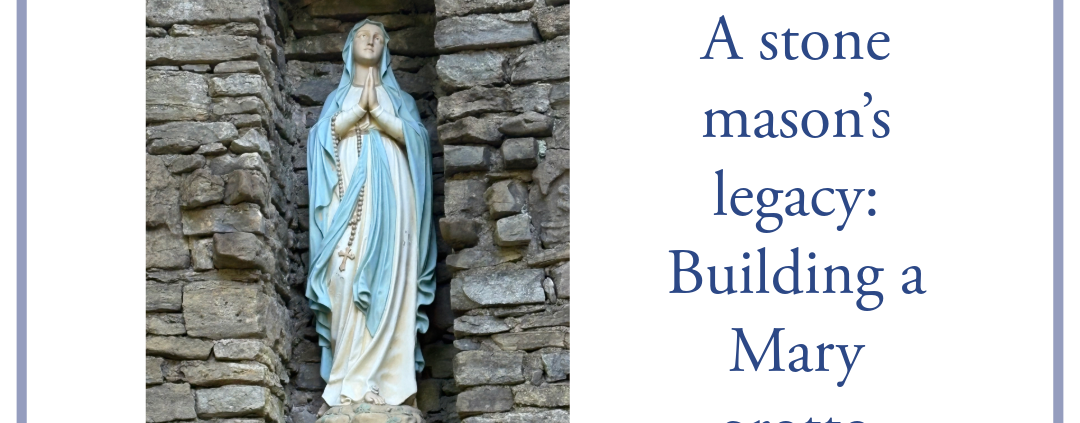
St. Anthony Parish, Taylor Mill, is home to one such grotto — a significantly sized stone edifice with a statue of Our Lady of Lourdes perched in its top niche. Recently, Father Ivan Kalamuzi, pastor, met Bob Leen, the grandson of the stone mason who built the grotto, while he was visiting there.

Behind St. Anthony Church, the stone grotto has stood for generations — its rockwork still tight and steady, even after decades of weather. Mr. Leen said that family stories trace the Mary Grotto back to the early 1930s and to his grandfather and Northern Kentucky craftsman: George Henry Ricken, a working stone mason whose hands shaped walls and landmarks across the region.

As the story was passed down through the Ricken family, a priest — remembered as Father Bernard Nurre — asked Mr. Ricken to build a shrine. Father Nurre was pastor at St. Anthony Parish for 46 years, retiring in 1967.

At the time, Mr. Ricken’s family attended Holy Cross; he himself was not Catholic. But the work, and his conversations with the priest along the way, became a turning point that eventually led him to convert to Catholicism.

Mr. Leen said that his grandfather approached the grotto the way he approached every job: by letting the material guide the design. He reportedly walked up and down neighboring Banklick Creek collecting rocks, choosing pieces he knew would set well and last. The result was a grotto built with heavy stone and plenty of mortar — solid enough that visitors still remark on its strength and craftsmanship.

One detail the family remembered most vividly was a cross. According to his grandson, Mr. Ricken didn’t want a cross pieced together with mortar joints. Because he understood the grain of stone and how it would split, he searched until he found a rock that could be cut into a cross from a single, solid piece.

That original stone cross is no longer there — whether it fell, weathered away, or was removed over the years is unclear. Still, the grotto itself remains, its stonework holding firm.

Mr. Ricken was known locally for building things to endure. He worked throughout Northern Kentucky, including stone walls in Devou Park and other projects in the Latonia area. Mr. Leen recalled that he cut stones precisely rather than stacking rough rock — an old-world method that, in the best examples, leaves walls that “never, ever moved,” he said.

Today, parishioners still visit the Mary Grotto for quiet prayer and, at times, community devotions like the rosary. The statue itself needs occasional restoration, but the rock structure remains remarkably intact — an enduring testament to the mason who built it and to the faith journey that, according to family memory, began with stone gathered from a creek bed.

Diocese of Covington studies creating Catholic Foundation to support diocese, parishes, schools

Laura Keener

Editor

The Diocese of Covington has formed three commissions that will spend the next four months studying, praying and discussing a strategic plan that will guide the diocese for 30 years or more. These three commissions are — Catholic Schools Commission, Catholic Charities Commission and Catholic Foundation Commission. A fourth commission — the Diocesan Governance Commission — will begin its work in the Fall, building on the needs and direction identified by the other three commissions.

The Catholic Foundation Commission is examining whether to create a Catholic Foundation — an independent nonprofit that could help parishes, schools and diocesan ministries with long-term giving and fundraising support. The Catholic Foundation Commission held its first meeting April 15, where Bishop John Iffert addressed the Commission via video.

Referencing the With One Heart planning process that parishes and the diocese have been implementing the last three years, Bishop Iffert said, “Tonight we’re kicking off on another kind of parallel strategic planning process. In this process, especially, we want to work on developing the capacity of the local Church to be able to support ministries that make a difference in people’s lives.”

The work of the Commission, Bishop Iffert said, is “to study and to bring into fruition a Catholic foundation to encourage giving in support of the mission of Jesus and his kingdom. That’s what this foundation is all about, to encourage that natural response that we need to give.”

The conversation for a foundation started about a year ago during efforts to better coordinate planned giving and estate planning across the diocese. Jim Hess, diocesan director for Stewardship and Mission Services, said early talks with Catholic Charities raised a simple question: How can the Church make it easier for people to include their parish, school or ministry in their long-term plans?

“We were having conversations about encouraging planned giving in the diocese and estate planning, and how we could both do that and coordinate that work together,” Mr. Hess said.

When leaders asked other dioceses how they manage that work, he said the answer was consistent: “Every diocese that we talked to said that you have to have a foundation in place.”

Mr. Hess said Bishop Iffert has approved a planning process to explore the idea. Whether or not to move forward with forming a foundation or what the final structure of the foundation would look like is the work of the Foundation Commission and its three subcommittees.

“None of these things have been decided,” Mr. Hess said. “This will be the work of the commission, and it’ll be an intensive work over the next four months.”

At the commission’s first meeting, about 60 people attended, including priests, school leaders, parents and other parishioners. Mr. Hess said the group’s questions took up so much time that organizers didn’t get to the second half of its agenda.

“It was wonderful to see how curious people are,” Mr. Hess said, adding that the discussion helped explain “what a foundation could provide for the diocese and also what a foundation is not.”

In general terms, Mr. Hess described a diocesan foundation as a separate nonprofit organization created to serve the Church’s local needs. “A diocesan foundation would be an independent 501(c)(3), an independent nonprofit that works to support our parishes and schools,” he said.

He said it could offer services the diocese is not currently set up to provide, such as education on estate planning, support for planned giving, and help establishing and growing endowments for parishes and schools.

Mr. Hess said those funds could be professionally managed and “invested ethically … in Catholic and ethical portfolios.” He also said a foundation model can add oversight through a lay board and clearer reporting, giving donors “visibility into how their money is being used, how it’s being invested.”

Just as important, Mr. Hess stressed that a foundation would not replace parish offertory or compete with schools and parishes for donations. “We’re not competing with the parishes and schools,” he said. “The foundation actually expands the capacity of parishes and schools to be able to accept different ways of giving that right now they’re not set up to receive.”

One practical example is fundraising consulting. Mr. Hess said parishes and schools often hire outside firms for capital campaigns, which can cost tens of thousands of dollars for a standard campaign. A foundation could reduce that cost by building an in-house team.

Equally important, when outside firms leave, he said, “any of the relationships that they’ve created with our faithful leave with them.” A diocesan foundation, he said, could help ensure those relationships stay in the Church.

Deacon Jim Fortner echoed the need for a coordinated approach.

“Today, everybody’s separate. There’s no strategy,” he said, noting that parishes are often “on their own” when it comes to endowments, planned giving or major fundraising.

Deacon Fortner said he sees a foundation as “the umbrella that everything hooks into,” helping keep donor relationships and information “inside the Church” instead of handing them to consultants “who come and go and take all that valuable data with them.”

Mr. Hess said recent research into local giving trends has been “very eye opening.” Looking back over decades of records, he said, “on average, the diocese and its parishes receive less than one percent of their income from bequests,” and “the majority of those funds come from priests.”

In dioceses with a working foundation, he said, bequests often average “eight to 10 percent.” For a diocese this size, he added, that can mean around $2.5 million a year in bequest gifts. Currently, the diocese averages about $25,000 in bequests each year.

Deacon Fortner said other dioceses encouraged Covington leaders to start talking about estate planning sooner rather than later. “Faithful are passing and we’re just not in the conversation,” he said. Deacon Fortner also pointed to broader challenges, including fewer households participating in parish life, saying the diocese needs “a more strategic approach” if it wants ministries to remain “healthy and robust.”

Mr. Hess said a foundation could also help parishes teach stewardship in a practical way.

“A major aspect of living a life of stewardship is deciding what you’re going to do with the gifts God has entrusted you with when we pass on from this earth,” he said. Mr. Hess said many Catholics have not taken that step, adding that “70 percent of Catholics don’t have an estate plan in place.”

When families do plan, he said, it can bring relief: donors often feel “an immense peace of mind … for their children and grandchildren” because it can prevent the estate from going through probate court and tying things up for months or years for loved ones.

Mr. Hess said that planned giving isn’t only for the wealthy. “For the vast majority of people, the largest gift they’ll ever make in their life is their estate,” he said, which may include a home, insurance policies, or retirement accounts. He said the foundation’s work would especially help “the vast majority of people that doesn’t have … a network of financial planners and legal advisors.”

For example, the average teacher that might have an estate of $30,000 when they die, doesn’t have a legal team but still has a need to sit down with someone to guide through estate planning.

Questions about oversight are central to the commission’s work. Mr. Hess said there are “different models” for how much involvement a bishop has, and the Governance Subcommittee will study what has worked in other dioceses. He said the goal is to set up something that will serve local Catholics for the long haul: “For the decades and centuries to come, we want to take our time now to establish something that is going to serve the Diocese best.”

Over the next four months, the commission will continue gathering feedback and reviewing possible services and governance options before making recommendations. For now, diocesan leaders say the discussion is about building a stronger support system for parishes and schools — while making sure any new foundation is clear in purpose, transparent in operation and focused on serving local Catholic ministries.

For more information on the Planning Commissions visit www.covdioplanning.org.
Catechesis of the Good Shepherd, St. Catherine of Sienna Parish, brings students closer to God with Montessori principles

Bella Bailey

Multimedia Correspondent

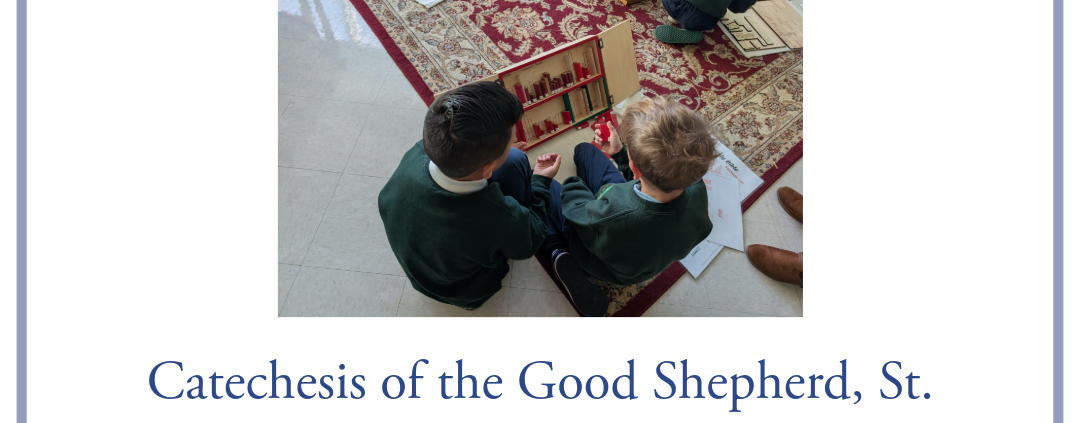
For two years, St. Catherine of Sienna Parish, Ft. Thomas, has been a home to the Catechesis of the Good Shepherd program, a Montessori style educational experience, where children learn about God’s love and grow in relationship with him. Using Montessori principals of a prepared environment in the “atrium,” and catechetical materials designed with child development in mind, Catechesis of the Good Shepherd gives children a unique religious experience.

Jeanne Hicks, catechist for Levels 1 and 2, brought the Catechesis of the Good Shepherd to St. Catherine. “I just felt God was calling, was asking me to bring it to Northern Kentucky,” she said. Soon after, Mrs. Hicks approached Father Stephen Bankemper, pastor, St. Catherine of Sienna, who jumped at the idea. “It was from there that it really exploded,” she said.

Currently, Catechesis of the Good Shepherd at St. Catherine’s accommodates Level 1, ages 3-6, and Level 2, ages 6-9. Growing popularity in the catechetical program, however, has allowed for expanded offerings, with Level 3, ages 9-12, in the beginning stages of development. Catechist Dan Teller helping the St. Catherine of Sienna program expand into the Level 3 plane of development.

While Levels 1 and 2 focus on “enjoyment and growing in love, and growing in relationship and being open to the mystery of who is Jesus and what is the kingdom,” said Mr. Teller, Level 3 moves beyond relationship into understanding and reason.

“Six- to twelve-year-olds have entered the age of reason … so we start to introduce the history of the kingdom of God, we embed a strong emphasis on ‘How am I part of this history? How do I continue to the unfolding of the Kingdom of God; what is my particular role?’”

In addition, Level 3 begins the process of “explicit moral formation,” said Mr. Teller. “How are we supposed to live well in the Kingdom of God? What are the rails, what is good and what is bad, what is right and what is wrong.”

Catechesis at every age, however, “rests on the spiritual characteristic of a child at each particular age.” With younger students utilizing “catechetical materials,” in the atrium, a prepared environment where children can interact with different areas, each focusing on a facet of religion.

“There’s an area for baptism, there’s an area that emphasizes the altar and Eucharist, there’s an area that emphasizes the geography and incarnation of Christ, there’s an area that emphasizes the Paschal Mystery, the parables of the Kingdom of God … and it’s prepared in a very beautiful way.”

Once the Catechist of the atrium shows the children how to properly interact with the catechetical materials and areas, children are free to independently work with them. This might manifest in children drawing, acting or writing a prayer about parables of the Bible, like the Good Samaritan or Prodigal son.

“It’s through really immersing themselves and the children thinking about these things over and over again and just wondering, what is Jesus saying to them through these moments. I think I see a huge impact with that,” said Mrs. Hicks.

“Children do develop a personal relationship with Jesus and with the life of the Church, and it happens because they have a real, vivid, active experience in the environment that’s called the atrium,” said Mr. Teller. “Children all respond to their own unique way to the life of the atrium and to the content, but they’re responding interiorly to the beauty, to the mystery, and to the truth of Jesus and the Church.”

The atrium is more than a place where children come and experience God’s love for them, it is a testament to the St. Catherine Parish community. “Our own parish has come together,” said Mrs. Hicks. “Everything is handmade in the atrium. Parishioners have made bookshelves, they’ve sewed the prayer cloth, they have handwritten calligraphy all kinds of Scripture verses for the children to just think about and to copy. Thy have made all the little handmade items we have in there.”

The success of Catechesis of the Good Shepherd at St. Catherine, began two years ago when Mrs. Hicks answered a calling. Since then, through God’s divine providence, the program has excelled, with more than 70 students currently enrolled in the program. “It’s really beautiful,” said Mrs. Hicks. “Jesus really does speak to their hearts and through their works.”

Currently looking to train more catechists as the program expands — Catechesis of the Good Shepherd is hosting trainings at St. Catherine Parish this upcoming summer with more information available on their website at https://www.stcky.org/cgs1formation.

Altar servers are a key piece of the Church’s constant prayer, recognized with annual Serra Club server awards

Bella Bailey

Multimedia Correspondent

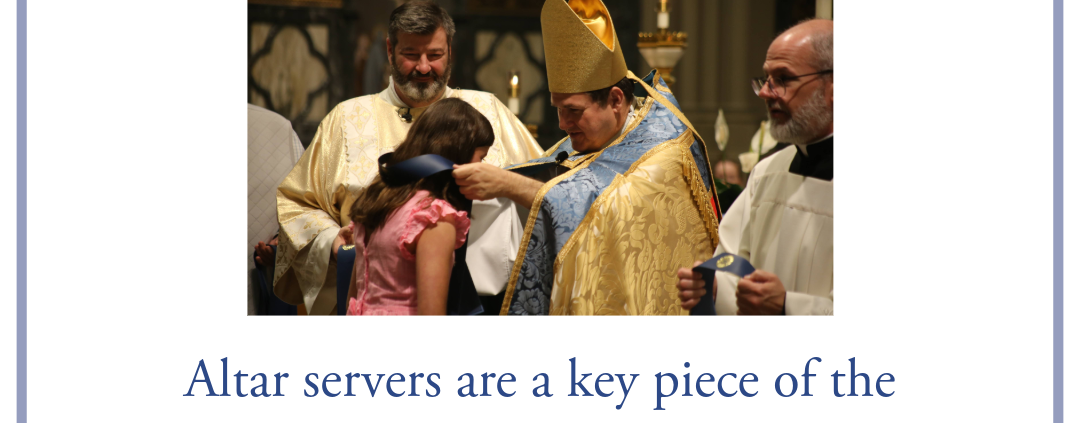
Altar servers from around the Diocese, along with their families, gathered for the celebration of Solemn Vespers and awards at the Cathedral Basilica of the Assumption, Covington, with Bishop John Iffert, Father Ryan Maher, rector, Cathedral Basilica of the Assumption and Deacon Scott Folz.

The Serra Club of Northern Kentucky welcomed the servers for the annual award ceremony, which celebrates the service of middle school altar servers, who volunteer their time and talents in the assistance of liturgies across the Diocese. This year, more than 150 altar servers were recognized for their outstanding service, with each server present receiving a blue sash, affixed with a silver crucifix. A symbol of excellence, the sash is worn while serving on the altar, denoting the wearer as an outstanding altar server.

In his message to the servers and their families Bishop John Iffert shared that their work, in service to God at the altar, envelopes them into the Church’s “constant routine of worship, constant routine of prayer, of living with the Scripture, of letting the word of God sink into our lives and our hearts,” he said.

Bishop Iffert explained that every hour, of every day, the faithful of the Church are “carrying out the commandment of the Lord to pray always, carrying out the command for the knee of every believer to bend at the Lord’s name.” There is not a moment, said Bishop Iffert, which God’s name is not being exalted in thanksgiving and lifted in glory.

Speaking directly to the altar servers gathered, some of whom were wearing their cassocks and others in their Sunday best, Bishop Iffert said, “you are part of that great offer by your service at the altar and your service in all the other liturgies you might be asked to be part of. Whether that’s Good Friday liturgy, or whether it’s assisting at baptism, or marriage, or funeral Mass; you are an important part of this work offering thanks and praise to God constantly.”

Bishop Iffert thanked the altar servers, for their tireless dedication to the work of the Lord in service at the altar and assured them that they remain in the prayers of the faithful, during every liturgical celebration.

“Every time we pray one of these Hours, every time we lift our face and give thanks to God, every time we turn to the Scriptures, you are included in that prayer and the whole Church in this great cycle of liturgical prayer. Praise for you, for your good, for your happiness, for your safety, for your continued growth in the spirit of God,” he said.


Members of the Immigrant Neighbors Network share successes, challenges, at April meeting

Maura Baker

Staff Writer

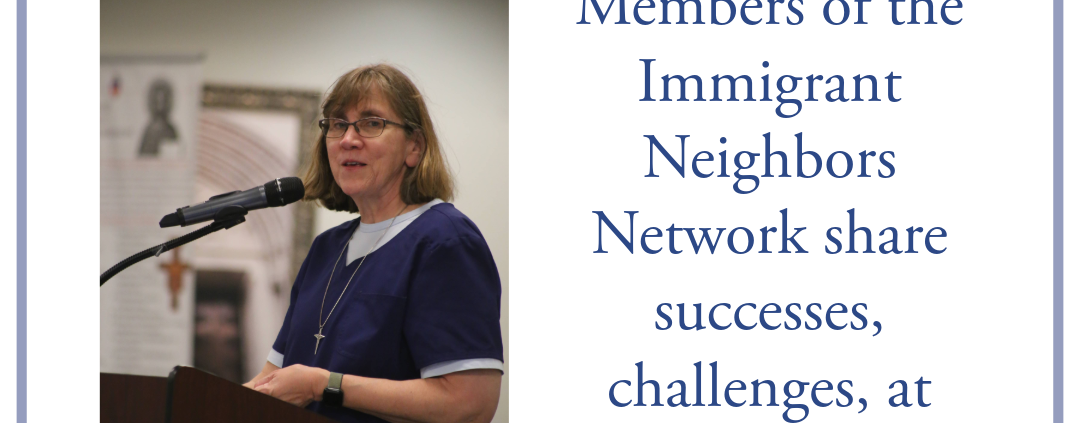
The Immigrant Neighbors Network (INN) held a meeting, April 23, in Bishop Howard Memorial Auditorium at the Diocese of Covington Curia, Covington. Established by the Intercommunity Sisters Peace and Justice Committee, the INN consists of individuals and agencies dedicated to supporting and uplifting immigrant neighbors in the diocesan community.

Joining the women religious present were representatives of agencies such as Esperanza, Kentucky Refugee Agencies, Fiesta, and the Mother of God St. Vincent de Paul conference. These agencies provided updates of its individual ministries, including current outreach efforts.

Divine Providence Sister Kay Kramer, a member of the Intercommunity Sisters Peace and Justice Committee, began the evening. She started by sharing recent successes — including the recent Community Baby Shower hosted by the Diocese of Covington’s Pro-life Office, which offered necessities and resources to expecting mothers, including immigrant families.

Sister Kay also shared news of the committee’s most recent efforts. As Kentucky horse racing season continues, many workers who provide direct care to horses are immigrants themselves, with Sister Kay reporting 600 of these workers, employed by the owners of the horses, living on Turfway Park’s premises during the last racing season.

“It’s what’s called the ‘backside,’” Sister Kay explained, describing inhumane and unfavorable conditions — with many of these workers, both at Turfway Park and other tracks, staying in “cinderblock buildings” with limited access to non-processed food and other necessities, such as running water.

The INN have been supporting these workers since the season began — cooking meals for them twice a month and providing clothing and hotplate heaters for cooking their own meals.

“We are finally at a point where we’re able to have Mass there,” Sister Kay said, “because that was recognized early when we started there, that they wanted to have Mass in Spanish and the ability to go to confession — so we’re really grateful that we’re making some progress, there.”

Violetta Coleman, who works with Esperanza Latino Center, Covington, spoke also of her ministry’s efforts — which includes services to the local Latino community such as a health clinic and an in-house immigration lawyer. They also collaborate with the Mother of God St. Vincent de Paul conference, which provides clothing vouchers and food necessities — with members additionally offering to pray with individuals whom they support.

Most recently, Esperanza, as Ms. Coleman reported, met with the mayor of Covington. Having previously expressed the agency’s concerns, Esperanza “expressed their needs” — forming as a result “a very smooth connection” with the Kenton County Jail.

“It’s important because we have seen that in many cases, when people are detained (for immigration reasons), it is only one member of the family while the others are left behind,” said Ms. Coleman. “The families are separated, and the children are born mostly in the US.”

A “complex situation,” according to Ms. Coleman, Esperanza’s relationship with the jail helps to bridge a gap that helps the agency to work to overcome challenges of authorization and paperwork that keeps families separated.

Non-profit Fiesta, who describes its goal as to help families by supporting self-sufficiency and “uplifting and advancing the Hispanic community of Northern Kentucky,” according to founder Teresa Cruz — who was also present at the meeting — gave updates on its outreach efforts.

“We’ve grown,” said Ms. Cruz, “and we are very blessed to have had the capacity to grow. We’ve expanded our service and expanded our programs for the families,” which included an added “diaper program,” which is supported by the Diocese of Covington, and provides diapers and wipes to families with infants.

Fiesta was also able to recently open a health clinic, in partnership with the UK School of Medicine, which serves an average of 20-24 patients a month. Ms. Cruz also described the success of Fiesta’s “culturally relevant” food pantry, which provides cultural necessities such as rice, lentils, familiar proteins and beans.

The INN also heard from Jared Lopez, of the refugee resettlement agency Kentucky Refugee Ministries. With funding cut and the government-contracted program of resettlement within the ministry ending in January, KRM is now focused on supporting the 800 clients that they were able to resettle during the programs run, according to Mr. Lopez.

“We’re still dedicated to our clients that are here in Northern Kentucky,” Mr. Lopez said, “offering employment services and case management.”

At the meeting’s conclusion, Sister Kay spoke again to those gathered regarding the context given by the attending ministries. “Hopefully,” she said, “we’re all going to leave just feeling grateful that so many good things are happening in our community … gratitude helps us stay hopeful, too — and we have to stay hopeful in the midst of everything that’s happening now.”

Catholic Charities Commission to discuss new evangelization through service

Bella Bailey

Multimedia Correspondent

The Diocese of Covington is embarking on a new strategic planning process, looking to guide the Diocese through 2030. The planning process will be focused on four key aspects to the ministry of the Diocese of Covington: Catholic schools, Catholic Charities, the Catholic Foundation, and diocesan governance. Faithful from across the Diocese of Covington have been invited to participate in commissions and subcommittees, with the goal of advising Bishop John Iffert on the best path forward in these ministries.

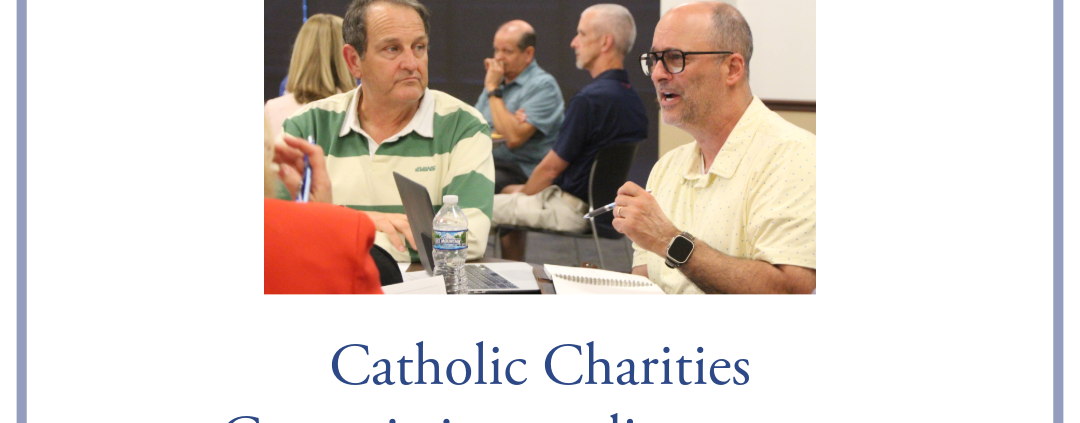
The meeting of the Catholic Schools Commission, April 14, began the process of commission and committee meetings, with the Catholic Charities Commission meeting April 15. The Catholic Charities Commission meeting brought together approximately 50 people, said Deacon Jim Fortner, chief operating officer, Diocese of Covington, all of whom are vested in the success of Catholic Charities.

Chris Goddard, executive director, Catholic Charities of the Diocese of Covington, said about the crowd, “I was really pleased with the enthusiasm, the diversity of representation in terms of the breadth and depth of professionals, men and women, different careers and people that came who are very interested in programs and services.”

Deacon Jim Fortner called the group of participants, “prayerful people.”

Their role will be to meet and discuss the future of Catholic Charities in the Diocese in terms of ministry services and how to reach people in need. Mr. Goddard said, “the greatest thing that I heard was that Catholic Charities could expand its reach and scope across the Diocese … there’s a tremendous opportunity to increase awareness across the community, that a lot of people don’t know who we are.”

In opening remarks made via video at the commission meeting, Bishop John Iffert told the crowd, “It’s time for us to engage in strategic planning. That is, planning that is really directed towards building the capacities of Catholic Charities and our Diocese, to be able to respond to the needs of our neighbors who rely on us and our spiritual need to be able to serve others and to give charitably.”

Moving past just increased volunteerism in the community, Deacon Fortner hopes to evangelize through service, a callback to the With One Heart Campaign of Mercy.

“I would love to see then, obviously, by us serving we strengthen the body of Christ through more people, stronger people, fully participating into the works, the spiritual and corporal works of mercy; not just going to Mass, but going to Mass and serving.”

The Campaign of Mercy, a process of evangelization through practice of the corporal and spiritual works of mercy, is instrumental and a natural fit for Catholic Charities in the Diocesan strategic planning process.

“This campaign of mercy was fundamental to evangelization,” said Deacon Fortner. “We need to get out there and really do something, break through, as a form of reaching those that are unchurched, those that may not feel the love of Christ’s hands.”

While Catholic Charities has many ministries that meet the physical needs of a person, Mr. Goddard emphasized the importance of inviting people into a life with Christ; emphasizing the need for ministry to be not only “transactional” but “relational.”

“I think equally important,” he said, “is people knowing that they’re loved by God and sharing the good news.”