Archive for category: Planning Commissions 2026

The strategic plan of 2026 involved the creation of 4 Commissions: Diocesan Governance Commission, Catholic Foundation Commission, Catholic Charities Commission, and Catholic Schools Commission.

The Catholic Schools Commission; how prayer, discernment and community drive strategy

Bella Bailey

Multimedia Correspondent

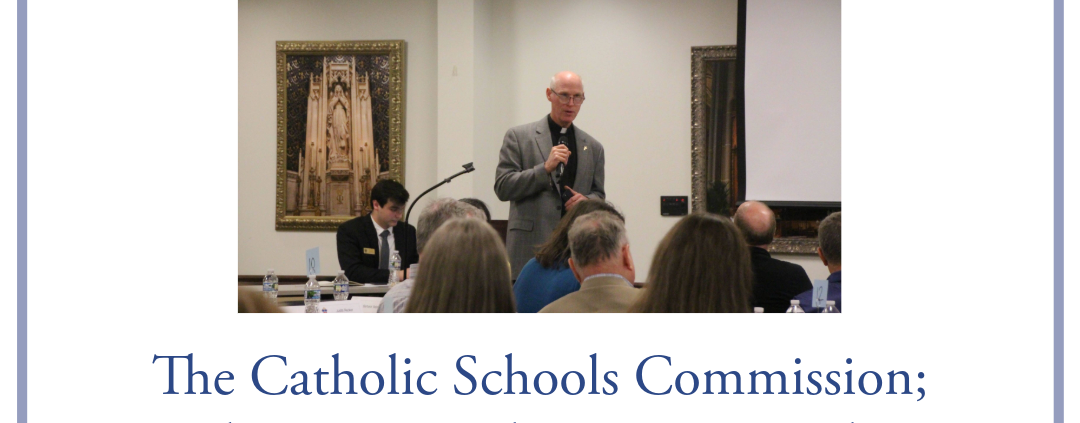
The first in a series of four meetings took place, April 14, for the Catholic Schools Commission as part of the new Diocese of Covington strategic planning process. This commission is one of three that will meet throughout the 2026 summer months to discuss a strategic plan which will carry the Diocese through 2030. The fourth commission, Diocesan Governance, will meet in the fall months and will build on the fruits of the commissions that came before.

Each commission is broken into four sub-committees. The Catholic Schools Commission sub-committees will focus on: mission and Catholic identity; academic excellence; governance and leadership; and operational vitality.

In his opening remarks, shared via video, Bishop John Iffert said to those in attendance, “The Diocese of Covington is rightly proud of its schools. In a Diocese of fewer than 90,000 Catholics, we have more than 10,000 people, 10,000 students in our Catholic Schools.”

It will be the work of the Catholic Schools Commission and its sub-committees to discuss, “a clear strategy around how do we strengthen the faith of the students and the teachers? How do we strengthen the Catholic identity,” said Deacon Jim Fortner, chief operating officer, Diocese of Covington.

The commission will, “really examine the faith, how it’s delivered, how we hire teacher’s, what’s our qualifications to be teaching,” he said.

Nearly 140 people attended the April 14 commission meeting including principals, teachers, priests, women religious and dedicated laity of the Diocese.

“It was like the Who’s Who, it was an all-star cast of experts in the schools,” said Deacon Fortner. “I’m pretty confident we have the right people. But they have got to believe in it themselves … this is not just an exercise.”

Kendra McGuire, superintendent of Catholic schools, said, “there’s a lot of people signed up on the commissions with a lot of varying backgrounds and knowledge and experiences, and I think with their input and review of this, I am hopeful that we will come out with … a strategic plan that we can move forward with to improve our schools.”

The Catholic Schools Commission is, so far, the largest of the four commissions, helping to realize Bishop Iffert’s vision for this strategic planning process.

“I want this process to benefit from as wide a collaboration as possible,” said Bishop Iffert in his video message. “I would like to see the participation of the entire Church – clergy, consecrated religious, lay people — working together to make decisions that are in our common interest and the common interest of our community.”

About the collaborative effort, Deacon Fortner said, “it’s a synod approach of listening, engaging people. The approach, I feel is very, very rich in theology and in practice in our Church.”

Deacon Fortner said that it is Bishop Iffert’s intention to be as transparent as possible, so that conversations and recommendations can be both mission and data driven. To that end, commission members received enrollment data from the last 30 years for every elementary and high school in the Diocese and will soon receive similar financial data. Additionally, the results of a recent survey of 1,200 alumni, parents, donors and priests have been shared.

Soon, leaders for the four sub-committees of the Catholic School Commission will be selected and prepared to lead the discussion of the fundamental aspects of Catholic education in the Diocese of Covington.

Mrs. McGuire emphasized that keeping the Holy Spirit at the forefront of the process is essential. “All of our work is guided by the Holy Spirit,” she said. “Our mission of Catholic education, at the center, is to be Christ-centered schools that are teaching about Jesus and the faith, and so everything we have do has to be through that lens.”

“I think the thing is, pray and trust that the Holy Spirit is going to guide us,” said Deacon Fortner. “It’s about spiritual transformation, it’s changing lives.” This, Deacon Fortner said, is why the Diocese is focusing on strategy, it is about changing the lives of those who walk through the doors of Diocesan schools.

“What is sacred in this process is the revelation that Jesus Christ is Lord, and the sacrifices of prayer, talent and treasure that our ancestors had offered in sewing the seed of faith in our region,” said Bishop Iffert.  “As far as I’m concerned, there are no other sacred cows, there is no other set agenda. We need to discern together the way forward.”
Help shape the future of the Diocese of Covington

Your input is important! Help shape the future of the Diocese of Covington by joining one of four pastoral planning and development Commissions.

The Diocese of Covington is launching an expansive, consultation‑driven process to develop a Diocesan foundation and set a pastoral course for “the next decade or more.” Bishop John Iffert is inviting parishioners from around the Diocese to be involved in the discernment and recommendation process.

The commitment involves four monthly sessions from April through July, lasting 90 minutes to two hours each.

Participants will attend an initial kick-off General Session, April 14, 15 or 16, 6:30–8:30 p.m., followed by three focused subcommittee meetings to benchmark best practices and draft actionable strategic goals. Meetings are held at the Curia, Bishop Howard Memorial Auditorium, Covington.

Registrations are now being accepted, visit www.covdioplanning.org.


The Catholic Foundation Commission will evaluate the feasibility of establishing a Diocesan foundation designed to inspire greater generosity and ensure sustained support for the Church’s mission. To inform this strategy, the Commission will analyze giving trends within the Diocese of Covington over the last 20 years, reviewing data across parishes, schools, and Diocesan ministries. This process includes benchmarking against peer organizations to adopt best practices in annual funds, major gifts, and planned giving.

Subcommittees of the Catholic Foundation Commission are:

Governance Committee
Foundation Services Committee
Communications and Technology Committee


The Catholic Schools Commission will work closely with the Superintendent of Schools and the Diocesan School Board to create a three-year strategic plan for the Office of Catholic Schools to ensure our diocesan school system is operating as a proactive, mission-driven model that ensures long-term viability, spiritual vitality and academic excellence. In an era of changing demographics and financial pressures, such a plan will serve as a “living roadmap” to align resources with our core values. The commission will use the National Standards and Benchmarks for Effective Catholic Elementary and Secondary Schools as the framework for the planning and sub-committee organization.

Subcommittees for the Catholic Schools Commission are:

Governance and Leadership Committee
Operational Vitality Committee
Academic Excellence Committee
Mission and Catholic Identity Committee

The Catholic Charities Commission will study the vital mission and history of Catholic Charities at both the local and national levels. With the Board and staff having celebrated the completion of its current three-year strategic plan and all associated achievements, this commission will develop a new strategic plan to guide Catholic Charities in the Diocese of Covington through 2030.

Subcommittees for the Catholic Charities Commission are:

Governance Committee
Programs and Services Committee
Parish and Community Partnerships Committee
Communications and Fundraising Committee

The Diocesan Governance Commission will meet from September–December 2026.

Specific dates and times will be determined and published in July.

Subcommittees for the Diocesan Governance Commission are:

Governance and Organization Committee
Finance and Financial Services Committee
Technology Committee
Communications Committee

Listening first: How the Diocese of Covington is shaping a foundation and a pastoral plan for the next decade

Laura Keener

Editor

The Diocese of Covington is launching an expansive, consultation‑driven process to develop a Diocesan foundation and set a pastoral course for “the next decade or more.” And like the process used to develop the 2022 diocesan pastoral plan, Bishop John Iffert is inviting parishioners from around the Diocese to be involved in the discernment and recommendation process.

Bishop Iffert says the effort stems from the 2022 pastoral plan, which called for a study on forming a foundation to “encourage giving.”

Rather than “put the cart before the horse” by filing papers and naming a board, the Diocese chose to listen first — to pastors, parish and school leaders, potential board members and donors — so the foundation’s structure and services truly match local needs. “We really needed to hear from pastors … from people who would benefit from these services … [and] potential board members and donors … What would be helpful to them?” Bishop Iffert said.

These initial conversations resulted in a process designed to keep the work focused and transparent by organizing the planning into four Commission-led dialogues:

— Foundation Commission — Designing the foundation’s governance, services, staffing and budget.

— Catholic Schools Commission — Addressing sustainability, structure, curriculum, finances and above all, mission and Catholic identity.

— Catholic Charities Commission — Evaluating governance, rural access to services, volunteer pathways and next‑generation ministries.

— Diocesan Governance Commission — Studying assessments, how diocesan structures and services support parishes and schools, and priorities like technology and communications.

Bishop Iffert is inviting parishioners from throughout the Diocese to consider being a part of a commission, based on personal interest, experience and expertise. The commitment involves four monthly sessions lasting 90 minutes to two hours each. Participants will attend an initial kick-off meeting followed by three focused subcommittee meetings to “benchmark best practices and draft actionable strategic goals,” according to the initiative’s website, covdioplanning.org.

Meetings will be held from April through July, except for the Diocesan Governance Commission whose meetings will occur in the fall and will be announced in July.

The commitment, he says, is to make the process “as open and as transparent as it can be” so that “we can come up with a set of solutions that we can walk out supporting together.”

Spearheaded by Deacon Jim Fortner, diocesan chief operating officer, the Diocese is working with L’Etoile Development Services to help lead and organize the process. Based in Orlando, Florida, L’Etoile Development Services was founded in 2011 by Marilyn Blanchette. Named after her late father, Raymond C. Letoile, the consulting agency specializes in strategic planning, major gift fundraising and leadership development. Joining Ms. Blanchette in leading the process is Mark Dollhopf.

Bishop Iffert describes his leadership approach as rooted in broad consultation that moves toward consensus and, when ready, a clear decision: “Decision making is always a group process, to gain the wisdom that’s there and to try to move towards a shared decision.  … [and] then there’s that moment of decision taking and that’s the role of the bishop; as those conversations progress, to recognize when we’ve come to a moment of consensus that also reflects my view and something we all can live with and support. Then it’s the unique vocation of the bishop, to take that decision and bring that conversation to a conclusion and promulgate whatever policy is going to come out of it.”

At its heart, planning is local Church discernment. “I believe God blesses every local community with the gifts they need to address their problems,” Bishop Iffert said. “In my mind, it’s an extension of God’s promise to fill the body of Christ with gifts; it’s kind of an extension of that promise to provide the kinds of pastors, the kind of shepherds that we need. I talk about a local genius. It’s not one person but it exists within the community. And that’s what we’re trying to do, we’re trying to be prayerful and discern together.”

As the conversations and discernment process begins, Bishop Iffert encourages everyone to “don’t assume” and to “stay open.” There is no agenda, no predetermined outcome. The process is really gathering information and expertise to answer questions that will help shape the future of the Diocese.

“What does the local genius tell us about the future of the Church here?” said Bishop Iffert. “How are we going to be best situated to witness to our neighbors, to evangelize one another, to grow deeper in faith in Christ, and to serve the local Church and the school community, not just in the way we always have, but the way that seems best? We’re going to study and we’re going to go where our discernment and our analysis leads us — with the hope of strengthening Catholic education [and] our life as a diocese.”