Diocesan Governance Commission begins work on strategic plan for Diocese of Covington
Laura Keener
Editor
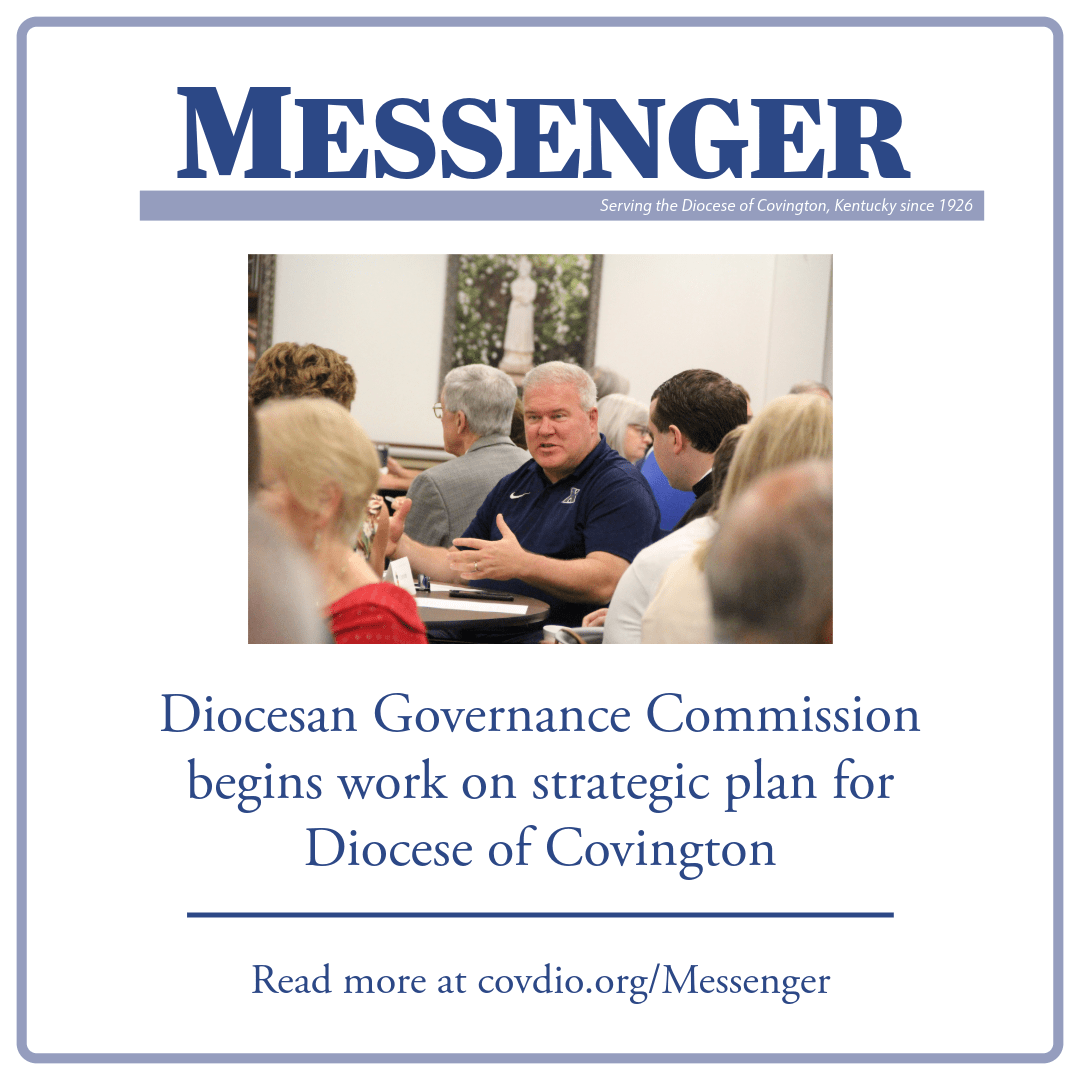
Bishop John Iffert welcomed about 200 volunteer participants, Sept. 12, for the first gathering of the Diocesan Governance Commission at Bishop Howard Memorial Auditorium in Covington. The meeting opened the final stage of a larger strategic planning process for the Diocese of Covington.
The Diocesan Governance Commission is the last of four commissions formed to help the diocese plan for the future. The first three commissions focused on Catholic Charities, Catholic Schools and the creation of a Catholic Foundation. Informed by the priorities raised by these groups, the Diocesan Governance Commission will look closely at the structure and work of the diocesan Curia — the offices that help Bishop Iffert serve parishes, schools and ministries across Northern Kentucky.
The Diocesan Governance Commission will focus on four strategic areas: Departments and Ministries; Finance, Revenue and Allocations; Shared Services; and Communications. According to the Diocese of Covington’s strategic planning schedule, the Commission’s first meeting is a general session kick-off focused on strengths, weaknesses, opportunities and threats. The Commission is scheduled to continue meeting through December. In January, all of the Commissions will gather for a closing Mass and gathering.
The four-and-a-half-hour day of discussion began with 45-minutes of reflective, intercessory prayer a process that Bishop Iffert calls “spiritual conversation.” For the last couple of years, Bishop Iffert and the Diocesan Pastoral Council has used spiritual conversation for its deliberations.
“I like it because I feel like I get deep reflection and wisdom from the folks who are involved,” said Bishop Iffert about spiritual conversation. The feedback he has received from members of the DPC about the process has been positive.
“After about a year, I evaluated with them and asked, Do you feel like I’m wasting your time? Do you feel like these meetings are unproductive? And they said, absolutely not. We feel listened to. We feel like we get to reflect on things. We feel like we’re having real conversations. We’re making real progress.”
Guided with the repetitive reading of a Scripture passage, the spiritual conversation was informed on the initial question, “Five years from now, what would success look like to you?” as participants began the planning process.
In his opening remarks after the spiritual conversation, Bishop Iffert told the group that their work is important because the diocese is facing problems that cannot be solved by one parish, school or office alone.
“This, to me, is the beginning of a very important process, and this meeting is an extraordinarily important meeting,” Bishop Iffert said. “Why is that? It’s because I’ve concluded that our diocese faces some systematic challenges, and I always am a believer that systematic challenges require systematic responses. So that’s the situation we find ourselves in. I really am relying on the wisdom in this community formed here today. I’m really relying on the sense of the Holy Spirit of this group to help us to address those issues as we go forward.”
Bishop Iffert asked the participants to think of the diocese not as a separate office or outside organization, but as the whole local Catholic Church in Northern Kentucky.
“When we speak about the diocese, I’m afraid we fall into this ‘we, they’ parochialism,” he said. “Here’s what the diocese is: the diocese is the Church in Northern Kentucky. The diocese is the family of all parishes, schools, Catholic agencies, the lay ecclesial communities, ministries. That’s what the diocese is. The diocese has a head, and by the grace of God and with Pope Francis, I am humbled to be that head. The diocese is an organic living thing.”
He said diocesan decisions affect everyone because money and resources used in one area are shared by the whole local Church.
“When we make a decision that as a diocese we are going to invest in one place or another, what that means is that every other parish, school, agency, ministry is making a sacrifice so that we can invest in that priority,” Bishop Iffert said. “I have no money of my own. I have no huge Sunday Mass to take up a collection. What we do as a diocese is us working collectively to be the Catholic Church, the body of Christ throughout our region — that’s what it is.”
Bishop Iffert said that the purpose of the Curia is to support the pastoral work of the diocese, not to stand apart from it.
“We have a curial staff here that serves the diocese, and they are a kind of bureaucracy,” he said. “And we all know we have our attitudes toward bureaucracy, and our bureaucracy may or may not be organized well for its purpose. That’s what you are here to help discern. But our bureaucracy, the Curia, is always directed in a pastoral spirit. That’s the idea that we need some of that internal structure and support to be able to coordinate our pastoral ministries across regions and across the whole Church.”
He told the volunteers that their task is not small. Their recommendations could shape the way his ministry as bishop and the work of the diocese function for many years.
“I’m charging this group to develop the resources and the conditions within which my own episcopal ministry will function for the next 10, 15 years,” Bishop Iffert said. “That’s what I’m relying on this group to do — to help create the resources, the structures, the directives within which my own ministry as bishop is going to function for the next 10, 15 years. That’s why this meeting is so important to me.”
Bishop Iffert said he believes the Holy Spirit has already given the local Church the gifts it needs to face its challenges. He calls those gifts the “local genius.”
“Every skill, talent, resource we need to respond to the challenges we face, God has already planted in our local community,” he said. “There is a local genius. Now, that’s not any one person. So, if you think I’m talking about you, you’re on the wrong track,” he said with a chuckle. “But there is a local genius, and I think particularly in Northern Kentucky, we have a very strong sense of our local identity and our local genius. All the gifts we need to respond effectively, to put ourselves in a place where the Holy Spirit can use us, are already in our community.”
Bishop Iffert focused on the need to move from simply maintaining current programs to building a missionary Church that is ready to grow. He pointed to serious concerns, including fewer registered Catholic households, lower school enrollment and fewer donors to diocesan campaigns. But he also named signs of hope, including more people entering OCIA (the Order of Christian Initiation of Adults), rising Mass attendance and greater parish planning.
“All of this is about moving from maintenance to mission,” Bishop Iffert said. “That’s the goal — to move us from how do we keep the lights on and the doors open, to how do we grow? How do we get the word of Jesus to more people? How do we take an interest in their spiritual life? How do we make sure they know the people in the Church care about their spiritual growth?”
The bishop said one of his deepest concerns is the overall resignation that young people will leave the practice of the faith and that the Church is shrinking.
“The one thing that drives me, if you want to say one thing that drives Bishop John, I am sick and tired of just accepting the idea that we’re going to lose 60 percent of our young people from the life of the Church,” he said. “I am tired of pointing to those numbers and people saying, ‘Well, that’s just the way it is today.’ What if we dared to grow? What would it look like if we set as our goal that we were going to grow? What would we do then?”
Bishop Iffert said the Commission should work with a spirit of servant leadership, collaboration, listening, transparency and creativity. He said he is inviting the group into the work of decision-making, even though the final responsibility for decisions belongs to him as bishop.
“I’m inviting you into the decision-making process, recognizing that I have a unique role in that process. Pastors in your parishes function in the same way. They have a unique role, but not the only role in that process. I want to put forward listening and building consensus where we can. I think that’s always important,” he said. “At some point, this conversation will come to something that looks like a conclusion, and then, because I’m your bishop, I’m the only person in the diocese who can take that decision and say, ‘Okay, we’ve been talking long enough. We may be right, we may be wrong, but this is what we’re going to do.’”
He also asked the Commission to help the diocese make decisions based on good information.
“I very often have to make decisions in a low information environment,” Bishop Iffert said. “We just do not have data, and I want your help in moving from making decisions based on anecdotes and personal reports to having data to support the decisions we make. I am so often asked to make a decision, and I have no good data to support one decision or another. And I want to begin to change that.”
And finally, Bishop Iffert said, “I believe very much in transparency and in clear channels between me, the Curia, and the wider Church. I believe we exist, me and the Curia, we exist to promote the creative ministries of parishes, schools and agencies. We exist to motivate that kind of ministry and to support it.”
Considering that the Church is losing many of its young people Bishop Iffert encouraged the Commission to think and act boldly.
“I think we need kind of an entrepreneurial spirit. We need to try things, and when they work, we need to share them and reproduce them. We need to be creative in the ministries we do. We need to recognize the moment as the crisis that it is, and we need to respond with creativity,” he said.
As the meeting ended, Bishop Iffert thanked the volunteers and asked them to think creatively, pray and make recommendations that will help the diocese better serve its people.
“Go consider the problem, think creatively, form your best directions in the Holy Spirit, and make recommendations to me on how we organize ourselves,” he said. “Thank you. God bless.”