As a tabernacle of Christ, Mary was assumed into heaven, said Bishop John Iffert.

Bella Bailey

Multimedia Correspondent

Bishop John Iffert celebrated the vigil Mass for the Feast of the Assumption of Mary, August 14, at the Cathedral Basilica of the Assumption, Covington. This feast, traditionally recognized on August 15, celebrates Mary’s bodily assumption into heaven.

“Because she was the Mother of God,” said Bishop Iffert in his homily, “because bodily, she became the tabernacle of his earthly existence, her body was preserved from decay, her body was preserved from corruption, her body was preserved from the effect of sin.”

While the assumption of Mary into heaven is a point of distinction between Catholics and other religious denominations, Bishop Iffert defends the validity of the assumption with both anecdotal and doctrinal evidence.

Bishop Iffert, in his homily, recalled a story which happened to a friend who teaches at a university in the Palestinian side of Bethlehem. One day, Bishop Iffert said, this friend of his was taken on a tour by a Scripture scholar, and he was taken to three different locations. Each of which claimed to have the head of John the Baptist.

This friend, moved by disbelief, pointed out to the man displaying the relic at the third location that each of his previous stops also claimed to have the one head of John the Baptist. Bishop Iffert recalled from his friend that the man displaying the relic explained that they had the mature head of John the Baptist, and the village before them had the head of John the Baptist as a youth.

“I share this story not to add cynicism to the world but to point out just how desperate we are to connect to the holy ones who live before us. How desperate these communities are to exercise that claim for a connection to a holy saint … so much so that you end up with three heads of John the Baptist,” said Bishop Iffert.

“Nowhere in the world,” Bishop Iffert said, “do you find a relic of the Blessed Virgin Mary … nowhere in the world do you find a relic of her flesh, nowhere in the world do you find a relic of her bone. They don’t exist.”

The dogma proclaiming the assumption of Mary was defined 75 years ago in the year 1950 by Pope Pius XII, in the apostolic constitution “Munificentissimus Deus.”

“The Lord God preserved this vessel of the Lord Jesus from undergoing the corruption that normally occurs after death of a body. Mary was not allowed to be a corpse. She was always a body filled with life, that is the gift from the Holy Spirit. The Church teaches this, and it has been taught from the early centuries of the Church because it is true and it really happened,” said Bishop Iffert.

While the Church does not teach on whether or not Mary died or was “taken up in a whirlwind,” said Bishop Iffert, it does teach of her bodily assumption.

“Because she was the mother of God, because bodily, she became the tabernacle of his earthly existence, her body was preserved from decay, her body was preserved from corruption,” said Bishop Iffert.

The Deanery Pastoral Council serves as one facet of the body of the Church said Bishop Iffert at DPC orientation

Bella Bailey

Multimedia Correspondent

The annual Deanery Pastoral Council orientation took place August 9, in Bishop Howard Memorial Auditorium, Covington, where new members of the Deanery Pastoral Council learned more about their role as members of the council.

Each parish in the Diocese of Covington is organized into one of five deaneries based on their geographical area: The Cambell County Deanery, The Covington Deanery, The Northern Kenton County Deanery, The Southeast Deanery and The Southwest Deanery. Leading each of these deaneries is a dean, a member of the clergy from within that region appointed by Bishop John Iffert.

The Deanery Pastoral Council is a quarterly meeting of two representatives from each parish within a deanery. Members of the council serve three-year, renewable terms. From each Deanery Pastoral Council, two people are selected by their council peers to represent their deanery at the Diocesan Pastoral Council, which meets quarterly with Bishop Iffert.

The goal of the Deanery Pastoral Council is to discuss and advise Bishop Iffert on issues via their representatives to the Diocesan Pastoral Council. Bishop Iffert likened the hierarchical structure of these councils to that of the body. With the head, in this case himself as the head of the church of the Diocese of Covington, needing to listen to the lungs and heart in order to function properly.

“The head has to listen to the body. The head has to be responsive to the needs of the body. That’s what these councils are all about, to make sure that we are listening to one another and, even more importantly that we are discerning the Spirit of God together,” said Bishop Iffert.

Bishop Iffert recalled a story from his time as a parish pastor, when he provided counseling to married couples. It became to clear him, he said, that these couples did not want to be counseled, rather, the men wanted him to take their side.

“It happened over and over again,” said Bishop Iffert, “and usually they would throw out this thing about the man is the head of the household. They would say the man is to be the head of the household.”

To which Bishop Iffert would respond to them saying, “yes, that works to exactly the degree to which you are a saint,” he said.

“If we’re not saints and we insist on that kind of tight control, we have the potential of giving into our manipulative selves,” he said. Which is why the Deanery Pastoral Council and Diocesan Pastoral Council are structured in such a way, so that the head can easily listen to the heart and lungs.

“All authority in the church is to be exercised as servant leadership. All authority in the church is to be exercised as foot washing, with a gentleness to it, with a servant’s heart. That means we have to take the time to listen. We have to take the time to check our motivations. We have to make sure that we’re considering the good of others in as complete and full way we can,” said Bishop Iffert.

The meetings of the Deanery Pastoral Council are open to the public so that parishioners can voice their concerns and opinions, which will then be taken under advisement by the council. This pipeline from those in the pews to Bishop Iffert through the Deanery and Diocesan Pastoral Councils, allows him to listen to the body of the church of Covington.

“That’s my vision,” said Bishop Iffert, “that we are a family of faith together, our pastors are clearly the heads of those parish families, but none of us are saints, and so we need to be listening to one another and being gentle with one another and being about the work, not listening to my opinions about what things are, but for me, listening to the way the Spirit is speaking to me through the people of God.”

Divine Mercy/St. Bernard Parish Young Adult Group sets an example

Macie Becker

Media Intern

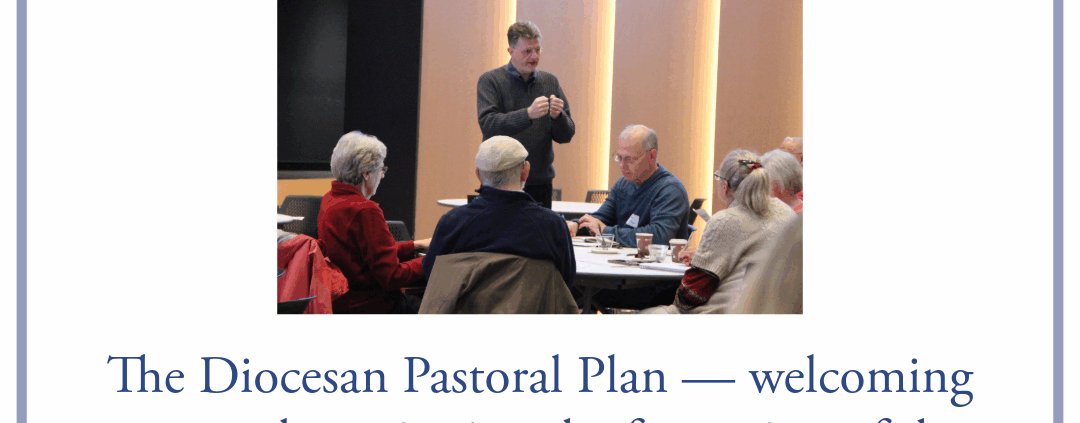
As part of the Diocesan pastoral plan, the diocese has partnered with the Catholic Leadership Institute (CLI). CLI has been working with the parishes in the diocese on long-term pastoral plans for each parish. Divine Mercy and St. Bernard Parishes, Bellevue and Dayton, are a part of Next Generation Parish, a program in which the parish is paired with a CLI consultant to help not only develop but also to implement their plan.

One of the goals for the Divine Mercy/St. Bernard (DMSB) pastoral plan is to increase parishioner involvement in social and service groups within the parishes. DMSB has a thriving young adult community, drawing in people from in and out of the parishes to their events. Father Martin Pitstick, Pastor, refers to it as one of their parish’s “charisms.” Having events almost every day, the DMSB young adults have been an influence on the parish community, setting an example for the pastoral plan.

The young adults within the parish have continued to set this example by getting involved with other aspects of parish life, such as serving Masses and planning after-Mass brunches for the parishioners. Mr. Nienaber says the reason for starting integrated events is for the parishes to be “living and breathing and really healthy going into the next 20, 30, or 40 years.”

They combine the religious and recreational, planning events like Masses and Bible studies, as well as fun events like bonfires and swing dances. That dynamic has drawn in many people, both Catholics and non-Catholics alike. Oftentimes, non-Catholic participants in these recreational events end up being drawn to the Catholic faith by it.

“We always try to find that balance,” says Colin Nienaber, DMSB Young Adult Minister, who continued to say, “we’re having a lot of fun, but we also want to integrate the rest of the parish so that it’s not like two different parishes being made.”

“The young adults are taking on the service role for the life of the rest of the parish to leverage and to be the yeast for helping the rest of the parish,” said Father Pitstick. He continued, saying “no program is perfect, but you take valuable resources from the program, and we’ve done that and it has been very helpful.”

To learn more or get involved with DMSB or their young adult ministry, visit https://dmsbcatholic.com/.

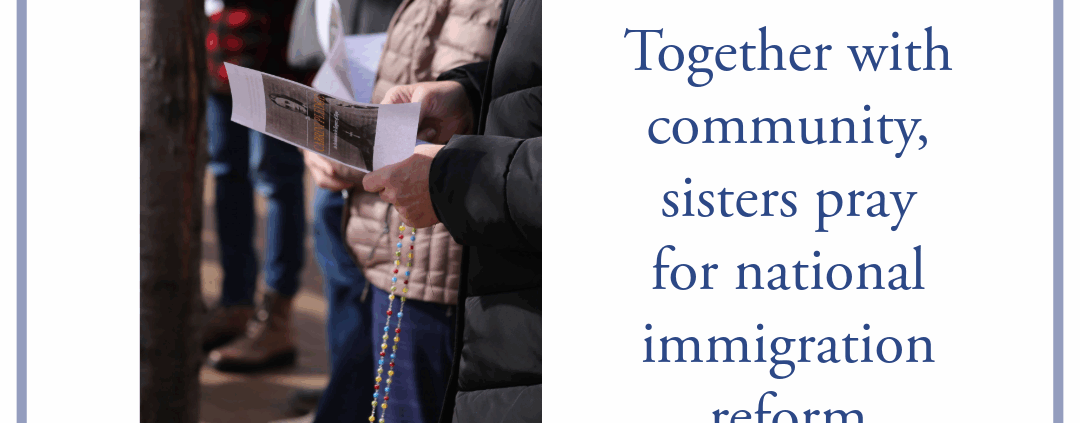
Diocese and intercommunity sisters continue dialogue on immigration with upcoming presentation, continuation of June efforts

Maura Bailey

Staff Writer

This past June, the Intercommunity Sisters Peace and Justice Committee, in a collaboration with the Diocese of Covington, held a presentation attended by near 200 participants on the topic of immigration — the Catholic perspective.

On August 18, the sisters aim to continue this dialogue with the second part of the immigration series, once again to be held in the diocesan Curia, Covington, from 6:30–8:30 p.m.

The August presentation will begin with a “deeper look at Catholic social teaching as it pertains to immigration,” said Divine Providence Sister Kay Kremer, one of the hosts and speakers of the event. “At the first session, Hannah Keegan,” of Thomas More University, “gave more of an overview of those parts of Catholic social teaching … but, this time, she’ll delve deeper into what it means specifically in regards to how we are called to treat migrants, and how we are called to live in contrast to what’s happened to migrants in the country right now.”

Immigration lawyer Jessica Ramos will also be participating in the upcoming presentation. She will be speaking on the “pathways to legal immigration and citizenship in our country,” said Sister Kay, “and how those things have drastically changed in the last six months.”

Attendees will also be supplied with a resource sheet of discussing immigration in the Catholic context, as well as local ways to help migrant populations.

“We want everyone who attends to feel welcome,” Sister Kay continued, “And we want this to be an opportunity for all of us to continue to learn about what the Church teaches about immigration.”

These conversations are important, she explained, as “people are really suffering right now,” Sister Kay said. “The majority of migrants are good, hard-working people who simply want to live their lives in a place where they’re safe and where they can provide for their families, and where their children have an opportunity for a good education. Their hopes and dreams for their lives are the same hopes and dreams that probably all of our ancestors had when they came to the United States.”

Bishop Iffert travels to Ghana to visit family, Church and culture of African priests serving in Covington

Laura Keener

Editor

A little piece of the hearts of parishioners from Immaculate Heart of Mary Parish (IHM), Burlington, now beats in Tepa, Ghana, in the form of the Immaculate Heart of Mary Technology Center. The Center, which is in the hometown of Msgr. Dominic Fosu, pastor, IHM, was made possible through donations and support from IHM parishioners. Bishop John Iffert dedicated the Center on a recent trip Ghana. The Center blessing was part of a larger trip, July 7–23, to the Archdiocese of Kumasi.

Bishop Iffert was accompanied by Msgr. Fosu, four other Ghanian priests ministering in the Diocese of Covington — Father Augustine Aidoo, pastor, St. Patrick Parish, Maysville; Father John Opoku, parochial vicar, St. Agnes Parish, Ft. Wright; and Father Samuel Owusu, parochial vicar, Mary, Queen of Heaven Parish, Erlanger — Msgr. Daniel Vogelpohl, Deacon Jim Fortner and Julie Fortner and nine IHM parishioners. All four of the Ghanian priests are from the Archdiocese of Kumasi, three of the four — Msgr. Fosu, Father Opoku and Father Owusu are from the city of Tepa.

“It was a wonderful, amazing trip. Instructive at every level,” said Bishop John Iffert.

The idea for the trip came from Bishop William Medley of the Diocese of Owensboro, Ky. In a conversation with Bishop Medley during one of the bishop’s meetings several years ago, Bishop Iffert learned that Bishop Medley had made a point of visiting the home dioceses of missionary priests ministering in Owensboro.

“He talked about what a joy it was to meet their families and have Masses in their home parishes. As soon as I heard him talk about that, I just thought, well, that is a good and right thing to do,” said Bishop Iffert in an interview with <<Messenger>> after returning from the trip.

Msgr. Fosu worked out the details of the visit with Archbishop Gabriel Justice Yaw Anokye, who proved to be eager for Bishop Iffert’s visit. Archbishop Anokye even invited Bishop Iffert to ordain five priests during the visit — four priests for the Archdiocese of Kumasi and a Redemptorist priest.

“That became the centerpiece of going there, to preside at the ordination and to visit the Archbishop, and then I also got out to visit the home parishes of these men, and to visit with their families, and to see the kinds of ministries they had done at home, and to learn about where they came from, and just to see them interact with their families and with the Church that they’re most familiar with,” said Bishop Iffert.

The Church in Ghana is “very lively and growing” Bishop Iffert said. The Archdiocese of Kumasi has 212 priests for its 72 parishes, with about another 75 priests serving outside of the country, like the four who serve in Covington.

Bishop Iffert said that the Archbishops of Ghana have taken seriously the call of Pope John Paul II who, on in his 1995 visit to Cameroon, exhorted the young Church in Africa to, “set yourselves on the path of holiness. Only thus can you be a sign of God in the world and relive in your own countries the missionary epic of the early Church. You will also be a leaven of missionary spirit … (Ecclesia in Africa 260) In the Kamasi, with the permission of Rome, priests are assigned secular jobs — professors and teachers at public universities and schools, architects, engineers, lawyers and government workers.

“The whole idea is that they will work in these offices, in these schools, and that they will never take a bribe; never ask for anything … To show up on time, work full days, and, to kind of set the example in ethics, to try to raise the bar for the whole culture,” Bishop Iffert said.

Their efforts are having a positive effect on priestly vocations. “There’s a lot of excitement, a lot of young men in seminary,” Bishop Iffert said, noting that he celebrated Mass for a high school seminary class of first- and final-year young men because the church would not hold all the students. It was estimated that 40 of the senior students would go on to college seminary and that 15 would be ordained priests. “Very lively vocational situation there,” he said.

The liturgies are equally lively. The ordination lasted over 5 hours with Sunday Masses in Tepa typically lasting 2.5 hours, with lots of singing, dancing and drumming.

“They did not just receive the Roman Catholic liturgy as an imported product,” said Bishop Iffert. “It really, at least in the central part of Ghana, they have made it their own.”

Also typical of a Ghana Mass, are several processions. During the offertory, worshipers are called by the day of their birth to dance up the aisle and present their gifts. In another procession, parish groups of women bring food, toiletries, cleaning products and anything they have that the Church would need. The items were brought to Bishop Iffert as he sat in the chair, and he touched each item in blessing. Afterward, the priests and seminarians would place the items under the altar.

“So that when you’re celebrating the Eucharist, you’re literally celebrating all the gifts that everyone had brought forward,” said Bishop Iffert. “Those gifts are used later, some help provide support for the priests and the rectory. Some of it goes out to the seminary. Some of it goes to the high schools to provide for their needs there, and others is kept by the parish to distribute to people in need. Just incredible.”

“If we brought all of that into our liturgy, it would be an import; it would not speak to us, it would be a distraction from the Consecration,” Bishop Iffert said. “But for them, it’s not. For them, it’s an expression of who they are and how they come to recognize Jesus. It’s really quite beautiful. That inculturation is part of what is encouraging the growth of the Church, is encouraging the growth in vocations, is encouraging young men and women to consider consecrated life as a real option. It’s, it’s amazing.”

A highlight was visiting the families of the priests in Tepa and Father Augustine’s family in Kumasi. “It was just a joy to visit them in their home… it was really a lovely, lovely gathering and to get to know their parents,” Bishop Iffert said.

The group also took time for some cultural experiences enjoying the local food, crossing a rope bridge, visiting art and cultural centers, the palace of the Ashanti King and meeting local artisans — weavers, printers and carvers. An especially haunting and moving was a tour of Elmina Castle — the first European slave trading post in sub-Saharan Africa.

“It was a slave dungeon, and it was where millions of people from that West African area were held captive and eventually shipped off on that middle passage. Probably half of the people who went through there died. Others were enslaved and became the beginnings of generations of chattel slavery in our country and others,” said Bishop Iffert. “It was just, it was very eye opening, and this made us aware of the other half of that equation. That was very, very moving.”

In the next year or two, Bishop Iffert plans to visit the home dioceses of the priests from India ministering in our diocese.

“I hope to make those visits and to meet their religious superiors and to meet the local churches that they’re from, and meet their families,” said Bishop Iffert. “It was well worthwhile.”

The new chimeras have arrived ready to take their spots atop the Cathedral Basilica of the Assumption

Bella Bailey

Multimedia Correspondent

Two years ago, the twenty-six chimera which lined the top of the Cathedral Basilica of the Assumption, Covington, were removed as part of the Cathedral restoration initiative. Now, their new and improved counterparts have arrived, ready to reclaim their spots atop the Cathedral.

The new chimera, perfect replicas of the ones removed, were made by Boston Valley Terra Cota, New York, and arrived in late July. In order to perfectly replicate the ones removed, 3D scans were taken, and from those scans foam molds were made, which were cast to make a hollow mold, from which they created the new chimera.

“There’s a lot of hard work,” said Don Knochelmann, director, Buildings and Properties Office for the Diocese of Covington, “there’s a team of artists that put all the really fine detail; the wrinkles in the elephant’s skin and all the different things, that’s all done by hand.”

Father Ryan Maher, rector, Cathedral Basilica of the Assumption said about seeing the new chimera, “I was excited to see them up close, to see the incredible level of detail that the artist put into replicating the former chimera.”

Previously, each chimera weighed approximately 270 pounds, having at one point been filled with concrete. Each new chimera weighs only 170 pounds and are hollow. Mr. Knochelmann, suspects the old chimera, which were originally hollow as well, were filled in an attempt to elongate their life.

“Our understanding from the design team is that doing that actually shortens their life,” said Mr. Knochelmann, “because the concrete and terracotta didn’t expand at the same rate.”

While the talented team at Boston Valley Terra Cotta created the chimera, Trisco Construction will be the ones installing them.

“The workmen, to see day by day the details that they pay attention to do this restoration, every millimeter matters, every inch matters. Being here every day and being able to see them exercise the care, the diligence, the hard work, using their expertise, their God given talents, to do these small, very important restoration pieces, I’ve really enjoyed seeing that unfold,” said Father Maher.

He continued saying, “we’re doing something for the Lord, for all the Catholics in the area, all of the non-Catholics in the area, anybody who comes. We’re doing a great work of service in the Lord with his help to make sure this cathedral is here for generations, and that this type of work doesn’t have to be done for a long time.”

The replacement of the twenty-six chimera is one piece of the larger Restored in Christ Campaign, which seeks to restore the Cathedral façade and architectural structure. To learn more, go to covcathedral.com/restored-in-christ/.

Concert at St. Mary’s Park honors Bishop Foys 80th birthday

Laura Keener

Editor

On a hot and humid evening, over 200 people gathered, July 25, at St. Mary’s Park, Covington, to celebrate the 80th birthday of Bishop Emeritus Roger Foys. The concert celebration was hosted by Bishop John Iffert and included live music by the Pete Wagner Band with Nancy James.

“It is my pleasure to be able to welcome you,” said Bishop Iffert as the concert began. Quoting from Psalm 90, Bishop Iffert said, “Our days may come to seventy years, or eighty, if our strength endures.” (10)

“There is no surprise to us that Bishop Roger Foys is strong,” Bishop Iffert said. “He led us here in the Diocese of Covington for 20 years, a quarter of his life. Before those 20 years, he spent another 20 years as vicar general at the Diocese of Steubenville. For half of his life Bishop Foys has been carrying the weight of leadership at a diocesan level in the life of the Church. We pray that we will have many more birthdays to celebrate with you, Bishop Foys.”

A highlight of the evening was the presentation of the birthday cake accompanied by six Margaret Mary Foys Ciesla scholarship recipients. The Margaret Mary Foys Ciesla ACUE Scholarship Fund was established by Bishop Foys and is named in honor of his sister, who died from pancreatic cancer not long after his installation as Bishop of Covington. Another highlight was a musical tribute by the Bishop’s Choir, a parody on the Andy Griffith Show’s “Welcome Sweet Springtime,” led by Greg Schaffer.

Speakers included Dale Henson, the diocese’s former Chief Financial Officer who worked with Bishop Foys for over a decade and Father Joey Shelton, former secretary to Bishop Foys.

Mr. Henson praised Bishop Foys for his commitment to Catholic education, especially in formalizing and centralizing the Alliance for Catholic Urban Education Consortium.

“This new model introduced elements of consistency and operational efficiency that allowed for the realization of significant cost savings,” Mr. Henson said. “His forethought in the formation and support of ACUE absolutely saved our inner-city schools and has allowed them to continue serving our community and transmitting the faith to hundreds of students over the years.”

Mr. Henson also commended Bishop Foys for his commitment to vocations by, early on, making the vocations promoter a full-time position.

“Bishop Foys himself was active in the diocese’s pursuit of good men for the priesthood. That increased focus had a profound impact on the number of men discerning for the priesthood in our diocese,” he said mentioning that at one time during his tenure, 28 men were studying for the priesthood and Bishop Foys ordained 42 men to the priesthood. “Today over 60 percent of our active diocesan priests were ordained by Bishop Foys. That’s a true testament to his love of the Church, the priesthood and our diocese.”

Father Shelton also affirmed Bishop Foys commitment to his priests. “Bishop Foys is a priest’s bishop,” Father Shelton said. “If a priest needed something – anything at all – Bishop Foys would do everything in his power to get that priest what he needed … He was always there to provide support and encouragement to those priests whose vocations he fostered … Bishop Foys loves the priesthood and during his time as our chief shepherd we knew and felt his love for us.”

In his remarks, Bishop Iffert recalled his first conversation with Bishop Foys just minutes after speaking with the nuncio calling him to Covington.

“From the very first moments he was supportive, encouraging, reassuring … from the very first moments he expressed his happiness to welcome me and to support me in this transition. That’s the graciousness of this man. That is who Bishop Foys is and has been to so many. It is why we are all so eager to be here tonight to wish him a happy birthday and to celebrate these 80 years of life,” Bishop Iffert said.

Bishop Foys ended the presentation in deep gratitude.

“To all of you who came I am very, very grateful,” said Bishop Foys. “I am grateful for all the outpouring of support, and encouragement and love that came from you these past 23 years. Know that I love you and pray for you every day and will continue to do so. I ask, please, that you pray for me. My sincere gratitude to Bishop Iffert who spearheaded this gathering — this is the kind and wonderful person that he is.”

For a related article go to https://covdio.org/foysbirthdaythankyou/.

Bishop John Iffert encourages school administrators and teachers to rely on Christ as the 2025-2026 school year begins

Bella Bailey

Multimedia Correspondent

The annual Mass opening the new school year had the Cathedral Basilica of the Assumption, Covington, filled to max capacity as faculty and staff from schools across the Diocese gathered to celebrate the start of the 2025-2026 school year. The Mass, celebrated by Bishop John Iffert and organized by the Diocese of Covington Office of Catholic Schools, is a way for these school faculty and staff to gather in communion with one another before the hustle and bustle of a new year.

“In just a few days, you will welcome students into your classroom,” said Kendra McGuire, superintendent. “Each child in your class will be unique coming to you from different families, backgrounds and experience, their interests, talents and abilities will be unique too.”

Mrs. McGuire continued saying, “This year, let’s teach by looking at each child as Jesus would, to love them as Jesus would.”

A sentiment reaffirmed in the first reading, Numbers 11:4b-15, and Gospel reading Matthew 14:13-21, which showcased Jesus’ merciful love and unending patience as a teacher to all.

In his homily, Bishop Iffert reflected on the first reading, where God provided for the Israelites in the desert with manna. This manna, said Bishop Iffert, would provide all they would need to sustain life, but still, they griped.

“Oh yeah, the Lord saved our lives. But what a monotonous and terrible life it is. Manna every morning, manna every noon time, manna every evening,” Bishop Iffert said, echoing the cries of the Israelites. After hearing the plight of Moses and his people, in his infinite mercy, God provided the Israelites with quail, giving his people meat.

Perhaps a moment many teachers have experienced, when they have given all, they have to give, and still the student entrusted to their care asks for more.

“There will come a day this year,” said Bishop Iffert addressing the teachers in attendance, “when you’re tested, when you feel like ‘I have nothing left to offer.’ In that moment Jesus invites us, ‘What do you have? What’s left? What scrap?’ And when we bring it to him, he will bless that, he will break that, and he will give for the life of the world.”

In the same way that Jesus, grieving the death of John the Baptist in the Gospel reading, fed the 5,000 that followed him, though he was tired, grief stricken, and “he’s had just about enough,” said Bishop Iffert.

“Jesus teaches us the way to respond when we feel alone and tired and put upon and ground down and abused,” said Bishop Iffert. For, in spite of his grief and exhaustion, Jesus took five loaves and two fishes, and from these scraps fed the masses.

This year, as teachers bring to the feet of Jesus their scraps, Bishop Iffert said, Jesus will break it, as he did the loaves and fish, “and this is the promise, it will be plenty. It will be plenty for you, it will be plenty for them. That is the promise,” said Bishop Iffert.

Echoing the early message from Mrs. McGuire, Bishop Iffert said, “Trusting in Christ, we hold our heads high. We commit ourselves to these children and to their families. We strive to be like Christ, and we beg him to be our support.”

“Thank you,” he continued, “for leading these children to the truth. I thank you for giving them the example of one who follows Jesus Christ, even unto the cross. I thank you for your dedication and devotion this year”

As the new school year opens, teachers remember, that when there seems to be no more to give, offer the scraps to God, and he will make it plentiful, “that is the promise,” said Bishop Iffert.

St. Henry student achieves rank of Eagle Scout, busts river bank refuse

Maura Baker

Staff Writer

An incoming junior student of St. Henry District High School, scout Sam Dirksing has achieved the rank and honor of Eagle Scout — the highest rank attainable in the organization of the Scouts BSA.

The efforts to become an Eagle Scout are lifelong, with Mr. Dirksing having entered the Boy Scouts of America in the first grade and continuing to this day. The journey culminates with an Eagle Scout project, scout-led and benefitting the community.

To Sam Dirksing, he took example from the conservation requirements needed for ranking up and turned his project into an opportunity to clean up the community’s local waterways.

He teamed up with the Ohio River Valley Water Sanitation Commission (ORSANCO) and rallied community members, family and friends for a litter cleanup along the banks of the Ohio River at Giles Conrad Park, Hebron this past October.

“I cleaned up the park and the bank of the river,” said Mr. Dirksing. “The weather was perfect, and it went great.”

In addition to the project, achieving the rank also gave Mr. Dirksing time to reflect on his achievements as a scout, and the memories therein.

“To me Eagle represents all of the hard work that I have put into scouting and all of the fun trips and memories I have made along the way and the ones yet to come,” he said, “This was accomplished by the love and support of many adults in my life and the support of my fellow scouts. Many of the rank requirements and merit badge requirements have collaborative aspects where a Scout has to teach, lead and demonstrate life skills to others. I have learned much about myself during this journey.”

138th annual St. Ann novena highlights the major Councils of the Church

Laura Keener

Editor

The major councils of the Church were highlighted at St. Ann Church, Covington, as the mission celebrated its 138th annual St. Ann Novena, July 18–26. Father Aby Thampi, pastor, welcomed a variety of diocesan priests and deacons to preach each night of the novena. Father Eric Boelscher, pastor, St. Joseph Parish, Crescent Springs, was celebrant and homilist on evening five; his topic was the Lateran Councils.

A quick show-of-hands survey determined that attendees were not adept on their knowledge of the Lateran Councils, alleviating any fact-checking, Father Boelscher humorously acknowledged. The Lateran Councils are five ecumenical councils that were held at the Lateran Palace in Rome over the course of about 400 years — First (1123), Second (1139), Third (1179), Fourth (1215), and Fifth (1512-1517).

It was a time, Father Boelscher said, when Church leaders couldn’t agree on almost anything. The first three councils occurred in quick succession because of this inability. And while there was an abundance of issues to discuss, during the fourth council Church leaders were determined to at least agree on the basics and were able to formally define the doctrine of transubstantiation, stating that in the Eucharist, the bread and wine are substantially changed into the Body and Blood of Christ.

“There is one thing we need to agree on, we all need to be real clear about who this is on the altar at each Mass. And once we get that, every promise and problem will be taken care of. All we are supposed to do is go and tell everyone we have seen the Lord,” Father Boelscher said.

Every evening of the novena has been recorded and is available for viewing on the “Saint John and Saint Ann Churches” Facebook page.